Weblog: June 28, 2006
Today is my mother’s 99th birthday. While she is here ‘in spirit’ and in ‘ongoing influence’, she is not here in body, to celebrate, having rejoined the all-inclusive flow some months before her 94th birthday.
Some quantum physicists say that ‘birth’ is a ‘quantum event’ that sends information cascading out for enfoldment in the evolving space of the continuing present, so that it is hypothetically possible to backward-continue that ‘quantum-event-imprinted’ information or ‘influence’ to the point of its birth. David Bohm described the space of quantum reality by the metaphor of a pin-prick drop of black ink in a treacle-like fluid, the fluid being stirred until the blackness of the trajectory of the stirred drop was transformed into an overall pastel gray of the stirred fluid, suggesting that the influence of an individual can ‘colour’ the quality of the space that the individual, and its fellows, are included in. In this quantum model, the substance of the universe is the enfoldment of cascading influence of many such quantum events.
Be that as it may, her influence continues, in some way or other, to pervade the dynamical hostspace I and those that knew her are included in, and today I am going to make note of what sort of influence that is.
My mother was a ‘home-maker’ and ‘home-making’ is all about conditioning the shared space we live in. The politicians and the university professors, when they are speaking to us in their usual terms of ‘how things work’ and ‘how to make things work better’ etc. say nothing about how to cultivate quality in the space we share inclusion in.
That’s where ‘home-makers’ like my mother are way ahead of the ‘experts’, political and scientific.
How this can be, is what I want to blog about today, on my mother’s 99th birthday.
Meanwhile, it involves an understanding that one has to ‘sneak up on’ since it eludes direct description.
One can start with the basic notion of ‘home-making’ and couple it with the thought of ‘holding others in one’s heart’.
It takes poetry to speak of this sort of spatial-relational-inclusional realm.
But scientists and politicians, rather than being ‘poetic’ are a literalist lot, that speak in terms of ‘independent objects’ and ‘what they do’ and their discourse lacks the poetic/musical spatial-relational understanding of the ‘home-maker’.
As children-in-the-home, from the time we rise in the morning till we snuggle in fresh bedclothes to sleep again at night, we walk in a space that is highly organized in a manner that accommodates the actualizing of our assertive potentials. The toothpaste, soap and towels are in the bathroom, the cereals are in the cupboard and the fruit and milk in the fridge, ... we walk over vacuumed carpets and washed floor-tiles and we come home to the delightful smells of supper simmering in the pots and sizzling in the frying pans.
The scientist tends to constrain his discourse to what ‘independent objects do’ and thus what we, as ‘independent objects’, do, ... and so do the politicians and priests of our western culture. Both the scientists (who feed their models to the politicians) and the priests model Nature and the world of social dynamics in terms of ‘independent material object-beings’ with ‘independent material-object behaviours’. Space as the mother of our dynamics was banished a long time ago in our western religion and western science, when we switched to ‘belief’ founded in terms of mutually exclusive objects, ... which could EITHER ‘exist’ OR ‘not-exist’, ... or be EITHER ‘good’ OR ‘evil’, ... but not both at the same time.
Mutual exclusion is foundational to the western conception of individuals as ‘independent’. And because we conceive of ourselves as ‘independent’, we notionally endow ourselves with ‘free will’ or ‘self-determinism’. This compensates for breaking ourselves out of the continuing flow and seeing ourselves as ‘independent’, by endowing ourselves with a notional capacity for internal ‘first cause’, sole-authorship of our behaviour driven from the inside of us. This is a convention we impose on our mental modeling that allows us to characterize the whole world dynamic and the whole social dynamic in terms of ‘what independent objects do’, so that we no longer need to incorporate and take into account the accommodating quality of the space that we are included in, in our mental modeling of the world.
Thus, when little Johnnie goes to school or when he goes to work at the grocery store, we see it in terms of ‘what little Johnnie does’, and the accommodating space that he is included in is nowhere to be seen. We cannot ‘see’ in this imagery of him moving, the accommodating potentials that his mother has sown into the space that he is asserting into, that induce a blossoming and shaping actualization of his assertive potentials.
The invisibility of the home-maker’s contribution is what the Nicaraguan poet Claribel Alegria is talking about when she says; “my grandfather was a famous engineer and my grandmother had no name.”
A culture that is obsessed with ‘what things do’ or ‘what individuals do’ blinds itself the accommodating role of the space we are included in.
Alegria also says of herself, in this same spatial-relational-including vein that ‘she is a cemetery’ who offers herself as a resting place for the many that went missing in the civil wars.
It is possible to ‘hold others in one’s heart’ and it is possible to cultivate order in a shared living space so that that space opens up and inductively shapes the actualizing of the potentials of those included within it.
The words that describe it can only be ‘poetic’ rather than ‘literal’ because the influence of what has been cultivated by the home-maker is invisible (we can only see ‘what the boy does’ and not how it is being shaped and made easier by the cultivating of an accommodating quality in the space he is included in). What is literal must be picturable and factual. Meanwhile what is beyond literal description can certainly be ‘real enough’, such as the felt experience of being situationally included in an accommodating or disaccommodating space.
What ‘home-making’ is all about is the conditioning of space so that it lightens, from suppression to receptivity, the accommodative backpressure that shapes the actualizing of an individual’s assertive potentials (metaphorically, in the inner-outer manner that one might experience by being enclosed by a plastic balloon which pushes in and smothers you if the pressure outside of it is too high, and which can itself expand and put you in a vacuum that bloats/inflates you if the pressure outside of it is too low.)
One cannot realistically speak of ‘what an individual does’ without acknowledging that they are situationally included in space and that all dynamics are relative and involve a mutual shaping that goes on between the actualizing of individual assertive potentials and the accommodating of the space that they are uniquely situationally included in.
The settler who came to the fresh and richly resourced space
of the
To attribute the blossoming actualization of individual potentials to some power within the individual is to blind oneself to the accommodating role of the space they are included in.
But that’s precisely what our western scientific and religious (doctrinal) cultures have been doing. They have stripped down the innate relativity of individual-asserting – spatial-relational-accommodating into a unipole (individual asserting) by imposing the notion of ‘free will’ or ‘self-determinism’ into the interior of the individual.
“Just as no outside force caused God to create the world, so no
outside force causes people to choose certain actions. For
man is created in God's image, which includes the possession of free will.”
By this ‘device’ of imputing ‘internal first cause’ in the individual (as ‘independent object’), the innate relativity of individual-asserting and spatial-accommodating is artificially removed and we are free to speak of dynamics in the sole terms of ‘what things do’ and social dynamics in terms of ‘what individual people do’.
Some philosophers speak of this as ‘the banishment of the Goddess or ‘feminine’, ... but by whatever name, it is an artifice that reduces the accommodating role of space to nothing, and thus reduces the essential contribution of the home-maker to nothing. It nullifies such spatial-relational understandings as ‘it takes a community to raise a child’, and has us instead focusing exclusively on the facts of what individuals do, ... facts that ‘mark the place where our investigations cease’.
Such is the result of imputing the ‘device’ of ‘internal first cause’ in the individual so that we can ignore the accommodating role of space. Such is our western manner of isolating the authorship of criminal and/or terrorist behaviour exclusively to the individual;”Just as no outside force caused God to create the world, so no outside force causes people to choose certain actions.”
Western science (mainstream) uses the same model. It regards the ‘organism’ as an ‘independent object’ with ‘independent object behaviour’, ... centrally managed, in the case of the human organism, by the brain (i.e. an ‘independent organism-object’, because we purport it to be ‘independent’ and to be capable of ‘independent behaviour’, requires that we impute to it ‘internal first cause’ of behavioural authorship. It is common for us to notionally ‘house’ this ‘internal first cause’ within a notional ‘central governing authority’).
Of course our experience as humans is that we are a continuing inner-outer dynamical balance-seeking entity, ... balancing fluid flows, balancing material flows, balancing gaseous flows, balancing pressure flows, balancing thermal energy flows, ... even when we are asleep and in a coma, and even when our brain, the notional ‘housing’ of a notional ‘central governing authority’ degenerates or is damaged beyond repair in an accident or by a stroke.
That this exclusively ‘internal first cause’ based authorship of individual behaviour, which makes the notion of individuals as ‘independent material objects’ ‘hang together’ does not accord with our experience is not sufficient, in the western culture, at least, to have us revise our model. Individualism and the pursuit of individual self-interest is very deeply infused into the everyday structures of western society. Even if we are being carried away in a tsunami or in a cart that is taking us to the guillotine, we like to insist that we have ‘free will’ and to prove it by kicking our feet when and how we choose to, and in the cart, by singing a song and dancing a jig of our our own choosing, when we choose to. Of course, such visual images involve the imposing of an absolute space-frame that we visualize our actions relative to. In reality, we are inextricably bound up in the flow, the evolving space of the continuing present and our actions are not really ‘our own’ (as they appear if we reference them to an absolute space frame) but they are instead RELATIVE to the spatial-relational flow in which we are situationally included.
This preference for thinking in terms that we act out of our own free will, rather than conceding that our actions are relative to the spatial-relational flow-dynamic we are included in, is why the wisdom of ‘home-makers’ is ignored by the political and scientific experts. Their models only address ‘what things do’, as in the absolute-space-frame referencing view. They do not see that the ‘relative’ dynamics of the host flow-space are the more fundamental reality while the dynamics of individual objects are illusion based on the absolute space-framing conventions we have imposed. After all, an ‘object’ is an ‘imaginary-line/surface-bounded closed geometric form’, one of the ‘invariable bodies’ of mathematical geometry.
Inner-outer spatial-relational dynamics give rise to such entities as ‘hurricanes’ that are nonlocally inferred flow-forms, rather than independent objects with independent object behaviours. Understanding how we can reduce this inner-outer standing-wave form to an ‘independent object’ and talk about it as having its own behaviour, as ‘Katrina is heading for this or that place’ and ‘Rita is doing such-and-such’ is a lesson in how our western acculturated minds banish the innate (spatial-relational) relativity of the world dynamic, the mutual shaping of individual-asserting and spatial-accommodating.
Further examples are mentioned by native traditionalists who
mock the existence of ‘Canada’ and ‘the United States’, not as the natural
reality of peoples and their lands, but as ‘imaginary-line-bounded independent
political objects’ that are deemed capable of ‘independent object
behaviours’. As the natives point out,
‘
The colonizing settlers were presented with this; “We are holding onto an imaginary-line-bounded property-object’. You can have a piece of it if you agree to swear an oath to believe in this imaginary line-bounded property object (nation-state) and to bear arms and defend your belief in it with your life, if necessary against any unbelievers, such as the indigenous peoples.
The cult of believers is the only foundation for the ‘reality’ of the ‘existence’ of the imaginary-line-bounded independent-property-object we know as the ‘nation-state’. Such ‘existence’ is established gradually, by people being so severely punished for ignoring the imaginary-line-boundaries of the independent-property-object nation-state as to ‘make believers, or at least, acceptors, out of those who would deny it (apart from the animals, birds, insects, fish, bacterium, spores, winds, rivers etc. which belong to a natural reality that has no place in it for such cult-based belief in imaginary objects).
Making imaginary-line-bounded independent-property-object nation-states backed by ‘cults of believers’ foundational to our world’s social dynamics (i.e. ‘political nationalism’) is yet another ‘twist off’ from reality that characterizes our western culture and its escalating dysfunctions.
By the same ‘device’ of imputing ‘internal first cause’ to the behaviour of independent objects, we play a language game wherein we say ‘Canada does such-and-such’ and ‘the US does such-and-such’ in the same manner as with the hurricanes Katrina and Rita, ... ignoring the inherent relativity of nature’s dynamics, wherein the asserting of any individual and the accommodating of the hostspace it is included in are a dynamical unity. That is, just as in the case of the child growing up, the actualizing of assertive potentials and the accommodating of the hostspace he is situationally included in, are a mutually shaping dynamical unity.
One cannot speak of ‘
The home-maker knows that that the organized potentials of our shared hostspace, that accommodate the actualizing of our assertive potentials are in a natural primacy. That they are denied and nullified by the device of visualizing the world in terms of ‘independent objects’ and their ‘independent object behaviours’ wherein we impute ‘internal first cause’ to the object so that these notions ‘hang together, stems from ‘literalizing’ our intuitive understanding of space, an understanding that is innately ‘poetic’.
To bring to a close this note celebrating ‘home-makers’, a view of how the poetic is being reduced to the literal is offered, by way of the works of William Blake.
There have always been ‘poetic tales of heroic deeds’ and this, at first glance, appears to be a glorification of the male-assertive aspect, outside of the context of the just-discussed primacy of the accommodating role of space.
But this interpretation is not so unless one literalizes
these tales of assertive heroism, since every ‘hero’ is mutually shaped by the
accommodating backpressure or ‘challenges’ of the space he is included in. There is always an inner-outer balance-seeking
individual-asserting – spatial-accommodating two-sidedness to the dynamics of
mythical heroes (not simply two polar opposites in a win or lose event). For example, Beowulf’s heroism depends on
going inside the space of Grendel’s lair; “As Beowulf sank beneath the murky waters, he was immediately
encircled by enormous and vicious creatures”
This relativity of individual-asserting and spatial-accommodating pervades the works of William Blake. Blake decries ‘generalization’ that strips the ‘independent object’ out of the space that it is included in that gives it its identity and particularity,.... ‘generalization’ that reduces the inner-outer spatial-relational to linear-temporal objects dynamics. The self-referencing of inner and outer is the very source of the unique and particular;
To see a world in a grain of sand,And a heaven in a wild flower,Hold infinity in the palm of your hand,And eternity in an hour.
A robin redbreast in a cagePuts all heaven in a rage.
And
in this same vein, it was when Blake was a (rebel) student at the
“Over time, Blake came to detest [the school’s president] Reynolds' attitude to art, especially his pursuit of 'general truth' and 'general beauty'. During an address given by Reynolds in which he maintained that the tendency to abstraction is "the great glory of the human mind", Blake reportedly responded "to generalise is to be an idiot; to particularise is alone the distinction of merit".
Here we see Blake speaking in terms of a ‘particularity’ that derives from an entity’s unique situational inclusion in space. The grain of sand is given particularity by its unique situational inclusion in the world (the world is its reciprocal complement as ‘relativity’ would have it), and the same for the robin. To generalize about the beauty of a robin by ‘objectifying it’ in visual terms is to destroy its particularity deriving from its unique situational inclusion in the common space that we, the observer, share inclusion in. The same is true for the grain of sand, which generalization would characterize in terms of its own geometry and substance, while lying on the beach it speaks to the rocky cliffs from whence it came or in the desert, to its spatial-relational place within a moving sea of aesthetically shaped dunes. Generalization that removed this spatial-relational particularity was anathema to Blake.
Blake realized that we ‘poetically’ impute God-like powers in the visual entities that are the ‘object’ of our attention, and that by taking this poetical imputing of internal power ‘literally’, we end up with the abstraction of ‘self-determinism’ or ‘internal first cause’. As western religious monotheist beliefs go;
“Just as no
outside force caused God to create the world, so no outside force causes people
to choose certain actions. For man is created in God's image,
which includes the possession of free will.”
In the picture-triad below, on the left is Blake’s plate 11 from The Marriage of Heaven and Hell wherein he explains how the literalizing of the poetical created the religious priesthood with its ideas of God-given ‘internal-first-cause’ in the individual ‘object’, the same sort of thinking that we use today to mutually exclude ‘criminal behaviour’ and ‘terrorist behaviour’ from their inextricable enfoldment within the accommodating quality of the hostspace dynamic.
In the middle picture, a painting by Brian Wallace entitled ‘The Guardian of the Falls’, we see the images of the west coast native poetic tradition wherein there is a personification of ‘the falls’ and a poetic imputing of divine power within the ‘falls-object’, ... something that the western scientist takes literally, thus giving him amnesia as to the spatial-relational (hostspace-based) source of the power.
In the right-most picture of the triad, we see the ‘old mill’ with its water wheel, where our language games impute ‘internal first cause’ powers to the water wheel and its turning axle, ... and then again, to the miller, who maintains that what he produces is ‘produced by him’, imputing ‘internal first cause’ based authorship to himself as an ‘independent material-individual’ with ‘free will’. (This recalls the joke about scientific man becoming so proud of ‘his own’ ability to create, that he tells God that He is no longer needed since scientific man can now create new men by himself. God asks for a demonstration and scientific man obliges, starting off;‘first we gather some material, such as some of this dirt over here, .... ‘ and God interjects, ... ‘use your own dirt.’)

Blake calls into question whether there really is a God-in-the-waterfall giving the falls its power, or the monotheist alternative, whether there is a God-given power in the waterfall infused by a monotheistic God beyond nature. Blake raises the same question with respect to the powers of the water-wheel and the ‘heroic’ powers of the miller. The aboriginals know very well what Blake is saying, that it is by poetry that we impute divine internal powers to individual entities, these entities being included energy-flow-forms in the dynamical unity of nature. And it is by reducing the poetic to the ‘literal’ that we split apart the innately unified spatial-relational balance-seeking energy-field-flow-dynamic of nature, into a discrete collection of divinely-powered objects, each with their own ‘internal first cause’ based behavioural authorship powers.
For the reductionist-literalist split into an ‘animate’ and ‘inanimate’ world, Newton has given the absolute attribute of ‘inertia’ to each object, the stubborn individualist internal-first-cause by which the ‘independent’ object refuses to move unless a force is applied to it. And for the ‘independent organisms’ of the so-called ‘animate’ split, the science of biology has imputed an ‘internal first cause’ that sole-sources behavioural authorship from within the ‘independent organism’, deferring and obscuring a ‘full explanation’ by burying the ultimate source of this internal first cause so deeply into biochemical and biophysical processes within the organism, that an understanding of them has to be ‘back-burnered’ along with the deferred explanation of the internal sourcing of ‘life’ in the organism. (avoiding the obvious, that life is the inner-outer balance-seeking property of our energy-field-flow space, ... and continuing to insist that it is a ‘biochemical process’ found down in the internals of certain ‘independent animate objects’ not only erodes the credibility of science, but makes science look silly).
So adept have western thinkers become at creating ‘imaginary-line/surface-bounded independent objects’ and imputing ‘internal first cause’ based authorship powers to them, that, to the astonishment of aboriginal peoples, this same approach has been applied to the dividing up of the unbounded continuous landscape into ‘property objects’ termed ‘nation-states’, ... endowing them with ‘independent behaviours’ even though they are total abstractions, and playing the language game that has this ‘independent-property-object-nation-state’ doing such-and-such and this other one ‘doing such-and-such’ and getting seriously caught up the political games that are founded on these delusions.
We are a culture that has amnesia, though perhaps not unintentionally, as to the accommodating role of space in our lives. An amnesia that has us translating all dynamics into terms of ‘what independent-object-things do’, imputing to those ‘independent-object-things’ (those imaginary-line/surface-bounded closed geometric-form-objects) the capability of ‘internal first cause’ that reverse-engineers the needed consistency with the notion of the behavioural independence of the objects.
In the delusional reality of such a world as understands social dynamics exclusively in terms of ‘what independent individuals do’, their behaviours seen as being sole-authored from their internal God-given self-determinism, the contribution of the ‘home-maker’ has little meaning, since the essence of its value is in the cultivating of accommodating ordered potentials in the shared hostspace of the family.
We
will search for the home-maker-cultivated accommodating quality of space in
vain, in western science explanations of dynamics that are exclusively in terms
of ‘what individuals do’ since such literal and scientific description
inherently lacks the capacity to address it.
‘To see a world in a grain of sand’ is
not possible by constructing reality from the reductive, generalized reality of
grains of sand seen in their own independent right (out of their
spatial-relational context within the evolving space of the continuing
present), ... from a ‘generalization’ of nature that reduces the continuously
self-enfolding energy-field-flow to ‘independent objects’. But we can ‘see the world in a human face’,
as well as in Shakespeare’s ‘Shall I compare thee to a
summer’s day?... Thou art more
lovely and more temperate.”
There is a ‘particularity’ in the manner in which each entity in nature is situationally included in the evolving space of the continuing present, that our western culture discards in favour of de-situationalionized (disincluded) generalization, ... choosing instead to generalize and categorize by way of objectifying an innately un-objectifiable (i.e. a transforming spatial-relational flow-based) reality. After we abstractly ‘surgically-excise-from-the-flow’, cookie-cutting by means of the imaginary-lines-and-surfaces of closed-form-geometric-figures, even such inner-outer spatial-relationally connecting entities as ‘waterfalls’ and ‘hurricanes’ yield to our new reality of dynamics in terms of independent object behaviours, ... by-the-way, there are two triangles in the following diagram, are there not? ... or does our mind simply impose such geometries?

While the scientific experts and the nation-state politicians and the religious priest-doctrinists continue to ‘go on about’ the ‘independently existing objects’ of our western reality and their ‘independent behaviours’ (endowed by God-given internal powers of ‘first cause’), ... the home-makers of the world will continue to operate on the basis of a deeper, intuitive reality, a reality that is poetic and musical, coming from an unbounded ongoing spatial-relational flow whose flow-forms that emerge and persist, transform and rejoin the flow, have a uniqueness to them that is beyond all manner of objectification-based generalization.
Home-makers are like bodhisattavas that give themselves up to creating an accommodating space for others so that their fellows may actualize their potentials for enlightment before them, and this ‘giving of themselves’ is the very ‘light’ of the enlightenment.
For anyone who has moved from a less accommodating situational inclusion in space where the actualizing of one’s assertive potentials meets with an oppressive backpressure, ... to a more accommodating situational inclusion in space where the actualizing of one’s assertive potentials meets with an inductive receptivity, ... or vice versa, ... the question may arise as to whether the ‘boost’ in one’s assertive achievement performance derives from some ‘internal first cause’ powers within oneself, ... or whether one’s individual-actualizing and spatial-accommodating mutually shape the manifest actualization.
While the religious priest can maintain that the boost in individual actualizing is ‘God’s will’, thus preserving the ‘independent object’ paradigm, the scientist (mainstream) may choose to attribute such boosts to ‘catalysis’, wherein the transformation of certain participants is enabled or accelerated within a group dynamic by others that don’t participate in the transformation but which ‘catalyze’ it. Such is the scenario consistent with those reductionist mental models that deny the participation of space in physical phenomena (‘the principle of relativity’, meanwhile, insists on the participation of space).
As we know from our life experience, home-makers are not just ‘catalysts’. They are sowers of accommodative potentials into the shared hostspace that enable an accelerated actualization of the assertive potentials of their fellows who are also included within that common hostspace. They make the shared space we live in pregnant with accommodative potentials that invite the blossoming forth of our assertive potentials.
Unfortunately our western culture ‘knows nothing’ of this quality of space. All it knows, or all it wants to know, is that the world dynamic is constructed from the assertive actions of independent individuals, and thus it encourages each individual to ‘make the most of itself’ in pure, one-sided ‘assertive behaviour’ terms, western society rewarding and respecting those individuals that are the highest performers on an assertive achievement basis.
You can be sure that the ‘home-makers’ will not be listed amongst those ‘high achievers’ since they give themselves up to cultivating the accommodative quality of space that inductively shapes and amplifies the actualizing of the assertive potentials of their fellows (sons, daughters, brothers and sisters) who share inclusion in that common space.
My
mother was a ‘home-maker’. She had a
fiery authenticity that to me recalled the anarchist ethic
(non-submission-to-hierarchical-control-ethic) of Arturo Giovannitti who came
to North America from her own tiny ancestral village in
Her
wisdom, which could never be accused of reducing the poetic and musical to the
literal and monotonic, transcends the plodding ‘knowledge’ of generalizing
scientists, priests and religious doctrinists.
As William Blake observed; “The tygers of wrath
are wiser than the horses of instruction.”
So, here’s to 99 years of my mother’s post-quantum-birth-event influence in the spacetime continuum as a home-maker, understanding the value of cultivating accommodating potentials in the shared hostspace, and who by her life and ongoing influence mocks the too-common blindered obsession with individual assertive accomplishment. My hope is that her ongoing influence will continue to enfold constructively with that of other home-makers, to subsume that home-space-quality-ignoring pursuit of individual self-interest that currently characterizes our western-acculturated society, both at the pseudo-reality level of the ‘independent object-human’ and the ‘independent-object-nation’.
* * *
Weblog: June 19, 2006
The rise of Non-Government Organizations (NGOs) orienting to the restoring and cultivating of global peace, harmony, ecosystemic balance seems to point to some kind of limitation of social management by means of ‘property-ownership-based nation-states’. The most wealthy and powerful nations on the earth, whose Justice systems protect the right of the ‘individual’ and ‘individual nation’ in the pursuit of self-interest seem to be consuming the ‘common wealth’ (resources) of the earth at a disproportionate rate. The impression recalls a disparity in blood supply which induces one limb to grow fat and strong while the other withers and weakens.
There is no sign that ‘nation-state governments’ are ‘backing off’ since the ethic of the pursuit of self-interested individualism is a built-in political philosophy. Individual persons, individual nations, and individual corporations are competiting harder than ever, theorizing that the more the ‘high performers make’, the more for everyone. But it has not been working that way.
On
the issues of ‘war and peace’, there are many NGOs that are not into the rising
‘war on terror’ mentality and watch in amazement as people are led by their
governments (as in Canada) into this stance without public discussion even. At the second ‘People’s Peace Summit’ at
The implication is, that ‘the people of the world’ need to do what the nation-state governments of the world seem unable to do.
That is, the growing emergence of organizations such as ‘doctors without borders’ and ‘peace-makers without borders’ and ‘environmentalists without borders’, ... raises questions about the basic ‘make-up’ of nation-state (property-ownership-based) government and whether it is ‘getting in the way’ of cultivating and sustaining balance and harmony in the world, not only in the global social dynamic by also in the global ecosystem dynamic.
The ‘unbounded good will’ and gregarious affability of the NGOs clashes with the imaginary-line-bounded individualistic pride and self-interest of the ‘political nation’ with its stern ‘central authority’ based management scheme.
In where or what lies the source of this difference.
A
clue comes from one of the early participants in the Peoples Peace Summit,
Penny Joy, founder of
“I realized the potency of conflict transformation. Not conflict elimination because that’s
impossible. Acknowledging that there
will always be conflict but not going at it in a way that is violent and
divisive. ... There are ways of learning
how to do things in a better way. And
for heaven sakes, its about time society and
government operated in that way.”
In dealing with conflict, the alternative ethics of ‘transformation’ and ‘elimination’ imply different types of ‘logic’. While ‘elimination’ implies the Aristotelian logic of ‘the law of the excluded middle’, ‘transformation’ implies the logic of ‘the included middle’, as was developed by Nicolai Vasiliev.
We have noticed that (a) the notion of a ‘central governing authority’ of a nation-state depends on a belief in its ‘existence’ and a belief in its existence depends on a belief in its imaginary line-boundaries, and (b) that the logic of animals, birds, insects and that nature-attuning aspect of our human selves does not give deference to imaginary line boundaries. But without the ‘belief’ in the ‘existence’ of the imaginary-line-bounded ‘independently-owned-property-object’ we know as ‘the nation-state’, the notion of ‘central governing authority’ makes no sense.
Indeed, as has previously been mentioned on this blog, traditionalists amongst the indigenous peoples of North America mock belief in the existence of ‘Canada’ and the ‘United States’, observing, with uncomfortably overt historical accuracy, that these ‘sovereign owned properties’ are simply the result of how thieving Europeans fought amongst themselves as to how to divvy up the lands they had stolen.
It has not gone unnoticed to the native mind that these political nation-objects not only provoke wars by their stealing ethic (law-protected acquiring and amassing of more than one’s ‘market share’ of ‘property’), but boost support for their own existence by provoking wars since the job of ensuring security has been proxied out to the same ‘central governing authority’ that is inciting conflict, and security is something that people are more than ready to invest in in times of conflict.
Also ‘transparent’ to the natives was the ploy, in the early days of the colonial land seizure, to organize a crowd of committed ‘believers’ in the imaginary-line-bounded property-object by giving them a free piece of the imaginary property object, provided the recipient would swear an oath, not only to his commitment to believing in the imaginary lines, but in defending them, by bearing arms and giving his life if necessary. This was a not-to-be-missed opportunity to potential settlers who were described, on the Statue of Liberty, in the following terms;
Give me your tired, your poor,
Your huddled masses yearning to breathe free,
The wretched refuse of your teeming shore.
Send these, the homeless, tempest-tossed to me.
I lift my lamp beside the golden door."
(from ‘The New Colossus’ by Emma
Lazarus)
So, as the natives would put words into the mouth of the European thinkers, ‘vee haff vays’ to make believers out of people, so that they will let their behaviours be directed by imaginary-line-bounded-objects and the ‘central governing authorities’ whose existence depends on the imaginary lines and imaginary objecthood known as ‘political property’, ... that no fish, bird, animal, plant, spore, bacterium or native will ever believe in (humouring the ‘vested interest’ believers is another matter).
For those of us who simply by intuition do not believe in giving precedence to imaginary-line-bounded-political-property-objects and the commands-and-controls that issue forth from their centers (centers that depend upon belief in those imaginary-boundary-lines), over and above one’s instinct to attune to the relational dynamics of the common, unpartitioned natural hostspace one is included in, ... the logic of the INCLUDED middle is instead at the helm.
Vasiliev’s insight was that while we normally think of logic as applying to ‘individual things’, which sets up the law of the excluded middle since one thing cannot, at the same time, be any other thing, ... if logic is deemed to apply to collectives, this condition of the excluded middle is naturally violated (is over-constraining nonsense that fails to address natural reality).
Thus, Vasiliev’s view was;
''Therefore the law of excluded middle ought to be completely removed from the cannons of the laws of thought''
For example, in the collective of planets (including the sun and moon etc.) the condition of ‘simultaneous mutual influence’ prevails that cannot be logically deduced on the basis of the behaviour of the individual objects (to even speak of ‘the behaviour of an individual object, we must impose in our minds an absolute space-frame to frame its ‘individual’ motion, breaking it out of its natural inherently INTERdependent relationships within the dynamical collective).
Vasiliev followed the same path in the development of ‘Imaginary Logic’ (logic of the included middle) as had been followed by Lobachevsky in refuting Euclid’s fifth postulate, opening the door to non-euclidian space geometries, as were necessary in addressing the principle of relativity. Vasiliev further observed;
''Imaginary logic inserts into logic the principle of relativity,”
There is a general finding here about the different ways we can make logical statements. For example, we can speak in terms of the existence of an object and what it does or what happens to it; ‘the chair is over there’, ‘that chair was made in 1946’, ... ‘yesterday someone broke that chair’. These are ‘factual statements’ where, as Vasiliev says, ‘the law of the excluded middle’ DOES apply, ... but if we start from non-factual, conceptual qualities of the collective of chairs, we know that chairs can be of different colours and thus a chair can be ‘something else’ at the same time as ‘it is what it is’ and the law of the excluded middle does not hold. Just as in the case of the planet in the collective of planets, there can be something ‘imaginary’ that the individual entity is included in but which is invisible if we are dealing solely with the existence of the individual entity and what it does or what befalls it. It is as if the ‘green chair’ is included in a green ether or the planet is included in a harmonious dynamical ether that ‘colours its existence’, since there is something more to it than we can get to by its basic existence and what it does or is done to it. An additional example given by Valentin Bazhanov, Vasiliev’s biographer, is the innate distinction between the logical statements; “Ivan is sick today” and “Ivan is a sick man”. Where the former is a factual statement marked by a ‘time-stamp’, the latter conveys the notion of Ivan’s inclusion in a green funk or ether, something which has ‘come over him’.
Vasiliev’s ‘imaginary logic’ of the ‘included middle’ is a ‘subtle and succinct’ development in logic which is alive and well today, though we don’t, as a habit, seek to understand our manner of thinking in terms of the different systems of logic that we can bring to bear. However, ‘relationships’ and ‘relativity’ have everything to do with the ‘finite and unbounded space’ (non-Euclidian space) of our natural experience that takes precedence in the ‘peacemakers-without-borders’ work of NGOs and which is addressed by the logic of the included middle, a natural capability we all have which is simply formally recognized in Vasiliev’s formulation of it.
Today,
we are being asked to proxy increasing authority to the central governance
authorities of our imaginary-line-bounded-property-objects known as ‘
Here we come to another basic property of individual entities and the logic of the excluded middle we handle them with. In declaring our political-property-nation-objects ‘independent’, and being capable of ‘independent behaviour’, ... having surgically excised them from the continuous natural landscape and the continuous natural dynamic of our common hostspace, we must now invent some creative source for their behaviour that resides within their interior. This source is know as ‘first cause’ and it has religious origins though these continue to be accepted in science as ‘hidden conventions’;
“Just as no outside force caused God to create
the world, so no outside force causes people to choose certain actions. For man is created in God's image, which includes the possession of
free will.”
The religious notion or axiomatic scientific convention that ‘independent objects’ (human individuals or individual nation-states) are equipped for internal ‘first cause’ (‘self-determinism’) is important to an understanding of our western justice system (which orients to ‘fact’) and to the dealings of political-property-object-nations with their fellow ‘political-property-object-nations’. Logic that constrains itself to operating on ‘fact’ is like the logic of Newtonian physics that constrains itself to operating on the time-stamped existence and actions of individual material bodies. ‘Does the earth rotate?, the philosopher-mathematician-physicist Henri Poincaré asks, in the same vein as Lobachevsky questioned Euclid’s fifth postulate and Vasiliev questioned Aristotle’s ‘law of the excluded middle’. The point is, there is no way to explain, in the time-stamped factual terms of the existence of the material body, ‘earth’ and what it does and what happens to it, ... the green funk it is included in by its participation in a simultaneous mutually influencing collective dynamic.
Johannes Kepler attempted to address this in his ‘Harmonies of the World’ (1619) in chapter 8, entitled “In the Celestial Harmonies Which Planet Sings Soprano, Which Alto, Which Tenor, and Which Bass? [‘Saturn and Jupiter sing bass, Mars sings tenor, Earth and Venus sing alto and Mercury sings soprano’]. The point is that the individual instances of the same class or category can be situationally included in the hostspace dynamic in different ways, that are invisible to factual, excluded middle logic. The same thing (a chair, a planet) can be, at the same time, ‘something else’ due to its inclusion in something else that ‘colours it’ differently.
When we start from a logical base of independent objects and describe them in positivist terms of their time-stamped existence and actions/interactions, ... there is no way to get to issues of ‘inclusion’ that are important to understanding the dynamics of our natural experience. That is; “a disparity in blood supply which induces one limb to grow fat and strong while the other withers and weakens”, as applied to nations, ... involves ‘inclusion’ (in the nourishing flow of blood) that is beyond the scope of factual information in terms of ‘the existence of the limb/nation and its actions/interactions’.
Life is innately balance-seeking. The very existence of a hurricane is in balance-seeking that strives to transport thermal energy from thermal energy rich equatorial regions to thermal energy poor polar regions. When we speak of a hurricane in factual terms, time-stamping it with its birth and death and its actions/interactions, by shifting the focus to the individual ‘atmospheric disturbance’ we lose sight of the behaviour-sourcing role of the dynamical hostspace it is included in,... the atmospheric disturbance collective that is transforming under one-another’s simultaneous mutual influence.
Our unique ‘situational inclusion’, the blue or green or rainbow funk that colours each of us as individual human beings or as individual communities, is invisible to logic that seeks to understand things in terms of the positivist, time-stamped, facts of individual existence and actions/interactions.
Will the behaviours of the withering individuals in the human collective, the ‘runts in the litter’, be inductively shaped by their being recipients of a disproportionate short supply of nourishment, as it dries up and slows down to a trickle? And will the behaviours of the plump individuals in the human collective, the ‘fatties in the litter’, be inductively shaped by their being recipients of a disproportionate over-abundant supply of nourishment, as it builds to the flood?
Or will those who in over-abundance develop ‘hoarding practices’? As Chief Maquinna of the Nootka’s, who lived not far from Royal Roads, observed;
"Once I was in
Aristotelian, law of the excluded middle, logic based on time-stamped factual information concerning the existence and behaviour of individual object-entities inherently lacks the capability to address such questions as the manner in which the dynamical space the individual is included in, inductively shapes his behaviour. Such questions imply an aureole of over-achiever funk that the ‘fattie in the litter’ is included in, and an aureole of unfulfillment funk that the ‘runt in the litter’ is included in. To the wielder of excluded-middle-logic, all space-induced influences have to be re-located to the interior of the individual in his ‘inner purpose’ where they can manifest in a positivist sense by way of his ‘self-determinism’.
No matter how carefully we monitor the factual information of individual rocks breaking off from the mountain and their actions and interactions as they roll down into the valley, we will not address the fact that the mountain and valley are two aspects of a mutually influencing transformation in the manner of the crest and trough of an ocean wave. This is because we consider the rocks to be ‘independent material bodies’ where in fact they are included in the landscape and the landscape is included in them. The conflict we project to exist between the mountain and the valley, wherein the valley seeks to bring down and eliminate (nullify the existence of) the mountain and the mountain seeks to ‘fill in’(nullify the existence of) the valley are the artefacts of our excluded middle objectification of ‘mountain’ and ‘valley’ as independently existing objects, when in fact they are dual features of a balance-seeking transformation (a dynamical unity). This transformation (evolutionary dynamic) is the source of pervasive beauty in nature; e.g. the naturally aesthetic dynamical form of migrating sand-dunes. Nevertheless, we are free to use the logic of the excluded middle in ‘split-apart’ independent-object-based thinking of a relationship of binary opposition between mountain (presence) and valley (absence).
This foray into ‘the logic of the INCLUDED middle’ brings us back around to the Penny Joy’s statement;
“I realized the potency of conflict transformation. Not conflict elimination because that’s impossible.”
‘Conflict elimination’ is what the logic of the excluded middle is all about since we use it to explain everything in terms of individual entities that exist independently and the essence of what they do comes from within them. If conflict arises, as users of excluded middle logic, we identify the ‘causal agent’ by reviewing ‘the facts’. If the solar system developed an instability, if the planets were using this same excluded middle logic, they would seek out which of them was responsible based on who was doing what when it first became perceptible (the ‘smoking gun’ approach wherein ‘the facts mark the place where our investigations cease’). The problem is, the base case was never ‘stasis’ or ‘not-causing-problems’ as implied, it is instead the continuing collective dynamic that is sustaining harmony in a condition of simultaneous mutual influence. The ‘instability’ constitutes a ‘departure from dynamical balance’, a dynamical balance which, in the case of three or more interdependently moving bodies, cannot be solved in terms of the explicit contributions of the individual participants.
If the participants are of a ‘causal mindset’ (a ‘logic of the excluded middle mindset’) then their logic-based beliefs will have it that each individual is the fully responsible author of their own behaviour and that the overall collective dynamic is determined by the dynamics of the individual contributors. Thus if the dynamic of the collective they are included in begins to manifest conflicts and instabilities, it ‘logically follows’ that they will launch an investigation, based on the ‘facts of the matter’, to identify the individual or individuals who are ‘causally authoring’ the instability.
Meanwhile, conflict as the fuel for transformation is what the logic of the INCLUDED middle is all about. If the solar system begins to manifest instability, or if three people rising back-to-back from a sitting-on-the-floor to a standing position manifest conflict and instability (giving and taking in an erratic over-balancing, under-balancing manner that threatens collapse), there is logically and mathematically no way to identify individual causal responsibility. An individual accused of ‘pushing too hard’ can claim that another ‘wasn’t pushing hard enough’ leading to an innately unresolvable circularity (the ‘three-body problem’). The team of three (or more), if employing ‘excluded middle logic’ would identify ‘who was mostly to blame’ and seek to eliminate and replace him. The team of three (or more), if employing ‘included middle logic’ would recognize that it was impossible to explicitly resolve ‘causal authorship’ and would therefore use the conflict, as nature does, as a means of inductively orchestrating attuned and harmony-sustaining (dynamical-balance-sustaining) collective dynamics.
The mountain and the valley do not go to war with the one aiming to prevail over the other, the mountain to ‘fullfill the valley’ and the valley to ‘eliminate the mountain’. This would be the logic of the excluded middle where the mountain would be seen as ‘one’ (presence, truth) and the valley as ‘zero’ (absence, falsity) rather than as slow moving aspects of one thing; i.e. the crest and the trough of a lithic wave in the landscape. In nature, ongoing transformative balance-seeking is the primary reality, and binarily opposed contradiction is an abstraction that we impose.
As
Penny Joy says, in remarking how
“We are moving more and more towards a belligerent stance in
the world.”
This is all we can
expect when, unlike the animals, birds, fish and natural selves, we put into
precedence a belief in imaginary-line-bounded-independent-property-objects and
their internally authored self-determined behaviours, since; “Just as no outside
force caused God to create the world, so no outside force causes [individual
humans and nations] to choose certain actions. For [individual humans and nations
are]created in God's image, which includes the
possession of free will.”
This type of excluded middle logical thinking, embodied in the
thinking of governments of political nation-states, creates the view that
naturally-arising dynamical imbalances should be resisted and that we should
seek out the causal authors of the conflict, and suppress or eliminate
them. Every nation will have their own
preferred candidates to hang the blame on, of course, and this can only be
resolved by the principle of Lafontaine; ‘La raison du plus
In response to this resistance to ‘conflict’ (rather than accepting it as the energy for orchestrating transformation) and the seeking out of causal authorship and the suppression elimination thereof, ... there follows an escalation of conflict and debalancing, in the manner of the tide running against the wind, increasing crest-to-trough differences (intensifying antithetical polarization seen in the over-simplified reductive terms of the logic of the excluded middle).
The ‘kicker’ is that this rising conflict, sourced by the oversimplistic logic of the nation-states that owe their existence to this same over-simplified logic, leads to the strengthening of the central control mandate from the people due to rising fear and the need for security (which has been proxied off to the central governing authority), ... justifying increases in military capability to be used to ‘eliminate conflict’ and at the same time, for increased defenceness to ward off the increases in the military capabilities of the adversary. In this manner the Aristotelian logic-armed people of the independent-property-object-nation-state collectively cultivate and nurture the red funk of rising conflict that they now find themselves included in, by way of putting the logic of the excluded middle into an unnatural precedence over their included middle logic. The improvements in defence permit increased belligerence with increased impunity, a combination that enables increased death, destruction and suffering in our common hostspace (the burden of which is born primarily by the poor who are most without defences) without collapse of the belligerents. This is an intensifying red funk aureole in which we are included that cannot be told in the factual terms of the individual belligerents just as the collapse of the mountain cannot be told by studying the actions and interactions of falling rocks. That is, the logic of the excluded middle is all about things and what they do, and in its over-simplicity, fails to address that other thing that Aristotle wrote about (not so popular as his logic), the source of all ‘things’, which is otherwise known as ‘place’;
“The physicist must have a knowledge of Place . . .. namely, whether there is
such a thing or not, and the manner of its existence and what it is, both
because all suppose that things which exist are somewhere (the non-existent is
nowhere --- where is the goat-stag or the sphinx?), and because 'motion' in its
most general and primary sense is change of place, which we call 'loco-motion'.
Further, the typical locomotions of the elementary natural bodies, namely,
fire, earth and the like, show not only that place is something, but also that
it exerts a certain influence. Each is carried to its own place, if it is not
hindered, the one up, the other down. Now these are
regions or kinds of place --- up and down and the rest of the six directions.
Nor do such distinctions (up and down and right and left, etc.) hold only in
relation to us. To us they are not always the same but change with the
direction in which we are turned that is why the same thing may be right and
left, up and down, before and behind. But in nature, each is distinct, taken
apart from itself. It is not every chance direction which is 'up' but where
fire and what is light are carried; similarly, too, 'down' is not any chance
direction but where what has weight and what is made of earth are carried ---
the implication being that these places do not differ merely in relative
position, but also as possessing distinct potencies, . . . These considerations
would lead us to suppose that place is something distinct from bodies, and that
every sensible body is in place. Hesiod, too, might be given to have held a
correct account of it when he made chaos first. At least he says; "First
of all things came chaos to being, then broad-breasted earth," implying
that things need to have space first, because he thought, with most people,
that everything is somewhere and in place. If this is its nature, the potency
of place must be a marvellous thing, and take precedence of all other things.
For that without nothing else can exist, while it can exist without the others,
must needs be first; for place does not pass out of existence when the things
in it are annihilated."
Let’s hope (and let our energies serve) the health and growth of ‘people-without-borders’ initiatives such as the ‘People’s Peace Summit’ with its ‘INCLUDED middle logic, so that we can restore our common unbounded community ‘hostspace’ dynamic to its natural primacy over the excluded-middle-logic world of ‘imaginary-line-and-surface-bounded-independent-property-objects that exist and do stuff’.
Weblog: June 10, 2006
Okay, I admit it, ... I let this blog slip for a few weeks, to attend the graduation of my daughter and granddaughter. Getting back into my work seems to take a little taper-in time.
In the interim, I have had lots of interesting conversations about education, science and life in general, and my feeling is that more people are coming around to questioning the role of science in society, which to me is as it should be.
But it will take a while before the average person to get around to (I am not average because I quit my job to work on this stuff continuously, year after year) questioning, in depth, the ramifications of imposing the abstract notion of ‘property’ on the continuing landscape.
Ok, everyone knows that by carving up the world into a patchwork quilt of little property tracts, at the level of the individual, the corporation, the nation, ... we open the door to everyone exploiting their local property without considering the overall Gaian ecosystem need, ... but that not the half of it.
Property ownership puts ‘religion’ into people. They didn’t call the landlord the ‘land-lord’ for nothing!
In particular, the property owner gets this sense of ‘first cause’ which is where he thinks that what he did with his land is what HE did! He says; ‘I came to this country with only a hundred dollars in my pocket and now I am producing over a million dollars worth of food products every year.’
This sounds better than what Jesus did with the fishes and the loaves. If God comes down (or ‘the Creator’ emerges from Nature) to check it out, he may ask the immigrant,... are you sure that YOU did this miraculous thing?’, ... the immigrant answers, ... ‘Yes, I did it.’ God then asks him to demonstrate how he does it. The immigrant starts off; ‘first, I bought some wheat seed and, in this dirt on my quarter-section homestead, ...
‘Wait a minute, says God, ... use YOUR own dirt!’
* * *
As the indigenous peoples of North America note, ... those tracts of land called ‘Canada’ and ‘the US’ and all the imaginary-line-bounded homesteads they are divided up into, are simply the way that the Europeans divided up what they stole in the colonial wars. The homesteaders were promised a piece of the action in exchange for swearing an oath of citizenship which obliged them to bear arms to protect the title of the imaginary line bounded land from any internal or external threats. That’s a good way to make believers out people who might otherwise mock the ‘existence’ of these ‘properties’.
So,
the immigrants in the new lands ‘did very well’ and of course it was ‘them’
that did it, and the beautiful, mineral-rich, fertile lands, quite unlike the
over-grazed, over-farmed and rich-and-royal-landlord-monopolized lands of
So the problem with dividing up innately interconnective land into discrete ‘owned’ parcels runs far deeper than ecological sustainability issues, ... it concerns this religious notion of ‘first cause’ or ‘self-determinism’ that property owners (nations and individuals) tend to be infected with. The following statement on ‘self-determinism’ (‘first cause’) shows the comparison that supports the notion of first cause;
“Just as no outside force caused God to create the world, so
no outside force causes people to choose certain actions. For man is created in
God's image, which includes the possession of free will.
Did the immigrant farmer act out of his own free will, ... or was his behaviour inductively shaped by the land, so that he moved to the fertile plains, and also by the seasons, so that he was induced to plant seed in the spring, ... not to mention the inductive pull of the offer of 160 acres of free land if he was willing, as his predecessors has been willing in the era of the indian wars, to put his life on the line (bear arms) to fend off anyone questioning the land ownership.
Apparently, the immigrant farmer intervened into a lot of established natural processes and cycles, rather than sole authoring his miraculous production. So his statement about turning a $100.00 investment into a $1,000,000.00 production is going to underscore what the indigenous peoples’ note is a colossal disregard for the life-sustaining contribution of the land, our common hostspace.
This
idea of ‘self-determinism’ or ‘first cause’ is not confined to immigrant
farmers and businessmen, it infects second generation politicians too. The president of the
If we are going to deal with individuals smitten with the illusion that because they are on what they declared to be independent properties, that they are self-determining, ... we are going to have to deal with the abstract notion of imaginary-line-bounded ‘property’ because these two absurdities are tightly coupled, ... which leads me to my today’s letter-to-the-editor;
Multiculturism: the core issues
Countries used to be formed by fairly ‘mono-cultural’
populations. Colonialism opened up land for multi-cultural
population. As the incarceration of Japanese in
If we did away with multi-culturalism, then we would wipe
out terrorism, and replace the violence with ‘just wars’ since state-based
violence on the part of duly authoritized governments is classified as
legitimate war; e.g. if there was a ‘Wahabi nation’ then it could cite its
grievances, vote and to go to war against the western power nations and this
would be legitimate war rather than terrorism (The Wahabi nation would still
have to disperse its citizens globally so as not to provide a concentrated
target, but this does not infringe on the legitimacy of war; i.e. they could
not be labelled ‘unprivileged belligerents’ aka ‘terrorists’.)
Meanwhile, this anti-terrorism strategy is complicated by
the fact that ‘labour’ is a sub-culture within a country that can terrorize its
government for the government’s unfairness to the labour sub-culture in other countries
as in the ‘anti-capitalist’ movement. Labour could not have its own
nation-state since someone would have to move into management.
Another way to take care of this would be, as John Lennon
suggests in ‘Imagine’, to do away with countries. This would also do away
with the practice, that Karl Marx criticized, of objectifying the innately
continuous landscape by imposing imaginary-line-bounded ‘property ownership’.
Then we could wipe out war, and all violent conflict would then be
‘home-grown terrorism’. There would be nothing but ‘trojan horse
cultures’.
This is somewhat more realistic since we all share
interdependent living in a common hostspace; i.e. the surface space of the
Earth. We could call the new cultures who like to live in their own way;
Together-Residing-Individual-Brotherliness-Enterprises, or ‘tribes’ and the
overall government, responsible for sustaining inter-T.R.I.B.E. balance and
harmony would be an ‘inter-tribe-al council’ something like the UN, except that
there would be no imaginary-line-based defensive wall building since there
would be no ‘imaginary-line-bounded sovereign-owned nation-properties’. ‘
Hey, what goes around comes around.
This would be ideal for those of us who find the notion of
‘just wars’ and the invoking of ‘God’s blessing’ on imaginary-line-bounded
property tracts (tracts that represent ‘the way that Europeans divided up the
lands they stole’) to be bunkum.
Weblog: May 12, 2006
University graduation time is arriving, ... a milestone event in the lives of many young people.
I remember my own.
After high school I worked in the highly mechanized environment of a paper mill, pretty much as a cog in the machinery set up by management. I went to university in search of my own authentic development and to escape boredom and enslavement within a highly routine work environment. I certainly didn’t think of it this way at the time, but I went, involuntarily (unconsciously) into a training program where we as graduates would be empowered by society to set up routine machinery for others to work in. In some sense, we were just re-positioning ourselves within the multi-tiered machinery of our own making.
That was not my interest or ambition. I was interested in learning skills that would help to make me a valued contributor within my community so that I could earn a living through useful activities that I also enjoyed, ... which brought out my natural capacities and put me in a kind of authentic inner-outer resonance within the community/hostspace flow-dynamic. But in the process of developing these skills, I also became ‘part of the system’ which was oriented to ‘making things happen’ through corporate control hierarchies. That was where the ‘earning-a-living’ receptacle into which my university-education skills could plug into was located. It was not within a local man’s-relationship-with-the-land based community.
In effect, university prepared me for departure from, and handed me off from my inner-outer relationship with ‘the land’, the common hostspace, ... to participation within a genetic ‘make-it-happen’ mechanical complex. This shift from an inner-outer spatial-relationship with our natural living space to a linear-temporal ‘make-it-happen’ construction project seems to be part of what is called ‘western historical consciousness’, a form of consciousness that reduces our sense of inner-outer spatial –relational inclusion to dimensionally-reduced inclusion within a linear-temporal-causal genetic construction, otherwise known as ‘history’.
History
teaches us, for example, that WWII was ‘caused’ by the aggressive actions of
Adolph Hitler’s NAZI Third Reich, by purely internal (evil) motivation sourced
within notionally ‘independent’ people and ‘independent’ nations. But many people were saying, at the time of
the treaty of Versailles, that its harsh terms against Germany would guarantee
another war, and, for example, a 1920 British cartoon entitled ‘Peace and
future cannon fodder’ showed a German child weeping and Clemenceau (‘the
Tiger’) saying, ‘Curious! I seem to hear a child weeping’. How old will the weeping child be in 1940?,
... suggesting that the treaty had laid down the conditions for another war in
20 years time (Harold Nicolson, a British delegate
at Versailles, declared the treaties 'neither just nor wise', and called the
delegates 'very stupid men'. But Winston Churchill believed that
the treaty was the best that could be achieved, and that 'the wishes of the
various populations prevailed', a tough attitude of the type that keeps the
military-minded continually employed, making them both heros in vanquishing
‘evil others’ and cultivators of ‘evil others’ by supremacist oppression, in a
continuing cycle. There is no doubt of
the value of Churchill’s stalwart contribution in WWII, but perhaps the same
tough qu
This inner-outer spatial-relational feeling of exclusion
and disaccommodation felt by post WWI Germans cannot be ‘seen’ in ‘genetic
theory of evolution’ based ‘historical’ accounting terms wherein the behaviours
of the participating entities are seen as being purely internally sourced. Our experience and intuition informs us
differently as to the nature of evolution.
Inner outer dynamical balance between the individual and the common
hostspace he is included in is fundamental to the sustaining of life, health
and harmony. The ‘genetic construction’
portrayal wherein the ‘first cause’ of behaviour is seen to originate within
the ‘genetic components’ themselves, ... occluding the over-riding influence of
inner-outer spatial dynamics. In a
time-line plot of historical events (a genetic constructivist view), there is
nowhere to portray ‘feeling’ and inner-outer dynamical-balance-seeking is
spatial-relational experience that comes to us through ‘feeling’ rather than ‘vision’. The war that we ‘see’ erupts from ‘feelings’
and theory that envisages ‘first cause’ for behaviour as coming from within the
local ‘gene/object’ will portray this feeling in terms of an ‘evil’ intention
to do harm to an other.
Meanwhile, the British cartoon suggests that ‘feeling’,
rather than being sourced internally within the object, arises from inner-outer
spatial-relational balance-seeking, ... how the attempt to actu
The dimensional reduction from inner-outer spatial relationships to linear-temporal genetic construction is what the university education tends to deliver, in my retrospective view.
This
idea, and the general idea-theme on these ‘goodshare’ web-pages (‘inclusion
The same, in my view, holds true for universities and the ‘university education’.
And thus I find myself in the unpopular minority position wherein I see ‘the university’ and ‘the university education’ as .... ‘the tool that has run away with the workman’, short-circuiting our inner-outer relationship with the land (our common hostspace) and investing ourselves instead in linear-temporal ‘make-it-happen’ machinery (genetic constructivism).
The prime currency of universities is the analytical logic of Aristotle (the logic of mutual exclusion) and the very structure of the university, broken down as it is into departments and faculties wherein the jargon has most often so incestuously evolved that a ‘tower of Babel’ situation is the norm (which interdisciplinary studies and ‘transdisciplinarity’ is hoping to address).
My old friends who stayed in the mill or similar jobs persist in their scepticism as to the purported greater wisdom of their university educated fellows, and my own experience reaffirms such scepticism.
No, I am not saying that ‘a university education is a bad thing’.
But,
yes, I am saying that the simplistic operation
Since I am one of ‘them’ I feel I have the right to make this statement, and I am not dis-including myself.
The wisdom of the council of elders (e.g. in the native tradition) transcends ‘analytical/rational understanding’ in an important way; ... it does not search for ‘the truth’ in terms of ‘the current status of things’ and it does not seek to IMPROVE on the current status by way of some rational plan that will achieve the construction of a ‘better tomorrow’, ... a type of DETERMINISTIC thinking that pervades universities and the trained minds of university graduates.
The native council of elders sees everyone as included in the common hostspace of nature, ... in the common ‘flow’ since there is no such thing as ‘stasis’ or ‘status’ in the world; i.e. there is no naturally meaningful way to describe ‘the current state of affairs’ and to map out a plan to identify the deficiencies in the ‘the current state of affairs’ and to construct a ‘new future state of affairs’ that repairs the deficiencies.
In the view of the native council of elders, nature is a dynamical balance-seeking flow.
Thus where the western academic might argue that the persisting actions of a rogue leader (e.g. Saddam Hussein) are a deficiency in the current world condition that needs to be repaired and assemble a team of experts to develop a plan for ‘making the needed improvement’, ... the native council of elders will see the ‘current condition’ in terms of innately interdependent dynamical balance-seeking, rather than in terms of independent pieces on a chess board whose individual moves are self-initiated. An intervention is therefore not seen by ‘the council of elders’ as ‘deterministic’ but as a disturbance of the flow wherein the flow will seek to re-establish dynamical balance in an innately unpredictable way.
Whose approach is ‘more wise’?, ... that of the council of elders that believe that because of the interdependencies of all things, we must have an ethic of putting our movements in the service of sustaining harmony and balance in our common living space, ... or the council of experts who analytically determine ‘the way the world works’, identify the ‘problems’ and the ‘needed fixes’ and develop a plan of action for the construction of a ‘better tomorrow’ and seek to ‘make it happen’?
After many years of life experience and reflecting on this issue, my view is that the way of the council of elders (‘learning circle’), a way of understanding that is attuned to the balance-seeking dynamical flow of nature and to the sustaining of harmony in our common living space, ... is in a natural precedence over the western ‘analytical manner of understanding’. Meanwhile, ‘believing this to be the case’ still does not prevent me from being ‘mesmerized’ by the academic way of thinking, the way of thinking that was cultivated and refined in me during ‘my life in western society’ and which was particularly imbued in me by ‘university education’.
What I am saying is that ‘science’, the analytical understanding of the university-educated is a valuable TOOL that can be used in support of the understanding of the ‘council of elders’ but that for it to usurp or displace it, ... is a recipe for dissonance and dysfunction within our shared living space, as is often the case in our current epoch as the ranks of the academically trained, and their deployment in positions of power in society continues to grow.
Does the intuition not nag at us at least a little bit to see children come through university and go out directly into the corporate business world and into positions of power in government without ever having to touch base with ‘local councils of elders’? ... leaving the experience of the local elders to dry up and blow away without being ‘enfolded’ in the community dynamic? Does knowledge gained from academic learning really trump experience?
Or does ‘experience’ cultivate understanding that is very different from knowledge? It was Heraclitus who said; ‘The learning of many things does not teach understanding’.
What is happening today is that ‘the university’ has increasingly become the ‘supplier of product’ for the business corporation and as a result the trained mind is, in a sense, being commoditized and ‘bought and sold’ for use as a cog in machinery set up by a hierarchical management. The ‘knowledge economy’ allows one to rise up out of the ‘labour economy’, ... from out of the physical labour based machinery set up by management, ... to participate at the ‘knowledge level’ wherein the task is to design and implement the machinery of labour (the ‘means of production’).
What is ‘wrong’ with this picture wherein a diverse multitude of corporations develop and implement plans to ‘improve a product, service or condition?
What is ‘wrong’ is that the plan is based on a voyeuristic analytical outside-observer view, and intends to take its own view from ‘state A’ which is in some way wanting, ... to the ‘new and improved’ ‘state B’.
There
is a foundational problem in the academic (in the sense of deterministic) view,
and that is that the space wherein the plan has to be implemented is NOT the
‘logical space’ of the theoretical diagrams and write-ups authored by the
planning department, .... the space of implementation is the common living space
wherein a diverse multitude of participants simultaneously seek to actu
In
pursuing the actu
This
‘re
The implication is this; No-one has their own behaviour. Everyone and every system (corporation, nation etc.) is in the situation of Gould’s baseball hitter where his ‘hitting’ cannot be meaningfully spoken of, out of the context of ‘fielding’ since all we can observe is the ‘net’ of the two and there is insufficient information to resolve which part of what we are observing is due to the ‘hitter’ and which part to the ‘fielding’; i.e. behaviour is ‘relative’ rather than being sourced, ... hence the ‘Principle of Incomplete Knowledge’ that arises when we include the ‘hitter’ within the ‘fielding’ in our ‘system’ description.
“--- The Principle of
Incomplete Knowledge --- 'The model embodied in a control system is necessarily
incomplete.' ---, a principle derivable from Heisenberg's
uncertainty principle and from our experience that 'a system cannot represent
itself completely, and hence cannot have complete knowledge of how its own
actions may feed back into the perturbations.' “ (Francis
Heylighen, 'Principles of Systems and cybernetics: an evolutionary perspective,
http://www.cs.brandeis.edu/~richardw/Systems_Principles.txt)
It runs counter
to our acculturated beliefs that our behaviour is not ‘our own’ but is an
inseparable meld of the actu
The
university is a place that divides the understanding of the world into speci
If you imagine yourself as a bee, ... working in a cramped space under conditions of material shortage, ... it might occur to you that rather than everyone having to build separate cell walls, by pushing the spheres together and sharing the walls so that the outside of one bee’s cell is the inside of another bee’s cell, there will be a great savings of space (eliminating the holes between the spheres), materials (each wall can be used by two cells) and labor (half the effort in building the walls is done by ‘outsiders’). In this way of doing things ‘the inner is also, at the same time, the outer’, and it is arbitrary subjectivity that establishes which is ‘inner’ and which ‘outer’ (this ambiguity of inner and outer characterizes the non-euclidian space of relativity).

In
the middle picture showing bubbles, as the spherical bubbles in the cluster of
bubbles grows, they co-produce their own accommodative (resistive)
spatial-relational backpressure that mutually shapes the actu
The
council of elders knows that ‘we are not independent local objects with
independent local object behaviours that push out from our self-centers driven
by our ‘inner purpose’, ... that is an over-simplification as our behaviour is
inextricably bound up in the nonlocal and a-centric. the outside-inward accommodating backpressure
of our social hostspace dynamic is something we contribute to through our
inside-outward actu
The
picture on the right of the trio is of a fluid convection cell in heated water
which has no physical structure, only flow-form, the picture having been
obtained by putting fluorescent markers in the fluid. The flow gives form to itself, as is the
message of relativity and quantum behaviour and the structure is an impression
that forms in the observer; i.e. material structure is ‘schaumkommen’ or
‘appearances’ in Schroedinger’s terms,... a secondary ‘objecthood’ that the
observer imposes on a re
The analytical scientific thinking that prevails in university instruction, and in fact which gives rise to the type of structural organization in the university (departments, faculties, specialty fields) inverts the role of flow and form and re-represents phenomena in terms of ‘what things do’, ... bestowing ‘objecthood’ on individual flow-form entities and endowing them, in the case of human individuals, with an internal ‘first cause’ sourcing of their ‘own behaviour’ (e.g. in the manner that we recast the hurricane, an essentially nonlocal, a-centric flow-form dynamic (included in the hostspace dynamic), as a local self-centered object that we purport to have ‘its own behaviour’ (e.g. Katrina is moving north towards the gulf coast, ... Katrina is causing damage in New Orleans).
It is thanks to our imposing of the abstract notion of ‘objecthood’ on entities that are inherently bound up in the dynamics of the hostspace they are included in, ... a self-containment as constituted by the abstraction of closed-geometric forms, that we enable the re-representation of dynamical phenomena in object-behaviour sourced causal terms, wherein the ‘hitting’ is artificially split out from the ‘fielding’.in spite of the principle of ‘Incomplete Knowledge’.
Henri Poincaré, in his introduction to ‘Science and Hypothesis’ reflects on this re-representing of ‘fluid’ dynamical phenomena in terms of having an object behaviour authorship (i.e. by imposing the convention of objecthood). Poincaré concludes that while the imposing of absolute euclidian space and absolute objecthood are ‘the results of the unrestricted activity of the mind’ that are imposed on our scientific mental modeling but not on Nature’, ... they can be compared to the laws of a prince who rules absolutely but wisely and consults with his ‘Conseil d'État’. That is, the absolute view delivered in the abstract terms of independent local objects and their independent local object behaviours must be over-ruled by our intuitive understanding of the inherent relativity of individual entities and the dynamical hostspace in which they are included;
“ But upon more mature reflection the position held by hypothesis was seen;
it was recognised that it is as necessary to the experimenter as it is to the
mathematician. And then the doubt arose if all these constructions are built on
solid foundations. The conclusion was drawn that a breath would bring them to
the ground. This sceptical attitude does not escape the charge of superfici
Instead of a summary condemnation we should examine with the utmost
care the role of hypothesis; we
shall then recognise not only that it is necessary, but that in most cases it
is legitimate. We shall also see that
there are several kinds of hypotheses; that some are verifiable, and when once
confirmed by experiment become truths of great fertility; that others may be
useful to us in fixing our ideas; and finally, that others are hypotheses only
in appearance, and reduce to definitions or to conventions in disguise.
The latter are to be met with especially in
mathematics and in the sciences to which it is applied. From them, indeed, the
sciences derive their rigour; such conventions are the result of the
unrestricted activity of the mind, which in this domain recognises no obstacle.
For here the mind may affirm because it lays down its own laws; but let us
clearly understand that while these laws are imposed on our science, which
otherwise could not exist, they are not imposed on Nature. Are they then
arbitrary ? No; for if they were, they would not be fertile. Experience leaves us
our freedom of choice, but it guides us by helping us to discern the most
convenient path to follow. Our laws are therefore like those of a prince who is
absolute but wise, who consults his Council of State.” --- Henri Poincaré, Science and Hypothesis
(1905)
My scientific university education did not impart to
me this ‘over-ruling’ of the notion of ‘individual behaviour’ by acknowledging
the innate natural primacy of spatial-relational form. My scientific university education did not
equip me to understand why Poincaré poses the question ‘does the earth rotate?’
(which implies that the earth ‘has its own behaviour’) and then come out and
says that such a concept is without meaning (since the earth is bound up within
a dynamic that emerges from multiple entities moving under one another’s
simultaneous mutual influence, as flow-forms within flow). My education did not equip me to understand
things in terms that avoided attributing behaviour to ‘independent objects’,
whether individuals, corporations, nations, ... in acknowledgement that there
is no such thing as ‘hitting’ out of the context of ‘fielding’, that these two
things are aspects which the observer breaks out of a hostspace dynamic that
is, at the same time, outside-inward AND inside-outward as in the above picture
of honeybees, bubbles and convection cells.
The message is that the manner in which we seek to
actuali ze our assertive potentials
within our shared, common hostspace shapes the accommodative backpressure
(relatively more receptive in this respect and relatively more resistive in
this respect) we experience in seeking such ‘self-actuali zation’. As the honey-bee pushes out against his
neighbours in trying to build HIS cell, he feels the accommodative backpressure
that is emerging from the hostspace dynamic that is authored neither by ‘him’
nor by ‘his neighbours’ but which is purely relative (spatial-relational) in
the sense that ‘hitting’ and ‘fielding’ are relative.
This belief in our being able to source our own
behaviour, the belief in being able to hear ‘the sound of one hand clapping’
defies our experience. If we in a cart
being taken to the guillotine, while we could claim to possess free will and to
be able to source our own behaviour by first declaring that we were going to
get up and sing a song and dance a jig of our own choosing, and then ‘prove it’
by demonstrating it, ... this would completely avoid and occlude the fact that
we were all the time inextricably bound up in the hostspace flow. We would simply be imposing a ‘euclidian
space frame’ for our dynamics in place of the real world hostspace flow which
our experience informs us that our individual dynamics are relative to.
This is implied in the analytical scientific
thinking that prevails in university education.
It lifts us out of our real world inclusion-in-the-hostspace-flow
experience and recasts us IN OUR MIND as an independent assertive agent in a
causal, deterministic world of independent local objects with independent local
object behaviours.
While this ‘rational worldview’ is a useful tool,
... we need to, as Poincaré observes, over-ride it by consulting the ‘Council
of State’ or ‘Council of Elders’ (native tradition).
To a large degree, in the modern westernized world
this over-ride by our real-world inclusion-in-the-hostspace-flow experience is
being overlooked and rational models are being implemented as if they ‘made
sense in themselves’ rather than being ‘guides’ to be moderated by our real-life
experience.
How did we come to believe that our behaviour is
sourced from within us (one-sidedly rather than relatively with the hostspace
dynamic we are included in)? This
‘self-determinism’ comes to us in two ways, by the notion of an innate ‘intellect’
(the ‘demon of Laplace ’) and by the western
religious notion of the grace of God;
That is, in our western culture, the scientific side
of us believes that actions of
independent material bodies ‘determine’ the future from transactions/interactions
in the immediate past, ... as was Laplace’s worldview. but also in Laplace ’s
world view was the notion that scientific man was able to comprehend this and
thus to himself determine behaviours.
"We
may regard the present state of the universe as the effect of its past and the
cause of its future. An intellect which at any given moment knew all of the
forces that animate nature and the mutual positions of the beings that compose
it, if this intellect were vast enough to submit the data to analysis, could
condense into a single formula the movement of the greatest bodies of the
universe and that of the lightest atom; for such an intellect nothing could be
uncertain and the future just like the past would be present before its
eyes."
-Marquis Pierre Simon de Laplace [This "intellect"
has later been dubbed
In our current culture, ... there is a
widespread belief in our ‘independence’ and our ability to self-determine
effects that comes from our western religious tradition.
What is widely believed in our culture is
that ‘the self’ is ‘independent’ and ‘the first cause’ of his own actions. This is foundational in our western system
of justice, ... even in the case where the community splits into ‘haves’ and
‘have-nots’ wherein some are basking in affluence while others are
starving. If ‘jean valjean’ should steal
a loaf of bread because he can no longer stand to hear hungry children crying
(as in Victor Hugo’s Les Miserables)
our justice system nevertheless assumes ‘first cause’ (cause that is born
within him) on his part and thus holds him fully and solely responsible for the
act of theft (compassion or acknowledging mitigating circumstance may lower the
sentence but will not cancel the ‘guilty’ verdict). This is the western religious view of
‘self-determinism’;
“Many object to self determinism on the grounds that if
everything needs a cause, then so do the acts of the will. Thus it is often
asked, What caused the will to act? The self determinist can respond to this
question by pointing out that it is not the will of a person that makes a
decision but the person acting by means of his will. And since the person is
the first cause of his acts, it is meaningless to ask what the cause of the
first cause is. Just as no outside force caused God to create the world, so no
outside force causes people to choose certain actions. For man is created in
God's image, which includes the possession of free will.
A further argument for free will is that God's commandments
carry a divine "ought" for man, implying that man can and should
respond positively to his commands. The responsibility to obey God's commands
entails the ability to respond to them, by God's enabling grace. Furthermore,
if man is not free, but all his acts are determined by God, then God is
directly responsible for evil, a conclusion that is clearly contradicted by
Scripture (Hab. 1:13; James 1:13 - 17).
Therefore, it seems that some form of self determinism is
the most compatible with the biblical view of God's sovereignty and man's
responsibility.”
Thus
the SELF-determinism embraced by our culture and built into its justice system
implies the independence of the individual (by way of either Laplace’s Demon in
scientific thinking that prevails in university or by way of God acting through
our ‘inner purpose’ wherein ‘first cause’ is ‘by the grace of God’ though it is
not God Himself who is authoring this ‘first cause’). This notion of ‘self-determinism’ avoids ‘relativity’
wherein the actu
Whether
we believe that ‘God’ or ‘Laplace’s demon’ is the source of the ‘first cause’
that ‘comes
This ‘independence’ of individual behaviour flies in the face of our experience and is refuted in principle by relativity and quantum theory, but it is an entrenched belief, the questioning of which continues to be avoided in university education, leading individuals to believe that they are the sole causal authors of their effects, ... as if the King is the sole causal author of the crowd opening up before him as he moves through it, even as it ignores the pauper who seeks passage. It is on this basis that the corporate CEO now compensates himself 1000 times more than his average employee is compensated.
Furthermore,
this university teaching encourages us to take as ‘re
That ‘the tool [of rational mental modeling] has run away with the workman’ as Emerson says in ‘The Method of Nature’ is only too true, and the ‘running’ seems to be turning into an all-out gallop.
Perhaps
it is not up to the university with its fragmented disciplines and speci
That
is, the flow of analytical ideas are increasingly bypassing the ‘Council of
State’ and going directly to operation
It is our blindness to this situation, even after a university education, and perhaps even moreso because of a university education, that my reflection on graduation brings back to me.
* * *
Summary
and comments re ‘reflections on graduating from university’
Our culture has chosen a scientific paradigm for understanding the world based on ‘objects’ where, as in ‘genetic construction’ and ‘historical consciousness’, the ‘first cause’ of opinion and behaviour is seen as being fully internally sourced within the ‘object’, and we have embedded this ‘object paradigm’ within our educational system. How we regard and seek an understanding of the human individual is a prime example of our imposing of ‘objecthood’. When we start from the assumption that the individual human is an independently existing object, it follows that we shall seek to understand the object and ‘what makes IT tick’ by inquiry that drills down into its interior, to understand its biogenetics, its biochemistry and biophysics and to understand how these interior systems work together to source the human individual’s behaviour. That is, we regard the human individual in a genetic constructivist sense rather than in an inner-outer dynamical balance-seeking sense where there is no mutually excluding object-environment separation between the individual and the hostspace he is included in, other than the mutual shaping inner-outer assertive-accommodative spatial-relational dynamics.
As
the above discussion mentioned, we assume that the ‘first cause’ of the
individual human’s behaviour originates in his interior, sourced either by the
‘intellect’ (the ‘demon of
Once we have started with the object model scientific paradigm with its genetic constructivism, there is no way, by adding corrections or refinements to the basic object premise, to re-consider the human individual as an inner-outer dynamical balance-seeking system rather than as an ‘object’ that exists in its own independent right. The balance-seeking ‘flow paradigm’ gives one a very different understanding of the world and its social dynamics that resolves many of the paradoxes troubling us today, the harvest of our western scientific object paradigm as it intensifies, fuelled by university education, in its permeation of global dynamics.
While aboriginal man and the local councils and elders felt themselves to be innatedly connected to their hostspace, their relationship with the land being of primary importance, ... modern scientific-object-paradigm man sees himself as connected with his ‘temporal-historical past’, his continuous improvement being that of an object that is continually refining along a historical time axis without dependence on his hostspace. As Mircea Eliade Says in ‘The Myth of the Eternal Return’;
“The essential theme of my investigation bears on the image
of himself formed by the man of the archaic societies and on the place that he
assumes in the Cosmos. The chief difference between the man of the modern
societies with their strong imprint of Judeo-Christianity lies in the fact that
the former feels himself indissolubly connected with the Cosmos and the cosmic
rhythms, whereas the latter insists that he is connected only with History.
Of course, for the man of the archaic societies, the Cosmos too has a
‘history,’ if only because it is the creation of the gods and is held to have
been organized by supernatural beings or mythical heroes. But this ‘history’
of the Cosmos and of human society is a ‘sacred history’, preserved and
transmitted through myths. More than that, it is a ‘history’ that can be
repeated indefinitely, in the sense that the myths serve as models, for all the
responsible activities in which men engage. By virtue of these
paradigmatic models revealed to men in mythical times, the Cosmos and society
are periodically regenerated. Later on in this book I discuss the effects
that this faithful reproduction of paradigms and this ritual repetition of
mythical events will have on the religious ideology of the archaic peoples.
It is not difficult to understand why such an ideology makes it
impossible that what we today call a ‘historical consciousness’ should
develop.”
Historical consciousness derives from knowledge of the connective chronology of events. Evolution described in terms of temporal progress (apes to man) has often been refuted, but it continues to capture our culture’s tendency to think in these inner-outer-spatial-relationship-ignoring genetic constructivist terms. For aboriginals, our experience and our evolution is an inner-outer dynamic rather than logical temporal progression, as, for example, in a woman’s ‘moon days’ (which are acknowledged in native coming-of-age ritual and in ongoing custom). The local council of elders are the keepers of the inclusional relationship with the land, an ever-deepening enfoldment that each successive generation will be enfolded into.
This differs radically from the inner-outer-spatial-relationship-ignoring notion of temporal progress by means of a succession of causally connecting events. The modern space-age scientific object-paradigm child therefore has no need to aspire to move into the local council of elders to help sustain the deepening enfoldment of man’s relationship with the land (a view in which the ancestors continue to be included in the evolving hostspace). The land has got nothing to do with it in a historical consciousness oriented view. If young people can attend a university on Jupiter or Mars, ... this would appear to suffice for the purpose of sustaining temporal progress in man’s intellect and in ‘western style civilization’. The land which was the living womb, the ongoing creation or ‘Great Mystery’ in which we are included seems less and less important, as does the inner-outer-spatial-relational balance-seeking of hostspace-attuned man that comes to us through our ‘feeling’ experience, and the local councils of elders, the keepers of man’s relationship with the land, seem to be a dying breed.
Can
we safely do away with man’s relationship with the land and work on ‘the
progress of civilization’ in a lateral time-historical ‘genetic constructivist’
sense wherein the felt qu
Perhaps this question is already intuitively seeded in the hearts if not in the acculturated minds of today’s university graduates, ... and they have ‘heard’ the warnings about building shells around our individual selves and our national selves that seek to fulfill the prophecy of an internally-sourced ‘first cause’ for our object behaviour and to seemingly obviate the need for our inner-outer dynamical balance-seeking relationship with the common hostspace we are included in.
"Today we
participate almost exclusively with other humans and with our own human-made
technologies. It is a precarious situation, given our age-old reciprocity with
the many-voiced landscape. We still 'need' that which is other than ourselves
and our own creations." --- David Abram, Spell of the Sensuous
In closing, ... some inner-outer best wishes for new university graduates, including my daughter and grand-daughter
May the sun bring you new energy
by day,
May the Moon softly restore you
by night,
May the rain wash away your
worries,
May the breeze blow new strength
into your being.
May you walk gently through the
world and know its beauty all the days of your life.
- - - Apache blessing
Weblog: May 8, 2006
today seems like a kind of time for
summarizing some of the things that have come together over the past week (a
week of silence as far as weblog entries go), and the best way to do this, it
seems to me, is to include here a ‘summary’ as outwelled in an inter-associate
dialogue.
so with that, ... here it is;
* *
*
musings on quantum consciousness and
john flach,
The sheer
audacity of My Dinner with Andre drew throngs of curious filmgoers who
made the film the most talked-about art-house hit of 1981. After all, who'd
ever heard of a movie consisting of nearly two hours of nonstop dinner
conversation? Ah... but this isn't just any conversation--it's the kind of
mesmerizing, soul-searching, life-affirming exploration that we feel privileged
to listen to, and with unobtrusive style, director Louis Malle invites us to
eavesdrop to our hearts' and minds' content. The film was written by two New
Yorkers at the dinner table, noted playwright-actor Wallace Shawn and
well-known stage director Andre Gregory, who essentially play themselves. They
taped their conversations for several weeks and Shawn gradually shaped them
into a scripted conversation, but you'd never know it from watching the movie.
The talk flows and flows until you're captivated by Gregory's stories of world
travel and spiritual quests in Poland, India, Tibet, the Sahara desert... the
tales of a soul-searcher who'd dropped out of the theater world to rediscover
his zest for living. Shawn plays the skeptic, the voice of reason, his feet on
the ground but his own mind willing to soar. The cumulative effect of this
conversation is almost hypnotic, and certainly plays into our eternal appetite
for storytelling. Both primal and sophisticated, witty and profound, My
Dinner with Andre is a film that can be savored over time, offering new
revelations with each viewing as the listener-viewer develops his or her own
appreciation of life's great mysteries. --Jeff Shannon
sometimes when i read the
exploratory works of others, i get what carol calls, ... the ‘my dinner with
andré’ feeling, ... a kind of vit
where does this feeling come from?
this is the game of twenty
questions-surprise version, is it not?, ... where there is no a priori answer
to be had but the multiplicity of questions elicits a multiplicity of personal
experiences which are brought into coherent connective confluence in the mind
and we have a kind of ‘feeling’ based answer that is non-explicit but all the
more exciting since closure would bring an end to all the fun.
my personal way of thinking of this
is ‘holography’ or ‘wavefield’ imaging since that is what i worked with and on,
in geophysical exploration. if there is an object under the soil
under your feet, like a big granite boulder dropped in the valley by a glacier
and buried by fluvial erosion of the mountain flanks and redeposition that
raised the valley floor (inclusional history), ....then it can be imaged using
wavefields by a technique that knows nothing of ‘objects’ but which understands
only in a relative inner-outer self-other sense, ... how an inner-outer
elastically asserting spherical volume of litho-space (as small as you like)
and the reciprocal-complementary outer-inner elastic accommodating (or
suppressing) host-lithospace, ... engage in a mutually shaping dynamical
behaviour. amazingly, this purely relative a-centric wavefield
information delivers a three-dimensional image of a closed geometric form
object like the glacial ‘erratic’. but, of course, it is human cognition
that knows about ‘objects’ and imposes such objectification on the ‘inverted’
(‘imaged’) wavefield data. were the same technique being employed in a
marine environment, the closed form object could be a closed-geometric-form
lens of slightly warmer water in a tidal current, ... a mere ‘form in the
flow’, ... a more general definition of ‘objects’, perhaps, than the
closed-geometric-form we impose on it.
so, holography to me is like the
surprise version of the game of twenty questions, it works by imaging from the
outside-in, by ‘coherency’ as we bring a multiplicity of experiences into
connective confluence. the fewer (source-receiver) experiences, the
lower the resolution of the imagery, ... but no matter how many experiences and
how fine their qu
maybe the surprise version of twenty
questions IS all we get, ... maybe there are no ‘explicit’ answers or explicit
objects. it seems as if we could resolve the details more and more from
the outside-inwards in an inferential sense without ever getting to ‘heart of
the matter’.
this must be some kind of ‘magic
point’, must it not, where the outer-inner progression from possibilities and
inference get’s close enough to ‘the heart of the matter’ for the heart of the
matter to ‘overtly declare itself’, ... must it not?
john flach, and
Intentional Dynamics
This view of space as a
dynamic entity – every part of which is influenced by, and influences, every
other part – is quite different from
but there’s no romance in ‘fact’ and
when you think about it, what’s factual about that glacial erratic, the granite
boulder? it’s going to be exposed again and eroded, and if not, it will
be recycled as the continental plate dives down into the hot mantle.
everything is in flux and we simply
impose our absoluteness and self-centered closed geometry-form objects and
their actions on it.
john wheeler speaks of ‘what does
happen’ but what does that mean when everything is in flux?
while i don’t deny that something
mysterious is going on at the point where the surprise version game of twenty
questions leads to a flash of enlightenment, i am suspicious of wheeler’s
statement here which makes it look like we can make nature ‘speak’ by ‘making a
measurement’ so that nature ‘commits itself’ and precipitates actu
and i am suspicious of john flach
and
to, me, this is the same thing as
observing a person who lives in an amish community for two years followed by a
hell’s angel gang for two years, and knowing that his behaviour that we actually
observe is mutually shaped by his intended actu
our question is; who is this
person? and what we imply is ‘how does this person behave when he
is not under ‘hostspace-load-conditions’. well, of course, this is
akin to ‘what is the sound of one hand clapping’ since there is no way to think
of a person without the person being under some or other
‘hostspace-load-conditions’, ... a person (human individual) being an innate
inner-outer dynamical balancing act involving the continual balancing of
thermal energy exchanges, gaseous exchanges, fluid exchanges and material
exchanges, ... so what meaning is there in the notion of ‘a person in-their-own-right’,
... is it not true that the inhabitant is included in the habitat in the manner
that the hurricane is included in the atmospheric hostspace, and that it is the
convenience of simplification that has us break the entity out on its own and
in a ritual ceremony, cap it with a name and say, ... rise sir object
such-and-such, ... for hereafter will you be known in the land by the
objecthood we have bestowed upon you.
so, yes, if one starts off thinking
about a ‘control system’ (an object with an implied center from which commands
are issued), then the ‘Principle of Incomplete Knowledge’ problem is
encountered
“ . --- The
Principle of Incomplete Knowledge --- 'The model embodied in a control system
is necessarily incomplete.' ---, a principle derivable from
Heisenberg's uncertainty principle and from our experience that 'a system
cannot represent itself completely, and hence cannot have complete knowledge of
how its own actions may feed back into the perturbations.' “ (Francis Heylighen, 'Principles of Systems and
cybernetics: an evolutionary perspective, http://www.cs.brandeis.edu/~richardw/Systems_Principles.txt)
but there we go, the ‘control
system’ has a center and the twenty questions approach, like the wavefield
imaging (holographic) approach, makes no assumptions about anything which is
other than ‘relative’.
so where do we go to resolve this
‘incomplete knowledge’, ... whether it be that of a ‘local self-centered
control system’ or that of an a-centric inner-outer relational entity which is
nonlocally inferred in the manner of the hurricane in the atmospheric hostspace
flow-dynamic, or the whorl that emerges in your full bathtub when you pull the
plug out (it being a relative form inferred by the nonlocal currents in the
flowspace in which it is included).
where we go to resolve this
‘incomplete knowledge’ is ‘experience’ and ‘history’ as john flach and
We can’t look to a
natural world or to a logical ration
The life of the law
has not been logic; it has been experience… In order to know what it is, we
must know what it has been, and what it tends to become. We must alternately
consult history and existing theories of legislation. But the most difficult
labor will be to understand the combination of the two into new products at
every stage. [Cited from Menand, 1997, p. 137; emphasis added]
as they point out, it happens that
‘history’ is something that ‘looks more deterministic’ in hindsight than it
does in the course of unfolding in the same manner that coming out of a maze
and explaining the path in reverse eliminates a lot of the cul-de-sacs that
were presenting themselves in the forward unfolding, ... a distortion in the
backwards-looking perspective referred to as ‘hindsight bias’.
how we conceive of history must thus
be reflected upon, and an example of such reflection they give is as follows;
Closing or Escaping the
Circle
The point is that the
universe is a grand synthesis, putting itself together all the time as a whole.
Its history is not a history as we usually conceive history. It is not one
thing happening after another after another. It is a tot
what comes to my mind from wheeler’s
comment is ‘spatial-relational transformation’ of the solar system variety
wherein many entities move under one another’s simultaneous mutual influence
(raising the ‘three-body-problem that demands an understanding beyond that of
caus
but this two-body self-other
conflict implied by ‘control-system’ – ‘environment’ engagement of john flach,
sidney dekker and jan pieter stapper’s, whether by circular caus
this two body representation reminds me
of the story of brere rabbit and the tarbaby, used by psychologists to
illustrate ‘projection’ (see A NOTE ON THE TAR BABY AND PROJECTIVE IDENTIFICATION, by Robert M. Young at http://www.human-nature.com/rmyoung/papers/tar1.html
brer rabbit punches tarbaby for not
responding to his ‘good mahnin’ greeting, and resistance offered by tarbaby is
interpreted by brer rabbit as ret
perhaps the reverse is also possible
wherein ‘self’ and ‘other’ are a dynamical ‘unum’ and ‘self’ is in denial of
the self-other dynamical unum.
this takes me back to the ‘my dinner
with andre’ zestiness wherein all inspection of what’s out there is, at the
same time, ‘introspection’ in the same sense that, for a native american
(pantheist believer in inclusion in nature and in mitakuye oyasin, we are all
related) that ‘all wars are civil wars’.
this ‘inclusion’ geometry implies
that andre, in setting out on an external journey of exploration to ‘find himself’
was demonstrating that introspection on the self-other relationship equates to
extropection (exploration) as to how the otherness pushes back when you assert
into it.
the place you are setting out from
on this journey of introspection-extropection is the same place you are
arriving at and the only difference is that the otherness has informed you and
you have exformed the otherness, as the following graphic aims to imply;
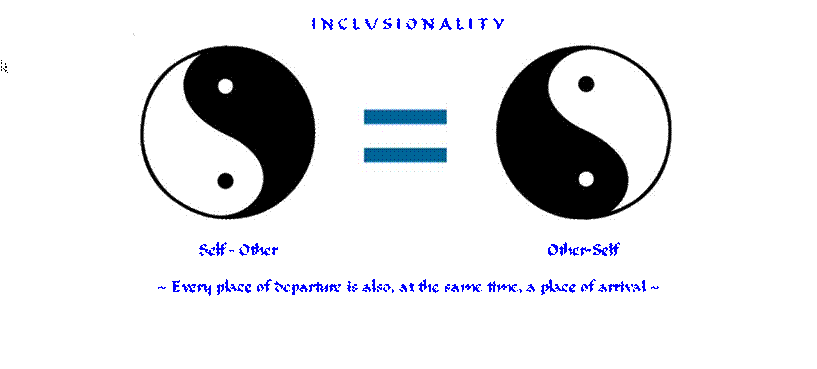
holding on to this relational
thinking, ... without having to totally ‘get it’, ... it is worth reflecting on
the problem with the notion of ‘history’; i.e. there are two notions, one of
which, the popular western one, is an ‘exclusional view’ which separates past
from present in a linear-sequential-temporal progression of ‘events’, ...
‘events’ being logical-conceptual entities that are spoken of as ‘real’ and
that precipitate as possibilities collapse into ‘actu
these different views of history
have interested anthropologists, and mircea eliade wrote a book on this
particular topic and referred to it as his ‘most important work’. he says
in the Preface to The Myth of the Eternal Return;
“The essential theme of
my investigation bears on the image of himself formed by the man of the archaic
societies and on the place that he assumes in the Cosmos. The chief
difference between the man of the modern societies with their strong imprint of
Judeo-Christianity lies in the fact that the former feels himself indissolubly
connected with the Cosmos and the cosmic rhythms, whereas the latter insists
that he is connected only with History. Of course, for the man of the
archaic societies, the Cosmos too has a ‘history,’ if only because it is the
creation of the gods and is held to have been organized by supernatural beings
or mythical heroes. But this ‘history’ of the Cosmos and of human society
is a ‘sacred history’, preserved and transmitted through myths. More than
that, it is a ‘history’ that can be repeated indefinitely, in the sense that
the myths serve as models, for all the responsible activities in which men
engage. By virtue of these paradigmatic models revealed to men in
mythical times, the Cosmos and society are periodically regenerated.
Later on in this book I discuss the effects that this faithful
reproduction of paradigms and this ritual repetition of mythical events will
have on the religious ideology of the archaic peoples. It is not
difficult to understand why such an ideology makes it impossible that what we
today call a ‘historical consciousness’ should develop.”
a reviewer captures the essence of
this book as follows;
“A luminous,
profound, and extremely stimulating work. . . . Eliade’s thesis is that ancient
man envisaged events not as constituting a linear, progressive history,
but simply as so many creative repetitions of primordial archetypes [note:
eliade clarifies that he intends NOT ‘Jungian’ archetypes that float in a
notional ‘collective unconscious’ but simply ‘exemplary models’] ... This is an
essay which everyone interested in the history of religion and in the ment
clearly these issues are not
unrelated to our problem at hand in exploring quantum behaviour vis a vis man’s
quest for self-other understanding. certain comments of eliade
speak further to some of the relevant issues and his notion that western
history has become too ‘provincial’, ignoring its eastern influences smacks of
the ‘hindsight bias’ mentioned by john flach, sidney dekkers and jan pieter
stappers, ... the reverse engineering by way of the path coming out of the maze
which ignores the cul-de-sacs in the forward path and their inevitable influence
in shaping the shaping the continuously unfolding present.
“Had we not feared to
appear overambitious, we should have given this book a subtitle: Introduction
to a Philosophy of History. For such, after all, is the purport of the
present essay; but with the distinction that, instead of proceeding to a
speculative analysis of the historical phenomenon, it examines the fundamental
concepts of archaic societies --- which, although they are conscious of a
certain form of ‘history’, make every effort to disregard it. In studying
these traditional societies, one characteristic has especially struck us: it is
their revolt against concrete, historical time, their nostalgia for a
periodical return to the mythical time of the beginning of things, to the
‘Great Time’. The meaning and function of what we have called
‘archetypes’ and ‘repetition’ disclosed themselves to us only after we had
perceived these societies’ will to refuse concrete time, their hostility toward
every attempt at autonomous ‘history’, that is, at history not regulated by
archetypes. This dismissal, this opposition, are not merely the effect of
the conservative tendencies of primitive societies, as this book proves.
In our opinion, it is justifiable to read in this depreciation of history
(that is, of events without transhistorical models), and in this
rejection of profane, continuous time, a certain metaphysical ‘valorization’ of
human existence. But this valorization is emphatically not that
which certain post-Hegelian philosophical currents --- notably Marxism,
historicism, and existenti
one can read in this distinguishing
between the transhistorical notion of history of aboriginal man, the same
distinguishing as implied between newtonian physics and relativity,
...wherein in the former the flow is along a linear time-line, ... and
this continues to be the model in the case of the notion of possibilities
precipitating actu
“All things are an equal
exchange for fire and fire for all things, as goods are for gold and gold are
for goods.”
this view is one of continuing
‘flow’ or ‘spatial-relational transformation’ which has no need of ‘profane
continuous time’ and which does not separate the past from the present but
continuously enfolds the past into the present.. as heraclitus also
says;
“The unity of things lies
beneath the surface; it depends upon a balanced reaction between opposites.”
this, to me, recalls the situation
mentioned earlier, where the confusing of the punching and fending of self and
other (seen in the two-body self-centered object sense of control system and
environment) needs to be jacked from this logical basis to real world
inner-outer experiential re
“to, me, this is the same
thing as observing a person who lives in an amish community for two years
followed by a hell’s angel gang for two years, and knowing that his behaviour
that we actually observe is mutually shaped by his intended actu
the outside observer cannot see this
balanced reaction between opposites but must FEEL IT by the empathic process of
‘feeling his pain or his joy or the hostspace suppressing him or the hostspace
over-accommodating and inflating what he would rather not inflate.
science always wants to be on the
outside looking in, and this is what gives rise to the external measuring rod
and reference clock, ... and thus it is a ‘scientific’ version of history that
gets outside of society in order document ‘what happens’ as a linear time
progression, ... and this same attempt seems to associate with the
‘precipitation of possibility into actu
but so long as we hold on to that
scientific voyeurism, which is necessary for us to formulate an explicit
‘scientific theory’ or ‘scientific interpretation’, ... we are splitting
ourselves out from our own experience.
throwing away our measuring rod and
reference clock and thus ‘outside-looking-in’ scientific voyeurism equates to
including ourselves in our own experience, ... allowing extrospection (science)
and introspection (spiritu
where these inside-outward and
outside-inward explorations come together into one, are we not talking about
‘pure experience’ or ‘pure understanding’? and is this not what excites us in
‘my dinner with andre’, .. the awareness on some level that extrospection and
introspection are ‘one dynamic’ and that, as t.s. eliot says;
We shall not cease from exploration
And the end of all our exploring
Will be to arrive where we started
And know the place for the first time.
is this kind of understanding not
where ‘self’ and ‘other’ merge?... and we understand and accept our innate
inclusion in the evolutionary dynamic, the self-enfolding space of the
continuing present?
anyhow, these are my musings, sent
to myself with copies to you, ... on my various ‘dinners with andre’ where i
have played the ‘straight man’ with y’all and enjoyed it.
mitakuye oyasin,
ted
Weblog: April 28, 2006
I
have just had an interesting email exchange with a friend (website designer and
worldly deep thinker) on ‘what is a blog’.
she was the one that had alerted me to the
the baghdad blog was very interesting to me in light of my having experienced and written about ‘sharing circles’ wherein multiple individuals, one-by-one, share their heartfelt subjective views of their unique situational inclusion in our common hostspace, without discussion (i.e. without trying to make ‘objective sense’ of what they are saying so as to reconcile it with one’s own ‘objective world view). as one gets the sense of the (multiple) individual’s evolving relationship with our common hostspace, made unique to them by their unique situational inclusion within it, ... one also infers, by bringing the multiplicity of subjective inclusional experiences into connection in the mind, ... the evolving hostspace dynamic.
there can be no avoiding the parallels of this form of inferential ‘imaging’ with the ‘holographic’ process which, instead of trying to use the images of the objects in the scenarizing, one backed off instead to the dynamic ‘spatial-relationships’ (phase information, as it is called in holography).
in both cases, the ‘sharing circle’ and ‘holography’, an overall view of the hostspace with dynamical forms included in it, is ‘imaged’ spatial-relationally, without dependence on the objects per se. this presentation, in holography (e.g. disneyworld holograms of spirits in the ‘haunted house’) gives it a ghostly appearance since the ‘objects’ are no longer ‘invariable bodies’, but are free to ‘morph’ relative to the space they are included in, ... in the manner of whorls in fluid flow.
that is, the dance of sub-marine sea-grass in the tides informs us EXPLICITLY about the flexibility and dynamical behaviour of the ‘sea-grass objects’ but at the same time informs us INFERENTIALLY (implicitly) about the dynamics of the hostspace the sea-grass is included in, ... all the way out to the celestial dynamics (lunar, solar, planetary) of the universe we are included in, which sources the cyclicities embodied in the tidal currents. the ‘sourcery’ of the hostspace dynamic would in fact seem to be more fundamental and persisting than the objects and object behaviours which emerge and subduct as inclusions within it.
this brings out the fact that there are two different ways of ‘perceiving’ the world; (a) EXPLICITLY in terms of invariable bodies or ‘objects’ and ‘what they do’,... and (b) IMPLICITLY in terms of spatial-relational transformation.
a ‘sharing circle’ is designed to ‘image’ the common hostspace dynamic we are included in the ‘holographical’ manner wherein we ‘see’ the human forms without have to ‘objectify them’ by seeing them in their spatial relationship with the evolving common hostspace itself (as in the ghostly holograms in the disneyworld ‘haunted house’ where the human forms, being purely relative [spatial relational] are free to morph relative to the world-hostspace they are included in).
in this ‘holodynamical’ imagery, the sourcing of behaviour no longer appears to be emanating from the interior of the object-forms; i.e. we do not, in this holodynamical view, think of the objects as ‘independent’ entities whose behaviour pushes out from the center of themselves, driven by their ‘inner-purpose’. instead, we see them as having forms and behaviours that are inductively shaped by the dynamical hostspace they are included in.
here we have the same ‘trade-offs’ in understanding as in the imagery of the men in a cart being taken to the guillotine. if we ‘objectify’ the men in the cart, and if they ‘objectify themselves’, we and they will ‘see them’ as ‘independent’ objects with ‘free will’ whose behaviours push out from their self-centers driven by their ‘inner purpose’. they can ‘prove’ their free will and their control over their own behaviour to us and to themselves, by declaring that they will get up and sing a song and dance a jig of their own choosing, ... and they can certainly do this. but at the same time, they are inextricably bound up in the (spatial-relational) flow of an evolving hostspace and they are in no way in control of where this is taking them and how it is inductively shaping them and their behaviour.
do they ‘really’ possess ‘free will’ and are they ‘really’ ‘in control of their own behaviour’? ... or is all of this secondary to the inductive shaping of their form and behaviour in the evolving flow-dynamic of their hostspace?
what the western mind is in denial of (we like the abstract notions of ‘independence’ and ‘being in control’) is that ‘the objective world’ characterized in our minds by ‘objects’ and ‘what they do’ is not ‘the real world’, but a mental re-construction of our spatial-relational experience within an inclusional flow-space.
as mentioned in my april 18th blog, ... ‘objects’ are abstract mental contrivances that ‘we fabricate’ from the spatial-relational field-flow-forms of the evolving space of the continuing present, as both ‘relativity’ and ‘quantum theory’ attest. that is, once we approximate the spatial-relational flow-forms of our included-in-field-flow-space-experience as ‘objects’, then we are forced to give those objects a ‘location’ in space and to resort to describing their ‘behaviour’ in terms of temporal displacements (we are forced to invent ‘time’ as a linear progression of past, present, future) and their transactions and interactions in terms of ‘cause-and-effect’. all of these are contrivances forced upon us by approximating the continously co-evolving spatial-relational flow-forms in terms of ‘invariable bodies’ aka ‘objects’;
[N.B. Henri Poincaré
pointed out that this causal model is too simple for delivering an
understanding of ‘natural dynamics’ since it ignores the influence of the
remote evolutionary past on the present and assumes that the future is being
constructed from the immediate past, such a model gaining favour because of our
proclivity for ‘understanding’ dynamics in terms of objects rather than in
terms of ‘fluid-flows’;
"First,
with respect to time [the first ‘approximation of convenience’ of mainstream
mathematical physics]. Instead of
embracing in its entirety the progressive development of a phenomenon, we
simply try to connect each moment with the one immediately preceding. We admit that the present state of the world
only depends on the immediate past, without being directly influenced, so to
speak, by the recollection of a more distant past. Thanks to this postulate, instead of studying
directly the whole succession of phenomena, we may confine ourselves to writing
down its differential equation ; for the laws of Kepler, we substitute
the laws of
“Since the word understand has several meanings, the definitions that will be best
understood by some are not those that will be best suited to others. We
have those who seek to create an [object] image, and those who restrict
themselves to combining empty forms, perfectly intelligible, but purely
intelligible and deprived by extraction of all matter.” --- Henri Poincaré
“Poincaré argued that the axioms of
geometry implicitly rely on assumptions about the nature of objects which they
are supposed to “define,” thus giving us a vicious circle that defines nothing
(“objects” are implicitly assumed to be invariable bodies). . ...
Therefore the axioms of geometry already contain an irreducible assumption
which does not follow from the axioms themselves. Axiomatic systems provide us
with “faulty definitions” of objects, definitions that are grounded not in
formal logic but in a hypothesis — a “prejudice” as Hans-Georg Gadamer might
say — that is prior to logic. As a corollary, our logic of identity
cannot be said to be necessary and universally v
in our pre-lingual condition, we suspend our objectification of the hostspace dynamic (world-dynamic) and we use ‘inference’ as in the ‘sea-grass’ behaviour example, that infers ‘the dynamics of the hostspace the sea-grass is included in’ (such inference is unbounded, extending to the immediate celestial dynamics and beyond).
if, every time we observe objects behaving, we take the inferential insight from it, ... after we have observed a multiplicity of object behaviours, we will have sufficient inferential information for bringing it into coherent connective confluence in our minds, the product of which is an outside-in based view of the hostspace dynamic in which there is no dependency on ‘invariable bodies’ or ‘objects’ and their ‘object-behaviours’. instead, it is now the ‘objects’ and their ‘object-behaviours’ that are ‘inferred’ from the hostspace flow-dynamic; i.e. they now appear to be inclusional flow-forms within the hostspace flow-dynamic, consistent with ‘relativity’ and ‘quantum theory’, and consistent with our experience since we know that our lives persist by our inner-outer balance-seeking dynamics.
that is, we seek to sustain balance in inner-outer thermal energy flow (we sweat, perspire, respire in attunement with the ambient hostspace conditions), oxygen and carbon-dioxide vapour pressures, water/liquid inner-outer flows, and inner-outer material flows. we do this continually, when we are unaware (when we sleep, if we are in a coma) and if our inclusional situation with the hostspace changes so that the ambient hostspace vapour pressure drops too low (the atmosphere thins) our blood will boil in an attempt to sustain inner-outer balance (we will be out of range of being able to sustain inner-outer dynamical balance), and similarly if our inclusional situation in the hostspace becomes one wherein the richness of thermal energy supply is too great for us to sustain inner-outer thermal energy flow balance.
our life experience (as well as modern physics and ‘complexity’ of ‘nolinear dynamics’) encourages us to conclude that our relationship with our common hostspace is akin to that of the hurricane’s relationship with its atmospheric hostspace; i.e. that we are ‘flow-forms’ in a fluid field-flow-space and that we sustain ourselves by inner-outer balance-seeking, and are re-assimilated (reformed) into the common hostspace when such inner-outer balance sustaining is not longer possible.
‘objectification’
is thus a degenerate simplification of our natural re
‘objectification’
is the game of rational reasoning in terms of objects and object-behaviours we
play in ‘discussion forums’, and it is game that is inevitably won in a
political world such as our western acculturated world, by the principle of
LaFontaine; ‘La raison du plus fort est toujours la meilleure’ (The ration
the
as a society, we are struggling to understand one another and the world we live in, in terms other than politicized objectifications, as is the currency of the mainstream media. were everyone to have a blog in which to express in a heartfelt manner their subjective experience of their unique situational inclusion in our common hostspace, then we could extend the advantages of the ‘sharing circle’ to the status of ‘sharing sphere’ and by taking away the spatial-relational inference from all of these heartfelt sharing, in the manner that we take away the inference from the sea-grass motion that alludes to the common hostspace dynamic in which it/we are included, ... we could come to understand the common hostspace dynamic we are included in, ... in a manner that does not depend upon ‘objects’ and their ‘object behaviours’, ... in the manner of a timeless spatial-relational evolution that includes us as it includes our ancestors and the little ones that have not yet emerged.
this,
i believe, was the ‘electric world’ dream of
i suspect that, had he lived to see the internet, he would have tuned right in to the community harmony sustaining potentials of the ‘blog’ with its ability to deliver to us an intuited understanding of our common hostspace, without dependency on politicized world views based on synthetic ‘causal’ understandings in terms of objects and their ‘good’ and’evil’ object behaviours.
Weblog: April 22, 2006 Earth Day
‘Earth Day’ is a reminder to me of the non-environmental orientation of our western culture and its current ‘waking up’.
The western religions of Christianity, Islam and Judaism, ... God bless ‘em, ... all regard the Earth as some place to put God’s chosen creatures, ‘men’ (and their Biblical lesser halves, ‘women’). one would have thought that Darwinian evolutionary theory would have restored top status for the Earth (nature) but the Dawkinsian’s got hold of it and cast the whole thing as a mechanical process wherein man was seen as being ‘constructed’ by ‘genetic determinism’ involving the recombination of little ‘genetic atoms’ in what is the equivalent of an ‘atomic theory of evolution’.
A
growing minority of modern biologists don’t believe this, of course, but it has
become so entrenched that it is quite literally ‘heresy’ to suggest that rather
than each individual ‘species evolving’
it is more re
What is wrong with the notion that ‘individual species evolve’? Seems pretty sensible, ... or maybe it seems pretty sensible because we have been taught it as if it were ‘the truth’ and because ‘everyone else seems to believe it’.
The problem with any theory that breaks things down into parts (e.g. ‘genes’, ‘DNA’) and explains the development of the system in the constructivist terms of ‘what the parts do’ is that this ignores the inductive behaviour and form-shaping influence of the hostspace the system/organism is included in. that is, ... standard darwinian evolutionary theory starts from the gene, the elemental bits that purportedly shape the appearance, properties and behaviours of the organism in an inside-outward ‘constructivist’ manner. there is no suggestion that there is any simultaneous interdependence between the inside-outward genetically determined behaviour and the outside-inward spatial-relational constraining of behaviour. for example, does it matter if the organism is situated within a liquid (hydrospheric) environment or within a gaseous (atmospheric) environment, ... because there is nothing in genetic determinism per se that handles the outside-inward hostspace-inducing influence on evolution.
As Stephen Jay Gould observes, ... it doesn’t make sense to consider ‘hitting’ out of the context of ‘fielding’. the two processes; individual asserting and spatial constraining/accommodating, are SIMULTANEOUSLY mutually shaping (dual aspects of a dynamical one-ness).
Psychologists studying behavioural dynamics and cognition have recognized, like Gould, that they were ‘forgetting something’ when they used a ‘causal’ model of ‘stimulus’ and ‘response’ which was all inside-outward (the environment influence was handled temporally/sequentially with ‘feedback’ and ‘adaptation’). today, they have added into their models ‘physical constraints’ and they give the example (Flach & Stappers) of a person trying to point at a target while someone else is continually pushing their hand away. this leads to a difference between the intended behaviour and actual behaviour which the intention is always trying to correct (thus we can never say that the actual behaviour we are seeing is an expression of the intent). what we see is the actual behaviour which is a melding of the intended behaviour and the spatial-relational constraining (more general than the pushing by an other’s hand, it could be that the organism is being physically constrained by being caught in a turbulentflow (a river or tsunami or etc.).
This
changes a whole lot of things when you consider that ‘what we see’ is not ‘an
expression of what was intended’ so that the ‘response’ to a ‘stimulus’ is not
coming from the inside of the organism but is SIMULTANEOUSLY mutually shaped
by; (a) the inside-outward asserting intent and (b) the outside-inward spatial
constraining (recall Newton’s third law of action and reaction). Furthermore, since dynamics are ongoing, it
is inherently ambiguous whether the inside-outward ‘individual asserting’ is
‘causing’ the outside-inward ‘spatial constraining’ or vice versa, ... leading
the cognition research psychologists to speak of ‘circular caus
this
would appear to be simply a gener
to recap where we have just ‘been’, we started off by noting that the western religions saw the earth as a support system for God’s chosen creature (here, man’s identity comes simply from man expressing his intention). but along came Darwinian evolution which said that man ‘evolved’ out of the earthly environment by gene combinations etc. but this ALSO was a one-sided linear-causal inside-outwards effect producing model that didn’t take into account that what we actually do is inductively shaped by ‘spatial constraining influences’ that shape and ‘train’ our behaviour.
adding
into our models the spatial constraining aspect and taking it together with the
actu
that is, there is a philosophical problem with ‘identity’ when we acknowledge that the behaviour we see is not the simple expression of intent but is mutually shaped by the spatial constraining/accommodating. the individual cannot, therefore, identify himself on the basis of ‘what he does’ (his behaviour is not ‘fully his’ but is co-owned by the hostspace he is uniquely situationally included in).
psychologically, we see this ‘identity’ problem taking shape in today’s world of commoditized ‘labour’ (‘labour’ in the general sense that includes trades, professions etc.) where a person ‘becomes their job’; i.e. they see themselves in terms of ‘what they do’, but in fact their behaviour is mutually shaped by the spatial-accommodating/constraining associated with the workspace, and when a person is suddenly laid off, the sense of their own identity is undercut by the removal of the spatial constraining/accommodating of the workplace (hostspace).
to
the aboriginal, man is included in nature in the manner that the hurricane is
included in the atmospheric hostspace, ... so there is no question of going out
on a limb and thinking of one’s personal ‘identity’ in terms of ‘what one
does’. how could ‘what one does’ make sense,
out of the context of the spatial-constraining/accommodating that one is
pushing into and that is mutually shaping the actu
since ‘nature’ is rarely pulled out like a carpet from beneath the feet of the asserting individual (except in times of drought or floods etc.), man’s ‘identity’ rarely suffers the undercutting that it increasingly does in the commoditized workforce.
here
we can see a comparison between the ‘identity’ traditions of the three western
religions (christianity, islam, judaism) which encourage seeing our ‘identity’
in terms of ‘what we do’, ... and the ‘du
meanwhile, the myth of man being simply placed on earth by God implies an ‘identity’ for man based strictly on ‘what man does’ as if ‘what he does’ equates to ‘an assertive expression of his intent’. but in fact what we see him doing is mutually shaped and there is also the spatial-accommodating/constraining side. thus, in the case of a woman who is spatially constrained/prevented from doing most lines of work needed to provide for herself and her self-development with the exception of giving of sexual favours to men, ... it can hardly be said that what she does is ‘an expression of her intent’ as in the linear, causal model though we nevertheless impose on her an ‘identity’ based on ‘what we see her do’, such an ‘identity’ ignores the inductive shaping role of spatial-constraining/accommodating.
this ‘philosophical error’ in the establishing of ‘identity’ is built into the old notions, in the western religions, that God placed man on earth since that suggests that man’s behaviour is an expression of man’s (God-guided) intent. this view continues to be supported by Darwinian evolutionary theory, the reductionist version thereof, where the development of the individual organism, and its behaviour, is seen as pushing out from its interior in a linear-causal way (e.g. as in ‘genetic determinism’).
in
re
one way to celebrate Earth Day, therefore, is in reflecting on how solidly our ‘identity’ is ‘grounded’ in acknowledging that we are ‘included’ in nature’s hostspace and in the social hostspace that nests inclusionally within nature, and that our ‘identity’ does not come solely out of our interior and ‘what we do’; i.e. our behaviour cannot be taken to be the simple expression of our intent (it is mutually shaped by spatial constraining/accommodating associated with our unique situational inclusion in our shared hostspace.)
to
think in this manner means that we cannot objectify people on the basis of
‘what they do’ but must accept that ‘spatial constraining/accommodating’
together with the ‘attempted actu
Weblog: April 18, 2006
Yesterday i wrote a letter to the editor in regard to how we are split in our view of ‘what central government is for’ and it occurred to me (an ‘occurrence’ stimulated by offline dialogues) that the split in ideas exactly parallels the split in our impressions of ‘what the brain is for’ in the human body.
many
people think that the brain is a ‘central control unit’ or a ‘central
processing unit’ as if ‘it’ (the brain) is the lightbulb-turning-on
sourcing-author of ideas, ... ideas that it subsequently operation
“Well,
it turns out a lot of processing occurs at the level of the organs. Human
behavior is determined in many places. The control of our behavior is not
located in our brains. It’s all over our bodies. So you could argue that “swarm
intelligence” rules human beings, too. Balance is controlled by the cerebellar
swarm, and rarely comes to consciousness. Other processing occurs in the spinal
cord, the stomach, the intestine. A lot of vision takes place in the eyeballs,
long before the brain is involved. And for that matter, a lot of sophisticated brain processing occurs beneath awareness,
too. An easy proof is object avoidance. A mobile robot has to devote a
tremendous amount of processing time simply to avoid obstacles in the
environment. Human beings do, too, but they’re never aware of it – until the
lights go out. Then they learn painfully just how much processing is really
required. So there’s an argument that the whole structure of consciousness, and
the human sense of self-control and purposefulness, is a user illusion. We
don’t have conscious control over ourselves at all. We just think we do.”
--- Crichton, M. (2002). Prey
[N.B. Michael Crichton has an
anthropology degree from Harvard, taught physical anthropology at Cambriduge
(UK) and later obtained his M.D. from
ok, the example of this ‘lack of control’ i am using in these april blogs is ‘adult-john’ who insists (his logic is in control) on keeping his jacket on in the midday heat, ... but his body doesn’t obey and cannot obey since his body behaviour is inner-outer balance-seeking behaviour over which his logical manipulations have no control (and putting a bullet through own his head is ‘control’ only in the degenerate sense of stopping behaviour rather than orchestrating it). child-john, meanwhile, attunes to his inner-outer balancing and takes his clothes off and puts his clothes on when his inner-outer balancing suggests it, ... he does not ‘fight’ the dynamical hostspace he is situationally included in, but puts his behaviour in the service of sustaining harmony and balance within it.
if one reflects on the implications of ‘relativity’, one comes around to conceiving of the ‘individual human’ as a sustaining dynamical balancing of the same sort as that which sustains the identity of the hurricane within the dynamical atmospheric hostspace. the concept of ‘absolute behaviour’ that is sourced from a local point (in the interior of some absolute ‘closed form’ geometric object) dissolves with relativity, and everything must be dealt with in terms of inner-outer fluid dynamics.
the brain’s job, in this case, would have to be the sustaining of dynamical balance, rather than ‘control’ since the individual no longer exists as an ‘independent unit’ but instead as an inner-outer balancing act within the overall hostspace dynamic.
here’s where the comparison crops up with central government in the ‘nation-state’. once again, the nation state is not an absolute independent ‘thing’, we only impose that notion by inventing some imaginary line boundaries. the nation-state is included in the overall global hostspace dynamic and it differentiates via its internal cooperative dynamics (coherent spatial-relational dynamics) which are, at the same time INCLUDED within the overall global hostspace ‘traffic-flow’ dynamic.
when you proxy in your personal ‘power’ and your personal ‘resources’ to the central government of your nation-state, do you see the central government as ‘central controller’? ... or do you see the central government as something you and your fellows have developed in order to strengthen and give greater resilience to, the balance act that sustains the persisting identity of the nation-state?
here’s where there is a split
in views. many people, myself included,
do not elect a head-of-state so that he can originate ‘genius ideas’ in his own
head and then use the proxied powers of the central government to operation
this ‘split’ in views of the ‘central administration’ of both the individual body and the individual nation-state have their roots in common soil, ‘monotheism’ or ‘the causal model’ wherein behaviour is explained in terms of the behaviours that immediately preceded it, the ‘final answer’ being supposedly given if we follow the ‘smoking-gun-trail’ backwards-in-time far enough to its ‘ultimate source’. since this is beyond our cogntive capacities, the monotheist God (a supra-nature divinity rather than an intra-nature divinity) provides a ‘virtual source’ in lieu of our completing the full ‘back-tracking’; i.e. He is the Ultimate Causal Agent.
meanwhile, the whole notion of
‘caus
[N.B. Henri Poincaré
pointed out that this causal model is too simple for delivering an
understanding of ‘natural dynamics’ since it ignores the influence of the
remote evolutionary past on the present and assumes that the future is being constructed
from the immediate past, such a model gaining favour because of our proclivity
for ‘understanding’ dynamics in terms of objects rather than in terms of
‘fluid-flows’;
"First,
with respect to time [the first ‘approximation of convenience’ of mainstream
mathematical physics]. Instead of
embracing in its entirety the progressive development of a phenomenon, we
simply try to connect each moment with the one immediately preceding. We admit that the present state of the world
only depends on the immediate past, without being directly influenced, so to
speak, by the recollection of a more distant past. Thanks to this postulate, instead of studying
directly the whole succession of phenomena, we may confine ourselves to writing
down its differential equation ; for the laws of Kepler, we substitute
the laws of
“Since the word understand has several meanings, the definitions that will be best
understood by some are not those that will be best suited to others. We
have those who seek to create an [object] image, and those who restrict
themselves to combining empty forms, perfectly intelligible, but purely
intelligible and deprived by extraction of all matter.” --- Henri Poincaré
“Poincaré argued that the axioms of
geometry implicitly rely on assumptions about the nature of objects which they
are supposed to “define,” thus giving us a vicious circle that defines nothing
(“objects” are implicitly assumed to be invariable bodies). . ... Therefore
the axioms of geometry already contain an irreducible assumption which does not
follow from the axioms themselves. Axiomatic systems provide us with “faulty
definitions” of objects, definitions that are grounded not in formal logic but
in a hypothesis — a “prejudice” as Hans-Georg Gadamer might say — that is prior
to logic. As a corollary, our logic of identity cannot be said to be
necessary and universally v
ok, if you don’t like technical jargon as in the ‘nota bene’,... i will simply requote the short version of my letter to the editor here, which suggests that central government for some, is a buffering system to increase the balance-seeking resilience of the non-absolute nation-state organism, while for others, it is a central control system in which the ‘head-of-state’ is authorized, like adult-john, to come up with his own absolutist genius ideas and to inflict them not only on ‘his own people’ but the rest of the world as well (since there is no discrete boundary between the individual nation-state dynamic and the global dynamic, only a mutual balance-sustaining dynamic);
Letter to the Editor:
* * *
The ‘Unholy (Common) Ground’ of Stephen Harper and George Bush
The discomfort many people are feeling and
voicing over Stephen Harper’s frequent use of ‘God Bless
On the one hand, we have the philosophy
common to the fundament
On the other hand, we have the philosophy common to eastern Buddhism, Taoism, aboriginal (First Nations) traditions, as well as the Christian heresies of Gnosticism and the ‘relativity’ of Giordano Bruno, wherein ‘divinity’ is immanent in nature and man is just one of the interdependent creature-brotherhood.
In the former instance, central authority is there to ‘make the correct things happen’ and the ‘Head-of-State’ sees himself in the direct ‘chain-of-command’ of the ‘Ultimate Central Authority’ and thus guided by the ‘universal knowledge of good’. Such is the ‘drive’ behind the deployment of powers and resources proxied to the central authority.
In
the latter instance, centr
The button, knobs and levers attached to the seat of proxied central authority and resources in our national government are available to whatever Head-of-State we put into this seat, regardless of the philosophy he will bring to bear (it is up to us to question the philosophy he will use to drive his deployment of proxied powers and resources before we put him into this position of central authority).
Those
who would see our nation as a “kingdom of priests and
a holy nation” will be taking comfort from Stephen Harper’s
frequent use of ‘God Bless Canada” and ‘God Bless our Troops’ and his
corresponding decisions, as in Afghanistan, driven by his ‘universal knowledge
of the good’, while those of us who would see our nation in the natur
* * *
to summarize today’s blog, ... our acculturated notion of absolute motion based on the absolutist notion of ‘independent objects’ forces us to invent absolute behaviour-sourcing mechanisms within the organism to make our notion of ‘independent object’ hang together; i.e. where else could the behaviour of an independent organism come from? (heaven forbid that we think of our individual behaviour as being relative to the hostspace dynamic we are situationally included in, since if we did, we could no longer sustain the notion of our ‘independence’ and ‘free-will’). thus we re-invent ‘the brain’ as a notional ‘central controller’ and ‘absolute originator of ideas on how to behave’ (in order to keep the ‘independent’assumption hanging together, we have to say that ‘consciousness’ emerges from the biophysics and/or biochemistry of ‘the brain’, which makes the brain into a ‘stand-alone information processor’).
anyhow,
all of this bullshit about absolute authoring of ideas and behaviours lurking
in the interior of absolutely ‘independent’ objects is something that carries
over, in our culture, to our ideas on central government, and the newly-elected
head-of-state (some of them, at least) believes that his job is to ‘information
process’ what others are telling him and to be the ‘originator’ of ‘ideas on
how our ‘independent’ nation should behave’ and thus to use the
proxied-to-the-center powers and resources of the nation to operation
the alternative is to go beyond the realm of rational ideas as child-john does and attune to the dynamic of the hostspace one is situationally included in and put one’s (nation’s) behaviour in the service of sustaining dynamical balance and harmony with/in the hostspace dynamic. when three or more participants (individuals, nations) are doing this at the same time, they move under one another’s simultaneous mutual influence, self-orchestrated as a collective by the resonances they are co-evolving. this complex dynamic is not soluble in terms of ‘which individual did what’ and thus, while it is natural behaviour, is too complex to be resolved in terms of the rational/causal model (based as it is on the behaviours of individual objects).
this
balance-and-harmony-sustaining is something we can achieve when we use our
‘feeling experience’, as child-john did, to attune to and sustain balance and
harmony with the collective hostspace dynamic in which we are each uniquely,
situationally included. that is, this
natural self-organization is beyond any individual-resident rational models (as
swarm behaviours also attest). centr
Weblog: April 16, 2006 (Easter Sunday)
Well, today is the day that christians celebrate the resurrection of jesus, ... but there are some signs that this representation is giving way to something a bit, ... ‘more natural’.
it is worth noting that ‘up’ and ‘down’ as in ‘heaven’ and ‘hell’ are absolute directions that mathematicians associate with absolute space; i.e. ‘euclidian space’ (euclidian space is the simplest possible concept of space and cannot accommodate relativity theory even).
meanwhile,
in the buddhist and aboriginal traditions, and in the heresy of giordano bruno
(and
if God is in nature (or if ‘God is nature’, as pantheists represent it) and we too are included in nature, then we are ‘permeated’ with divinity. so the issue is not really a question of the ‘divinity of jesus’ (contested by islam, gnostic beliefs etc.), but instead with the nature of divinity, ... er, ... with the divinity of nature. the ‘revised view’ would be that jesus iconized the divinity in nature and thus it was not necessary for him to be ‘resurrected’ to some remote place beyond nature.
imagine if we ranked people in general in terms of how well their behaviours ‘iconized’ or ‘resonated with’ all that is beautiful and aesthetic and loving in nature. this does not require the aristotelian hierarchy of gradations between the mutually exclusive opposites of ‘best’ (pure good) and ‘worst’ (pure evil). this aesthetic resonance rating is instead something that is spatial-relational (inner-outer). you can’t be aesthetic without being in harmony with the hostspace dynamic you are included in. each of us, from time to time, glows with this aesthetic resonance (aka love?) and, from time to time, is out of joint (in behavioural dissonance) with the hostspace we are situated in.
jesus
would have to be seen, in the heresy of giordano bruno, not as an ‘
but bruno’s views did not prevail while others did, but on what basis? was it on the same basis as the doctors of the church preferred to believe that the earth was the stationary center of the universe?
once one proposes an absolute center to the universe, there is going to be a pecking order, a hierarchy of importance, and those ‘farthest from the center’ are going to be seen as ‘less important’ than those closest to it. obviously, if one believes that God created the universe and put made earthly man and the planet earth the centerpiece of his creation, ... the rest of the celestial entourage is going to shrink in importance in proportion to distance from the center.
western religious beliefs have always had this ‘value hierarchy’ implicit in them. in fact, the original idea in the historical development of monotheism from polytheism, pantheism and mythopoeic thought was that God ‘chose’ man as superior to the rest of creation and that God ‘chose’ a particular people (those that first came up with ‘monotheism’) as the ‘interpreters’ and ‘implementers’ of ‘God’s Will’.
monotheist religious man, then, was charged with making the unfolding of world history a Godly history. ring any bells with current world political goings on?
“This [monotheist] conception of God represents so high a
degree of abstraction that, in reaching it, the Hebrews seem to have left the
realm of mythopoeic thought. The impression that they did so is
strengthened when we observe that the Old Testament is remarkably poor in
mythology of the type we have encountered in
“But thou,
Thus God’s will was felt to be focused on one particular and
concrete group of human beings; it was asserted to have manifested itself at
one decisive moment in their history and ceaselessly and relentlessly to have
urged, rewarded, or chastised the people of its choice. For in Sinai, God
had said, “Ye shall be unto me a kingdom of priests and a holy nation”
(Exod. 19:6)
In a poignant myth, this Hebrew myth of a chosen people, of
a divine promise made, of a terrifying moral burden imposed --- a prelude to
the later myth of the Kingdom of God, that more remote and more spiritual
‘promised land’ For in the myth of the chosen people the ineffable
majesty of God and the worthlessness of man are correlated in a dramatic
situation that is to unfold in time and is moving toward a future where the
distant yet related parallels of human and divine existence are to meet in
infinity.
Not cosmic phenomena, but history itself, had here become
pregnant with meaning; history had become a revelation of the dynamic will of
God. ... Man, according to Hebrew thought, was the interpreter and the
servant of God; he was even honored with the task of bringing about the re
now, is not hard to envisage here, the radical difference in behaviour that is going to be induced by a jewish, christian or islamic believer whose belief orients to this ‘i am God’s judge-on-earth and ‘policeman-on-earth’ to make sure that the history of the world plays out the way that God would want it to, ... and the pantheist (bruno, buddhists, aboriginals) who believe that the divinity is in nature and thus that the person who is most deeply attuned to the harmonies in nature is most in touch with the divine (‘closest to Go’). this latter behavioural orientation would have the individual, rather than ‘judging-and-imposing-good-[God-Willed]behaviour, seek to attune to and bring out the harmonies in even the ‘evil ones’, as this excerpt from the Kaienerokowa (Great Peace of the six Iroquois Nations) articulates;
"You shall be a good person, and, you shall be kind to all of
the people, not differentiating among them, the people who are wealthy, and the
poor ones, and the good natured ones, and the evil ones who sin readily; all of
them you shall treat kindly and you shall not differentiate among them. As to
your own fireside, never consider only yourself, you must always remember them,
the old people, and the younger people, and the children, and those still in
the earth, yet unborn, and always you will take into account everyone's
well-being, that of the on-going families, so that they may continue to
survive, your grandchildren."
this way, the way of bruno and other pantheist believers is the way of inductive transformation of social behaviour, not the way of ‘sitting in for God’ and imposing what one personally interprets to be ‘God’s Will’ on the rest of creation. it is not the way of ‘pacifism’ but can associate with whatever level of aggressive action is needed IN ORDER TO RESTORE SPATIAL-RELATIONAL HARMONY during such times as the hostspace dynamic has become disjointed, unstable, dissonant. the mother bear may kill you if you disrupt the aesthetic of her romp with her cubs but she doesn’t need to ‘judge you’ nor analytically indict you in a 36 page legal document.
as the jesuit priest george maloney writes in Mysticism and the New Age in speaking of the emergence of a ‘new age’ the relationship between God and man is being reconceived in terms of creation being ‘ongoing’ (as in pantheism, where ‘nature’, meaning the ‘evolutionary dynamic’ is ‘sacred’, the ‘Great Mystery’);
“Creation is reconceived by Teilhard out of God's revelation
in the light of evolution as an unfinished process. Salvation history and
creation history go together. This means that redemption and salvation take
place only in our role as co-creators with God in a world that is continuously
becoming as we human beings respond in loving obedience to co-create according
to God's Logos, His Divine Word in whom all things come into being.
A new global spiritu
now, i am not a religious person (in the sense of subscribing to religious doctrines etc.) but one has to acknowledge that this latter view of the man’s relationship with God is far from being in the linear chain-of-command, charged with judging what God deems to be the correct thing to do and making sure that that is what happens. no, ... the latter view is one that calls for attunement to the ‘continuing unfolding’ which is very much like aboriginal and buddhist pantheism and the pantheist heresy of bruno.
so, on this remembrance of jesus’ ‘resurrection’, the very notion of which depends upon the Aristotelian (logic of mutual exclusion) concepts of ‘up’ versus ‘down’. what if jesus were included in God as in nature? ... as the gnostics interpreted it? then ‘God’ is not an ‘object’ but an ‘influence’, ... the ‘Great Mystery’ of the ongoing creation that, in its balance-and-harmony-sustaining-seeking quest, gives rise to endless innovative beauty.
as Nietzsche said; “I am afraid we are not rid of God because we still have faith in grammar.”, implying that grammar employs ‘nouns’ and nouns ‘name objects’; e.g. making the whorling influence in atmospheric hostspace (hurricane) into an object (‘Katrina’) and thenceforth speaking of it as if it as asserting ‘causal’ agent in-its-own-right.
when
we conceptu
“For in the myth of the chosen people the ineffable majesty
of God and the worthlessness of man are correlated in a dramatic situation that
is to unfold in time and is moving toward a future where the distant yet
related parallels of human and divine existence are to meet in infinity.”
[Armageddon]
this error in ‘grammar’ or, in other words, our poor choice for a geometry of space ‘could cost us’, ... to put it mildly.
giordano bruno had a better idea as did teilhard de chardin and george maloney. nevertheless, the prevalent ‘force’ in today’s world comes from those who are ‘interpreting God’s will’ in the constructing of world history and who feel obliged to impose God’s will on the lower forms of creation, ... including unrepentant heretics such as giordano bruno and yours truly.
Weblog: April 14, 2006
Today is a day selected for the remembrance of the suffering and death of jesus through his commitment to transforming the social order. though there is agreement amongst the three western religions that jesus lived, islamic belief suggests that while jesus was miraculously born of a virgin, mary, that he himself was not ‘divine’ (a blasphemous idea in islamic belief) but that he was deliberately given life in the same manner that god deliberately gave adam life. more interesting still in the different views of jesus is that of jesus as a buddhist ‘bodhisattva’;
“According to the Sata-sáhasriká Prajñapáramitá, a bodhisattva desires Enlightenment first for
all beings and not for himself. He is consumed with grief on account of the
sufferings of others, and does not care for his own happiness. He desires the
good and welfare of the world.”
how different is this from the self-center based orientation of christian enlightenment-seeking?
and by the way, what has this got to do with the writings on this web-page that reference foundational ideas in mathematics and physics?
the difference between east and west in philosophy, in the foundational means by which we represent the world in our minds, ties back to these religious differences. giordano bruno was burnt at the stake for heresies in 1600 which were ‘mathematical’ in the sense that they interpreted ‘infinity’ in a different way, and ‘infinity’ is very much tied together with the theistic foundations of religious belief.
for example, the ‘causal model’ which continues to be the default in today’s popular scientific manner of thinking is consistent with a certain view of god in relation to the world since ‘god’ is seen to be the ultimate sourcing force, the force that ‘makes the universe go’. it is ‘heresy’ to conceive of the ‘divinity’, the divine source of the world dynamic, in the ‘mundane’ terms of being immanent in nature, though that is indeed what bruno reasoned to be the case with a compelling reasoning that has been supported in the modern era by relativity and quantum theory;
“For the Catholic orthodoxy based on Aristotelian and
Thomistic metaphysics, God is first cause, immovable motor and absolute
perfection. Since Bruno conceived God as immanent in the universe and identical
to it, Bruno was accused of pantheism and animism. God was considered not as
the creator of the universe, but as the world itself.” (Marcos Cesar Danhoni Neves in De Imenso,
De Minimo and De Infinito: Giordano
Bruno’s Micro and Infinite Universe and the “A-centric Labyrinth” of
Modern Cosmology and its Philosophical Constraints in Apeiron,
Vol. 8, No. 1, January 2001, at http://redshift.vif.com/JournalFiles/V08N1/V08N1DAN.PDF
)
bruno’s view (consistent with relativity and quantum theory) of the natural universe as ‘self-organizing’, where the ‘divinity’ is immanent rather than external and ‘supra-natural’ obsoletizes the ‘causal model’ (wherein behaviour is seen as being constructed from ‘independent’ ‘objects’ with ‘independent behaviours that push out from their self-centers driven by an ‘inner purpose’) makes an immense difference to how one sees oneself in relation to the otherness of the world.
in bruno’s view and in the buddhist view, there is no such thing as ‘independence’. individual beings are unique and authentic but they are no more ‘independent’ of the world-hostspace in which they are uniquely, inclusionally situated, than is the hurricane from its atmospheric flow-space. and there is a very good reason for individuals to think of others before oneself and for those that can’t see any connection between mathematics and issues of soul, spirit, ethics and divinity, ... the mathematics that show SPATIAL-RELATIONAL-INTERDEPENDENCE would suggest otherwise.
for
example, when we experience inclusion within a crowd dynamic or a traffic
dynamic, we are aware that these collective dynamics have the
spatial-relational qu
this curious fact is shown by nonlinear mathematics and physics. it is responsible for the fact that the wildgeese can fly farther and faster for 20% less expenditure of energy than they could ever do in solo mode. it goes like this;
as
we stir action amongst ourselves, we transform the spatial relationships that
accommodate the actu
it thus makes mathematical and physical sense to employ the bodhisattva ethic, and we have no need for inventing such notions as ‘altruism’, a corrective device that ‘fixes’ the unnatural abstraction of the assumption of ‘independence’ of the individual. that is, by assuming we are all interdependent (mitakuye oyasin) it makes sense to attune to our collective dynamic and seek to sustain resonances between one another and the collective behaviour. to shut down our attunement to the collective dynamic (the common hostspace dynamic) we are included in and seek to optimize our individual assertive objectives on our own is not only unnatural but highly dysfunctional.
but it is what we continue to do and it is indeed ‘unnatural’ because it is supra-natural and comes with the causal model of the universe wherein individual species and individual men were taken to be ‘independent’ entities created and implanted into ‘nature’, a containing garden or operating theatre for man, by GOD.
the notion of ‘independence’ and even of ‘objects’ (i.e. of ‘independent objects’) is mathematical and physics based, and that was giordano bruno’s point in defending his heresy; i.e. he maintained that the ‘doctors of the church’ had pushed their own limited mathematical and physical principles into the articulated belief system of the church (the earth-centric view being one case in point). history shows that the church had indeed interpreted the scriptures using mathematical-astronomical assumptions, such as the immobility of the earth at the center of the universe and that there was a great reluctance to allow changes in mathematical and physical concepts that would require alterations to the articulations of scriptural interpretation that had used them in a foundational way.
this
binding together of science and religion (in religious doctrine) by way of a
common aristotelian philosophical foundation is
‘infinity’ is a mathematical concept that underpins the notion of ‘independence’ and it was the basis for bruno’s different notion of divinity, as already mentioned. in our modern western thinking, we retain a consistency with the thinking of the church in the year 1600 and before (the church embraced and continues to embrace aristotelian mathematical and physical models). that is, we regard ‘space’ as absolute and ‘objects’ as absolute entities within this absolute (euclidian) space. this ‘absoluteness’ implies a particular mathematical form of infinity, a ‘countable infinity’ wherein we can divide things up (a line down into segments, or solids down into atoms) so that it will take an infinity of elemental line segments or atoms to build back and reconstruct the immenseness of the universe we live in.
this is not the only way of conceiving infinity and it was not bruno’s way of conceiving it. bruno’s idea was that ‘smallness’ would not be ‘smallness’ out of the relative context of the ‘vastness’ within which it is ‘smallness’. for example, we speak of ‘continents’ as if they are real things (independent objects) but they are in fact ‘forms’ that our minds produce because we cannot see through the ocean waters and thus we see forms that are produced by the intersection of the ocean surface and the topography of the lithosphere. their existence is therefore NOT ‘absolute’, nor ‘independent’ and if the ocean level were to continue to rise, there would at some point be only one continent, ‘everest’ and it would be a lone island, perhaps one hundred meters in diameter. it would be a tiny island in a vast ocean and its tinyness would be a REFLECTION of the vastness of the oceanic hostspace in which it was included.
mathematically
and physically and in terms of ‘divinity’ (the ultimate sourcing of our
dynamical world), the maximum can be seen in the minimum, and this kind of
relative opposition, known to mathematicians and philosophers of bruno’s era as
‘coincidentia oppositorum’ provided a different way of handling ‘infinity’,
that has been reinforced as more re
“Bruno’s idea of the Universe comes from the Nicholas de
Cusa’s hermetism: “Unde erit machina mundi quasi habens ubique centrum et
nullibi circumferentiam” [“The world’s machine has its center in the all and
its circumference nowhere”] (Cusa, Bk. II, Ch. XII, 1942:134). . . . “Bruno writes about “an infinite
sphere whose center is everywhere and whose circumference is nowhere” (Bruno,
Bk. II Ch. IX, 1980:493). On the other hand, in Bruno’s discourse, the infinity
of the Universe and divine infinity are linked, albeit differentiated. “Deum
esse infinitum in infinito, ubique in omnibus, non supra, non extra, sed
praesentissimum” [God is infinite in infinity, everywhere in everything,
neither above nor beyond, but absolutely present] (Bruno, Bk. VIII Ch. X,
1980:804). Divine unity and cosmic immensity are the basis of Bruno’s doctrine
on infinity.”
the interpretation of ‘the individual’ in this philosophy differs radically from the aristotelian interpretation of ‘the individual’ as an independent object/organism whose behaviour is internally sourced from its notional ‘self-center’ driven by its notional ‘inner purpose’. in bruno’s philosophy, the individual is a reflection of the hostspace it is situationally included in.
how would this make a difference in today’s world if bruno’s heresy had succeeded? a few examples follow;
the
self-image of an individual nation and/or person;
the US, for example (an example which can be applied to all nation-states), rather than seeing itself as an ‘independent entity’ with ‘independent behaviour’ that is the full and sole source of ‘its’ assertive accomplishments, these being the product of its pushing out from ‘its own’ self-center driven by its ‘inner purpose’, ... the US would instead see the world behavioural dynamic as a dynamical one-ness that is in a natural ‘primacy’ and would see itself as ‘included’ in the world dynamic in the manner that a hurricane is included within the atmospheric space dynamic; i.e. the dynamical behaviour of the US is nonlocally sourced and a-centric in the manner that the whorl from pulling the plug out of the filled bathtub is inferred by the nonlocal currents in the common including fluid hostspace. it is by the aristotelian logic of mutual exclusion that we mentally ‘excise’ the whorl, give it a name and consider it to have an ‘independent existence’ and an ‘independent behaviour’ (as with named hurricanes) that we delusionally interpret its behaviour as being sourced from its ‘self-center’ and guided by some ‘inner purpose’ of its own, as if the common hostspace dynamic it is included in is a ‘secondary’ phenomena that we can safely ignore as we shift our pursuit of understanding to this ‘object-i-fiction’.
the
same applies at the level of an individual person. we write our resumés as if our assertive
accomplishments ‘speak for themselves’ i.e. as if our behaviour is independent
and fully internally sourced. but our
real-life experience is that individuals with ‘similar assertive potentials’
achieve very differently depending upon how they are situationally included in
the common hostspace dynamic. in spite
of what the resumé says, we know from experience that the actu
bruno’s treatment of infinity, however, leads to the same point as was often made by the late evolutionary biologist stephen jay gould, that one cannot consider ‘hitting’ in its own right (as an independent behaviour); i.e. hitting has no meaning out of the context of ‘fielding’ (asserting has no meaning out of the context of spatial-relational accommodating).
in
bruno’s philosophy, the bodhisattva ethic emerges naturally since if we relax
our private agendas and put our movements in the service of cultivating a
harmonious community dynamic; i.e. by cultivating a highly accommodating
spatial-relational backpressure (which corresponds with inner-outer ‘resonance’
as in the wildgeese example), each and every one of us benefits in terms of the
actu
the
self-centered view of ‘one’s borders’
in bruno’s philosophy, there is no tangible and discrete border between the individual entity and the hostspace it is included in. in our aristotelian philosophy, however, we simply ‘make up some imaginary lines and surfaces’ and decree (in conjunction with ‘naming’ the object) an absolute separation necessary to fit with our notion of the ‘independence’ of the entity.
as we know from the histories of nations, the imaginary line boundaries can change and they are only sustainable by everyone agreeing to believe in them (often through force and coercion), and if that belief in them stops, or if they are challenged by a superior force, then they dissolve since they ‘never really existed’ in the first place (many north american natives continue to refuse to agree to believing in them);
WE DIDN'T CROSS THE BORDER: THE BORDER CROSSED
US!
What are borders? What is the
when
we share a common space as we do, the outside of one property is the inside of
a neighbouring property; i.e. the notion of ‘property’ is a western
ARISTOTELIAN PHILOSOPHY based abstraction.
it stems from ‘one way of handling ‘infinity’’. borders are abstraction (imaginary lines and
surfaces) whose pseudo-re
to
speak self-centeredly (one-sidedly) of
‘our borders’ as mentioned in my april 10th blog (that the [US]
congress has passed a law de
this
kind of aristotelian philosophy-based unilater
the
rising ‘have’ versus ‘have-not’ split
based on our continuing rejection of the ‘infinity’ of giordano bruno’s philosophy wherein the reflection of the vastness is in the tiny and vice versa, ... and the continuing embrace of the aristotelian ‘infinity’ wherein the tiny parts are independent and there is a countable infinity of them needed to reconstruct the universe, ... we continue to believe, religiously, in the notion that we can optimize our world dynamic by optimizing the behaviours of the independent parts; i.e. optimizing the behaviours of individual persons and optimizing the behaviour of individual corporations and optimizing the behaviour of individual nation-states.
this
is the antithesis of the bodhisattva ethic and the wildgeese ethic, and our own
‘friendly freeway-traffic-driving ethic’, all of those ethics understanding
that by the way we behave RELATIVE to one another (as we move under one
another’s simultaneous mutual influence), we set up the accommodating qu
how is it that we continue to cling so ‘religiously’ to our belief in such destructive insanity?
we might also ask; how is it we can watch the nonlocal, a-centric flow of the weather map, until our eye is attracted by the birth of a ‘whorl’ within the flow, ... and then proceed to ‘objectify’ the whorl, giving it a name, and then speaking of it as if it were an ‘independent entity’ with ‘its own’ behaviour; e.g. ‘hurricane katrina is now heading north by northwest and she promises to wreak a great deal of destruction on the alabama, mississipi and louisana gulf coasts’.
at
what point did ‘katrina’ gain her independence from the hostspace dynamic in
which she ‘was’ included? at what point
did the
they
never did! it was simply a case of
people agreeing to talk about them as if they had become independent
entities. on the basis of the
aristotelian philosophy then, we build entire pseudo-re
and
that may help to explain why we continue to optimize the assertive behaviour of
abstractions; i.e. ‘independent individuals’ (persons, corporations, nations)
as unre
* * *
well
it’s good friday and we continue to remember the suffering of jesus, though as
‘independent beings’ and only rarely in the bodhisattva manner; “a bodhisattva desires
Enlightenment first for all beings and not for himself. He is consumed with
grief on account of the sufferings of others, and does not care for his own
happiness. He desires the good and welfare of the world.”
what a difference, different ways of reconciling ‘infinity’ make!
good
friday means others things to people too.
my friend who is a ‘public employee’ is not being paid for the week off
she gets over the ‘easter holiday’ though she is a single parent living in a
small basement suite, below ‘the poverty line’ and near-to-bankruptcy who
struggles to stay off welfare and to give her child what she feels is important
to him in this formative stage of his life.
she is not being paid for ‘good friday’ and the rest of her ‘easter
break’ because, in order to optimize the performance of the independent
(privatized) public corporations, these corporations have sought to commoditize
their ‘non-professional’ labour resources (she has a B.Sc degree, a teaching
certificate from the university of quebec (not v
the efficiencies gained by ‘independent’ corporations (privatization of government agencies is a popular local trend) are something that governments with ‘limited budgets’ (many politicians being ‘business people’) are very attracted to, and the commoditization of labour, first at the non-professional level and then at the professional level are ongoing world-wide trends (viz. the recent student riots in france where legislation was passed to allow employers to fire any employee under 26 yrs of age within two years of his employment, without having to give any reason/justification).
we
live in a world where the re
people
like my C.U.P.E contract-employed single-parent friend who has little choice
but to accept the imposed status of ‘workplace commodity’ are having to
interface with an increasingly stern and mechanical social administration in
lieu of an empathic supportive community.
the community that ‘used to be’ has proxied off its powers and resources
formerly used for helping one another out, to the central governing authority
which is turning towards strictly logical machinery for responding to its ‘have
nots’. the philosophy is to invest most
heavily in the ‘most productive’ elements within our society so as to create
great abundance that will ‘trickle down’ to the ‘have-nots’. of course, the trickle-down plumbing and the
theory of ‘the more performant and less performant’ as a whole is not performing
exactly according to plan. as the
ongoing ‘glob
“As great wealth has accumulated at the top, the rest of
society has not been benefiting proportionally. In 1960 the gap between
the top 20% and the bottom 20% was thirty-fold. Now it is seventy-five
fold. Thirty years ago the average annual compensation of the top 100
chief executives in the country was 30 times the pay of the average
worker. Today it is 1000 times the pay of the average worker.
A recent article in The Financial Times reports on a study by the American
economist Robert J. Gordon, who finds “little long-term change in workers’
share of
the debacle that is continuing to unfold from the continuing embrace of aristotelian philosophy is not confined to the insides of our ‘independent’ nation-states’. while we used to use our military in support of helping others during periods of unrest to help open up some ‘safe-space’ for them to ‘get themselves back on their feet’ (to restore local dynamical balance and community harmony), we are busy instead exploiting ‘failed states’ to export this same system that is running out-of-control for ourselves. those who are aggressively resisting the exporting of our culture are lumped together under the labels ‘terrorist’ or ‘insurgents’.
last week canadian forces proudly killed thirty-two of ‘them’ (termed murderers and scumbags by the canadian military’s chief of staff rick hillier) in afghanistan, the residue of the insurgent forces disappearing into the community, making the imaginary line that separates ‘us’ (the good foreign powers and the good afghanis) from ‘them’ (the bad afghanis) very blurry indeed as one might expect with imaginary line boundaries. meanwhile, this fact that the dividing boundary line between ‘us’ and ‘them’ could actually be shifting due to our manner of engaging with ‘them’ does not seem to occur to the military whose job has historical tradition has been “not to question why, but to do or die’, and which, like a pointer dog, can be trained to distinguish between ‘black’ and ‘white’ and to go after the current version of ‘black’ with a vengeance (this is not to demean the courage and sacrifice of individual soldiers but to acknowledge the innately POLITICAL design of military missions);
“Col Ian Hope, the commander in charge of Canadian forces in
if the canadian military is trusted by the locals, why do the locals not inform on who in their community is participating in the insurgency, by providing their sons to the ‘insurgency’ and/or by the concealed harbouring of ‘insurgents’?
bruno’s philosophy would have an answer for this that our western aristotelian philosophy lacks. it is that there is no line that can be drawn between ‘black’ and ‘white’ since ‘white’ includes within it the reflection of black (and would be meaningless without it) and ‘black’ includes within it a reflection of ‘white’ (and would be meaningless without it). the minimum IS the maximum and there are no ‘straight lines’ in nature, but there are ‘cycles’ and ‘circles’ and when the radius of the circle approaches infinity, the length of a circumferential line is at a maximum at the same time as the curvature is at a minimum.
if this reasoning seems abstract and hard to ‘make sense of’, ... we might ask ourselves whether it is then easier to buy into the aristotelian reasoning that is built into our notion of the ‘independence’ of entities wherein space is purported to be an absolutely empty container that serves as a passive operating theatre for a collective of ‘independent’ ‘objects’ whose temporal-sequential actions, transactions and interactions determine ‘the world as we know it’; i.e. ‘the world of our experience’.
in any case, the notion of ‘independence’ of objects/organisms is foundational to our notion that optimizing the performance of our individual selves and our individual corporations and our individual nation-states is consistent with respect for the model established by jesus; i.e. our optimizing our independent selves first, a procedure wherein we ‘superior performers’ undertake (with ‘more performant’ others like ourselves) to generate such abundance as will provide trickle-down charity to those ‘less performant’ ‘beneath us’.
on
the other hand, we could take a leaf from bruno’s philosophy that acknowledges
the accommodative qu
only
in the game of hockey do we give points (assists) for setting up the
accommodative conditions for our fellows to score. in the mainstream of our western re
Weblog: April 10, 2006
Rarely have i seen such a great example of the chronic ‘foundational’ split in views that the world is currently experiencing as on the television news last night as evan solomon (CBC) interviewed tom tancredo (colorado republican) on tancredo’s (and others) proposal to erect fences along the US-mexican and US-canadian borders to ‘regain control of the borders’ and stop illegal immigration.
evan’s line of questioning was; ‘is this the way we want to evolve our neighbourly relationship’ while tom’s point was; ‘we do not want the legal flow of people across our boundaries to be impeded, we simply want to deal with the illegal flow, to regain control of our borders’, commenting that ‘good fences make good neighbours’.
the
same sort of difference in view had previously been seen in comments coming
from mexican president vicente fox last december, after tancredo’s efforts to
get a bill passed to build security fences along the
if we leave aside political allegiances
and examine this difference in views from a ‘systems’ perspective, we are once
again returned to the basic geometry of ‘adult-john’ who claims to be able to
‘control his behaviour’ (by keeping his jacket on in spite of the warmth of a
spring day) and ‘child-john’ who simply responds to his inner-outer
balance-seeking and gets naked and wet.
when we are asleep or in a coma, there is none of the brainwave activity associated with logical problem-solving yet our body continues to sustain inner-outer balances in regard to thermal energy flow, pressure balancing, oxygen and CO2 concentration balancing etc. just as the hurricane forms out of the need to balance thermal energy distribution (becoming the ‘robin hood’ balancing agent that steals from thermal energy rich equatorial regions and gives to thermal energy poor polar regions), so it is with our selves when we are not ‘calculating’.
so what exactly is the ‘anatomy’ of this shift from ‘balance-seeking’ (as in nature) to ‘calculating’?
to be in balance-seeking mode is to be ‘in the moment’, letting one’s behaviours serve the sustaining of inner-outer (inhabitant-habitat, individual-hostspace) harmony.
when one is in this condition, one is non-judgemental and there is no sense therefore that anything is wrong, ... things ‘just are as they are’ and there is no sense that ‘there is a problem that has to be fixed.’ this is the ‘child-john’ condition.
the ‘adult-john’ condition is ‘analytical’ and ‘analytics’ are about ‘what things do’, the behaviour of ‘independent objects’ that relate to other ‘independent objects’ by temporal sequential actions/transactions/interactions.
analytics;
the conscious-state object-identifying that mentally splits ‘inner’ from
‘outer’ (individual behaviour from hostspace behaviour)
in our ‘awake state’ where our logical calculating is done, we have the faculties of vision and tactility that allow us to ‘grasp’ and ‘identify’ the ‘objects’ out there. as psychological research has shown (vygotsky et al), this process of ‘self-other object identity determination’ is two-sided and three-phased; i.e. we determine the identity of objects in the following three phases, ‘the object for me’ (what it means to me as in ‘i want my bottle’), ‘the object for you’ (what meaning it has for you when i refer to it, such as when i reach for my bottle and find that you fetch it for me), and, ‘the object in itself’, when we begin to abstract the object as ‘a thing in its own right’ and refer to it by an object by name as if i, you , we and everyone have the same understanding of ‘what it is’.
that the developing of ‘identity’ for objects is at the same time developing ‘my own identity’ is apparent. for example, in the case of gender, species, race, culture etc. related i-thou relationships. if a person is in the presence of naked women and spontaneously desires to know where one of the women gets her hair done, we can assume that ‘the person’ asking the question is a woman. thus a woman’s identity forms together with the identity of the objects that she is identifying. we identify objects relative to ourselves, and thus the identity of a man whose primary interest in that same situation was with finding the name of someone’s coiffeur, would at the same time by part of his own ‘identity’.
when we talk about objects on the basis of ‘what they do’ as if we all ‘grasp’ what they are, we are leaving out the fact that ‘self-other’ object identities are mutually-shaping. we can describe ‘a woman-object’ in any amount of detail as if the ‘identity’ of a woman is something that exists in its own right (objectively) but this will say nothing about how my own identity (e.g. as a man rather than another woman) is ‘entangled’ with the identity of the woman-object.
since this kind of object-identity based analytics is unavailable to the ‘sleeping’ individual, the individual’s sustaining of inner-outer dynamical balancing (harmony/resonance) is not dependent upon it, though scientific observers looking into the body from the outside will objectify and analyze it and DESCRIBE its behaviour in a ‘what identified-object-things-do’ basis. and so it is with our description of the hurricane as an identified object, yet the hurricane is not an object. if i say ‘take cover, the hurricane is coming’ my identity is tied up with that of the hurricane, but at the same time, there are others who the hurricane is moving away from for which this statement makes no sense.
the point is that ‘objectification’ is a device for simplifying the description of our complex spatial-relational hostspace that is ‘not real’, but as wittgenstein and other philosophers have noted, is a kind of object and logic based ‘grid’ that we construct that emulates the RELATIVE dynamics of nature.
returning to child-john (whose behaviour issues forth from his inner-outer balance-seeking) and adult-john (who bases his behaviour on his ‘grasping’ of object-identities and his logical calculations), by what methodology is adult-john thinking of his inner-outer thermal imbalance? it is known as ‘single-loop learning’ and is described by the SIDA sequence; sense, interpret, decide, act. this replaces inner-outer relative dynamics with dynamics based on the independent behaviour of objects. thus adult-john asks;
- the sensing: - how does my current local condition; e.g. surface temperature compare with my desired local condition; e.g. desired temperature?
- the interpretation: - the desired versus actual temperature difference is too great. there is a ‘problem’.
- the decision: - i must take action to close the gap between my desired and actual temperature
- the action: - i will build a hermetically sealed box around myself and invent ‘air conditioning’ to ‘fix the problem’.
- the single loop learning: - i will return to step one and continue my temporal-sequential cycling through this SIDA loop to identify and fix problems.
in this manner, adult-john can compensate for the conflict between his claim that he is in charge of his own behaviour, as he demonstrates by not taking his jacket off, and the rising heat of his body-behaviour, a body-behaviour that is not ‘under his control’ because it is NOT independent of the spatial-relational hostspace dynamic he is included in.
instead
of accepting the natural re
of course, this artificial immediate habitat is necessarily ‘inclusionally nesting’ within nature so that at some point logical-behaviour-versus-natural-behaviour conflict that he has set up between himself and his habitat (an interdependence that is beyond his control) has in no way ‘gone away’ but is simply pushed out beyond his newly established interface, ... in the same manner that the colonial power, in establishing a puppet government in a colonized nation-state, pushes the interface between its own (the colonial power’s) control over behaviour, versus the local colony’s inner-outer balance-seeking, ... to a new location somewhere between the puppet government and the people of the region and their interdependent local relationship with the land and one another.
of course, adult-john and the colonial power could, alternatively, allow their own identity to ‘flex’ and be mutually shaped by the ‘objective world’ out there (to accept subject-object, inhabitant-habitat relativity), but given that they are insisting on their independence as individuals with free will whose independent behaviours push out from their self-centers driven by their (often purportedly divinely guided) inner-purpose (their habitat-independent identity), they may psychologically lack the flexibility to enter into a mutual inner-outer identity coevolution.
thus does this problem of ‘identity’ (the ‘self-other’, ‘inhabitant-habitat’ split) play itself out, by reaching the third psychological phase of ‘identity of the object in-itself’ that ‘forgets’ that identities are mutually shaped, the meaning we put into the identity of objects ‘out there’ at the same time giving meaning to our own identity.
we are all capable of operating in balance-seeking mode, as our body knows how to do even when we are asleep, but we have come to prefer the analytical approach of our ‘conscious’ mode with its ‘grasp of things’ (objects) that is both ‘visual’ and ‘tactile’, where we develop a view of the world based on ‘objects’ and their ‘identities’ and represent ourselves to ourselves as ‘independent objects’ with ‘independent object behaviours that push out from the center of ourselves driven by our ‘inner purpose’.
within
this synthetic re
adult-john first demonstrates what he calls his ‘control over his own behaviour’ by keeping his jacket on, on a warm summers day. his analtyical single loop learning then tells him that there is a gap between his desired state and his actual state (he is hot) and he sees this as a problem that he must fix; i.e. though he is resisting his balance-seeking behavioural intuitions by applying his logical control over his object-self behaviour, ... rather than him flexing as the child-john spontaneously does, he identifes the problem as being the condition of the habitat and proceeds, holding his own behaviour constant, to fix the problem of the faulty environment by redesigning it as a hermetically sealed box with an air conditioning unit in it.
he thus uses the technology of his analytical sciences to go to war against, and ‘tame’ the environment that he sees himself ‘contained in’, NOT like the hurricane-in-the-hostspace of the atmospher, but in the manner of an absolute independent object within an absolute euclidian space.
this delusional approach he applies, not only at the level of the individual self, but also at the level of the ‘nation-state self’, ... and this is the origin of plan to ‘wall in’ the US by erecting 15 foot, razor wire fences along the US-Canada and US-Mexico borders.
thus
the incredulity gap between evan solomon (CBC journ
also, yesterday, was the following relevant verse by Osho passed to me by a friend, on the issue of our capacity to put ourselves in there service of inner-outer balancing rather than interpreting the negative difference between our desired state and our actual state in terms of ‘something wrong with the environment’ and proceeding to re-engineer our environment to resolve the difference;
On War
by Osho, from "Zen: The Path of Paradox, vol II"
A man of peace is not a pacifist, a man of peace is simply a
pool of silence.
He pulsates a new kind of energy into the world, he sings a
new kind of song.
He lives in a totally new way, his very way of life is that
of grace, that of prayer, that of compassion.
Whomever he touches, he creates more love-energy.
The man of peace is creative.
He is not against war, because to be against any thing is to
be at war.
He is not against war, he simply understands why war exists.
And out of that understanding he becomes peaceful.
Only when there are many people who are pools of peace,
silence, and understanding, will war disappear.
Weblog: April 8, 2006
Today’s
NY Times report on investigation into the leaking of the identity of a CIA
operative, Valerie Plame, to undermine her husband’s public criticism of the
Iraq war is entitled ‘Leak-Hating President (Bush) as Leaker-in-Chief’. this is yet another reminder that all is not
as it appears to be ‘on the surface’ and that our western cultural orientation
to ‘the ends justifies the means’ is
we
euro-americans pretend that ‘what we see’ is the re
clearly,
we put the child-john and the adult john into conflict with themselves on the
basis of which re
the
one is a re
it is no surprise that the aboriginal peoples (the ‘in dios’ people who regarded themselves as ‘included’ in the sacred hostspace of the land), spoke of the ‘forked tongue’ of the white presidents.
really,
when you come to reflect on it, how can anyone regard ‘what is visible’ as ‘re
as
western logic would have it, of course, we are each ‘independent’ individuals
and thus our behaviour is fully and solely internally sourced. that’s what adult-john claims and he can
prove it by pretending that his inner-outer dynamical re
well,
if we are ‘independent’ and fully in control of, and responsible for our own
behaviour, then that must mean that the imposing, by threat of massive military
violence, of this visible facade of western-style politically correct
behaviour, has nothing to do with the behaviour of the afghani teenager; i.e.
we can then regard ‘re
so,
... the western way is to treat ‘visible behaviour’, minus feelings of inner
tension, as re
the
visual objects and their behaviours are, as erwin schroedinger suggests,
‘schaumkommen’, ... mere ‘appearances’ that obscure the ‘real stuff’ of our
evolutionary dynamics i.e. inner-outer balance-seeking resonances. that is, visual objects are ‘forms’ in the
evolutionary flow, in the manner that hurricanes are forms in the evolutionary
flow-dynamic of atmospheric space. we
can objectify them, name-label them and speak of THEM as ‘having behaviours’
(‘independent’ behaviours even), but that is a simplification of convenience
since the real-stuff is invisible because it purely inner-outer
spatial-relational. the ‘real stuff’ is
what we ‘feel’ but cannot see, like the child-john inside of the
behaviour-controlling adult-john, that attunes to his inner-outer coupled
dynamical re
visual perception is the faculty by which these dynamical-flow-forms come to our awareness, but as poincaré says, citing the example of how we use apples or tartes to illustrate fractions, ... we are not obliged to anchor our understanding of relationships to mental models that depend upon ‘objects’. our use of ‘objects’ is a convenience but in no way a necessity, and it is a convenience that can severely constrain understanding. ‘objects’ with their persisting identity are an absolute abstraction that, as poincaré notes, ‘would be utterly meaningless to a being living in a world in which there are only fluids.” (e.g. to a person living in a world wherein the gravitational field-flow transcended any dependence on ‘material objects’, these being simply local regions of complex concentration of energy’).
let’s
be real, here. ‘seeing without feeling’,
enabled by our mental imposing of ‘objects’ into the dynamics of our
experience, splits us off from the basic re
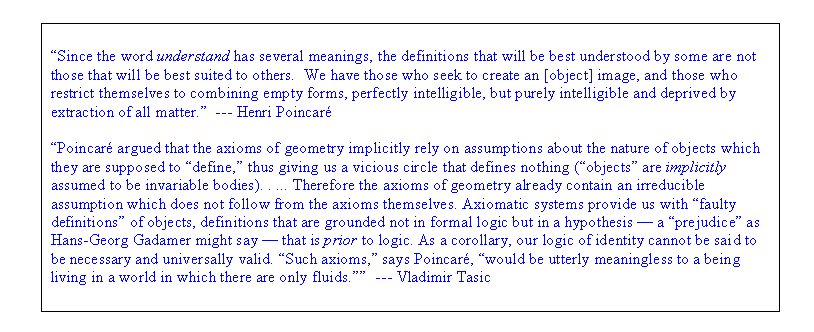
there
is also the invisible inner-outer spatial-relational potentials that are
accessible to us through ‘feeling’, thus, what is ‘visible’ is simply the
tangible component of our complex holodynamical experience. we are all capable
of feeling the inner-outer tensions within a social hostspace and thus we are
aware of a re
going
back to the first of poincaré’s arguments in the text box above, if we ‘let
visual perception FLOAT’ (without anchoring it as we usually do to the
center-driven asserting of objects) then
it is able to support and complement our felt experience within a complex holodynamical
experience. where we are screwing up
is, not only in anchoring the meaning that is coming to us from visual
perception, to an abstract ‘object’ base, but in coming to believe that this
visible re
in nature, as each grain is added to the pile, individual grains reach out to cling to their neighbours and to buffer the jolts that are incident on their neighbours. as the pile builds, this inner-outer dynamical balancing ‘networks’ until the tensions build so high that the smallest of incidents may unleash the accrued energies stored in the tensions in an avalanche of great violence. social tensions are also transpersonal and it is not easy for aboriginals to go against the imposed governance of the colonial powers, nor german citizens to go against the imposed governance of hitler’s nazis. enforcing moral and ethical rules based on the visible behaviour of the individual is thus a powerful means of ‘keeping the lid on’ and perpetuating a politically correct surficial behaviour at the expense of huge invisible-but-felt transpersonal tensions. those tensions, like the inner outer thermal balancing tensions on the warm spring day, cannot be controlled. without expansion joints as buffers, the concrete road by pushing against itself will implode and crumble.
the
myth of the ‘independent individual’ is only sustained by regarding what we
visibly perceive, minus our feeling experience of the invisible potentials
beneath, as ‘re
this
forked-tongue hypocrisy whereby those that cultivate the transpersonal webs of
oppressive high voltage tension insist on firm enforcement of moral and ethical
principles applied to the individual, stems from ‘seeing without feeling’, from
accepting visually perceivable behaviour as ‘re
our
western culture’s ‘technological advancement’, which does not appear to have
the relevant ‘wisdom’ of utilization bundled in with it, orients to
‘making visible things happen’ without regard to the invisible internal
tensions that are being induced. visual
perception is the assessment tool we use in constructing a ‘LOGICAL means to an
end’ in ignore-ance of transformative impact on inner-outer spatial-relational
dynamical balancing. going to war to ‘forcibly make peace
happen’ is perhaps the ultimate in our displacing of felt experience by our
preference of orienting to visual perception. world war ii was waged to
relieve the invisible tensions that underlay the superficial ‘visible re
to
regard ‘seeing without feeling’ as ‘re
how
far can we go in enforcing logical (politically correct) visible behaviours
that simply put a surficial cover over our continuing invisible inner-outer
balance-seeking behaviours? to what
degree will the west-installed-and-protected governments of
without acknowledge ‘feelings’ that inform us of our inner-outer internal tensions, as individuals and as communities, the premise that ‘seeing is believing’ becomes delusionary.
‘seeing’
in complex complementarity with ‘feeling’ are the makings of ‘holodynamical’ re
Weblog: April 6, 2006
Returning to the question, is it true that the hostspace dynamic we are situationally included in inductively shapes our behaviour, as the child-john would readily concede in the ‘taking off his jacket’ example, and/or is it (more/less) true, as the adult-john claims, that his behaviour is fully and solely internally-sourced by his independent self?
as
poincaré has described in The Value of
Science in the chapter on ‘Science and Re
in this case, the theory that the dynamic of the common hostspace inductively shapes the behaviour of those situated within that space explains the spatial-relational coupling in the behaviour of the collective (they all take off their jackets and put them back on in ‘synch’ (their behaviour has a cyclicity that is phase-coupled, and that phase coupling is induced by the dynamic of the hostspace they are situated/included in). the alternative theory of the ‘independent individual, which claims that his behaviour is fully internally-sourced does not even address the spatial-relational ‘phase coupling’ across a multiplicity of individuals; i.e. by ignoring and failing to address this spatial-relational coupling, the theory of the independent-behaving individual leaves such ‘self-organizing behavioural coherencies’ to the realm of ‘co-incidence’.
the term ‘self-organization’ itself seems to speak to the action of the inhabitants as if there is no habitat sourced inductive behaviour-shaping influence, ... as if the overall dynamic is constructed fully and solely from the actions of independent objects in empty euclidian space.
that’s what giordano bruno ‘got hit with’ in his meeting with english scholars on february 14th, 1584, and that’s what we continue to ‘hit ourselves with’ 422 years later, ... so intent are we, to insist upon the independence of individual behaviour, an ‘absolutist abstraction’ coming to us from the works of Aristotle (384 – 322 B.C.) whether or not he intended to make it as ‘big a deal’ as we have done.
today,
in 2006, we have those people whose views imply that since there is a
spatial-relational phase coupling amongst those individuals who become
‘terrorists’ (warriors that are not authorized by a sovereign nation-state),
and since that phase coupling is evidently induced by the hostspace dynamic
(e.g. evidence from an official inquiry shows that the london bombers became
‘terrorists’ because of britain’s decision to join with the US in the war in
iraq), that the theory that the dynamic of the common hostspace inductively
shapes the behaviour of those situated within that space is ‘more true’ than
the theory that behaviour is fully and solely ‘internally-sourced’ from the
‘independent’ individual. the ‘more
true’ premise being of the same nature as poincaré describes g
in this case, it is ‘more true’ to say that the violent behaviour of the terrorist was inductively shaped by the dynamics of the common hostspace, which we all contribute to, justifying the notion that ‘we are all partly the source of the terrorist behaviour’ as was the intuition of the 84% of the people in the Ipso Reid poll who rejected the idea that terrorist behaviour is fully internally sourced in the individual.
ok, we have two theories that both appear to be true, one arguably ‘more true’ than the other.
how can it be that some embrace and defend the one while some embrace and defend the other?
here
we come down to ‘how different people conceptu
“Since the word understand has several meanings, the
definitions that will be best understood by some are not those that will be
best suited to others. We have those who
seek to create an image, and those who restrict themselves to combining empty
forms, perfectly intelligible, but purely intelligible and deprived by
extraction of all matter.”
that is, spatial-relational form has no need of ‘objects’;
“Poincaré argued that the
axioms of geometry implicitly rely on assumptions about the nature of objects
which they are supposed to “define,” thus giving us a vicious circle that
defines nothing (“objects” are implicitly assumed to be invariable
bodies). . ... Therefore the axioms of geometry already contain an irreducible
assumption which does not follow from the axioms themselves. Axiomatic systems
provide us with “faulty definitions” of objects, definitions that are grounded
not in formal logic but in a hypothesis — a “prejudice” as Hans-Georg Gadamer might
say — that is prior to logic. As a corollary, our logic of identity
cannot be said to be necessary and universally v
that is, in fluid dynamics, particularly in the energy dynamics of relativity where ‘matter’ is now seen as local forms of spatial-relational energy concentration rather than absolute objects or particles, there can be no dependency upon ‘objects’. fluid dynamics are thus ‘purely dynamic’ (in Heraclitus’ world view, ‘everything is in flux’) and thus what APPEARS to be material objects are persisting spatial-relational forms within the flow. for example, we can ‘objectify’ a purely spatial relational form such as a hurricane and switch to describing it in terms of an object that possesses its own behaviour but it is ‘more true’ to recognize that it is an atmospheric hostspace induced behaviour rather than an ‘object’.
as
poincaré explains, the concept of an object is useful for the development of
understanding but it is not necessary as a foundation. in schools, ‘fractions’ are taught using
notional apples or pies that are cut into fractional parts but after the
students use these material object based examples to develop a proficiency in
de
still,
it is our western custom, both scholarly and commonly, to consider ourselves as
‘independent objects capable of independent behaviour’ and to consider our
‘nation’ as an ‘independent object capable of independent behaviour’ and these
object-underpinnings give us a ‘logical view of behaviour’, and it is from this
‘logical object-based view of behaviour’ that we come by this notion of ‘centr
in the same way, the adult-john makes his own ‘logical declaration of his individual independence’ and ‘proves it’ by keeping his jacket on for precisely the amount of time he prescribes to show that ‘he is in control of his behaviour’. but he is only in control of his logical object-based behaviour and his inner-outer dynamical balance sustaining (i.e. spatial-relationship INTERDEPENDENT behaviour) continues on and has a far more difficult time of it because his failure to attune to and respond to it.
the powerful nation-state, similarly, proves that ‘it is in control of its own behaviour’ by prescribing what it is going to do and when, and then doing it, ... but of course such ‘control’ is a logical abstraction as is behaviour in terms of ‘what object-things do’. natural behaviour is in terms of spatial-relational transformation (as in the ‘fluid-energy-dynamics’ of relativity); i.e. our feeling experience (as opposed to the logic of visual perception of objects and their object-behaviours) informs us of our inextricable inclusion within a spatial-relational flow.
our logical function, whether at the level of the ‘centrally governed independent individual-object’ or the ‘centrally governed sovereign nation-state-object’ is born from the notion of a local independent object with its own ‘center-of-self’ which possesses a notional ‘inner-purpose’ from which its behaviour is ‘seen to be driven’, thus doing away with any inductive behavioural influencing sourced by the hostspace in which it is situationally included.
furthermore, the notion of ‘control’ presupposes a center from which the controlling force emanates. without an absolute object, there is no absolute center and without an absolute center, there is no notion of ‘control’, there are only ‘spatial-relationships’ (as in the non-euclidian space of relativity) which brings us back to poincaré’s points (extracted from teaching science and mathematics, as well as from life in general) that;
“Since the word
understand has several meanings, the definitions that will be best understood
by some are not those that will be best suited to others. We have those who seek to create an image,
and those who restrict themselves to combining empty forms, perfectly
intelligible, but purely intelligible and deprived by extraction of all
matter.”
when you regard a hurricane, do you see pure fluid dynamic, pure spatial-relationship, or do you see ‘a locally existing object with its own center’, ... ‘an object that possesses its own behaviour and moves independently of the space it is situated in’?
you would perhaps agree that both options exist but that one is ‘more true’ than the other but yet, ... the one that is most simple and convenient is the one that is ‘less true’.
in order to see the ‘hurricane-as-local-object with local self-center based movement’, as in poincaré discussion around the question ‘does the earth rotate?’, we have to impose the logical convention of absolute space to frame the movement of the object so as to say that ‘it is the object that is doing the moving’. unfortunately, the most simple space framing convention is not ‘the most true’ in the sense of capturing and addressing relative spatial relationships. to cite poincaré yet again;
"Space is another framework we impose upon the
world" . . . " . . . here the mind may affirm because it lays down
its own laws; but let us clearly understand that while these laws are imposed
on our science, which otherwise could not exist, they are not imposed on
Nature." . . . "Euclidian geometry is . . . the simplest, . . . just
as the polynomial of the first degree is simpler than a polynomial of the
second degree." . . . "the space revealed to us by our senses is
absolutely different from the space of geometry." . . . Henri Poincaré. 'Science and Hypothesis'.
thus we differ in our preference to understanding, some of us preferring to understand the world in the terms that the world is a collection of independent objects with independent sequential-temporal behaviours (including individual human-objects) while others prefer to understand the world in terms of spatial relationships that are transforming in the continuing present, and ourselves as being ‘dynamical forms’ that are inextricably bound up in this flow.
our
current problem is that the object-based view of the world dynamic is a logical
view that provides an internally self-consistent logical re
for most of us, as the 84% in the Ipso Reid poll suggests, we understand the world dynamic in the terms that we all share in co-creatively shaping the dynamic of our common hostspace, as we do when we collectively interact in ‘freeway space’ and thus we all contribute, through the mediating agency of our hostspace dynamic, to the inductive behaviour shaping of ourselves as individuals who are situationally included in this common hostspace dynamic. when the collective of participants tends to assert more by the logic of objects with independent behaviour, so are the most vulnerable in the shared space exposed to making up the resulting dynamical imbalance. as it is in the busy space of the freeway, so it is in the space on the surface of the earth generally.
those that understand things in terms of ‘independent object-behaviours’ prefer to believe that their assertive accomplishments are fully and solely internally sourced from the center of themselves (driven forth by their ‘inner purpose’), so not only will they NOT accept that their behaviour is inductively influencing the behaviours of their fellows through the mediating of the common hostspace dynamic, but they will refuse to accept that the violent behaviours of others oriented against them comes from anywhere other than the internals of those ‘independent’ individuals. such an understanding will put into the primacy in their attempts to resolve the violence, the elimination of the source of the violence which they see as being trackable back to those who have violent ‘inner purpose’
this is simply a ‘preferred’ way of understanding that happens to be ‘less true’ than the spatial-relational way of understanding that shows an interdependent coupling of behaviours via common inclusion within a shared hostspace dynamic. such an understanding will put into the primacy the restoring of dynamical balance in the common hostspace so as to attenuate the disaccommodation and humilation associated with the powerful imposing their logic on others within the common space via their ‘not true’ belief in individual behavioural independence.
unfortunately, the arbiters of which of these ways of understanding the world is ‘more true’ (the object-based or spatial-relationship based) continue to be the aristotelian absolute-object-orienting and syllogism-embracing ‘oxford scholars’ that arbitrated the ideas of giordano bruno (relativity based on spatial relationship) on february 14, 1584 at la cena de le cinderi. the copernican theory was not simply re-situating the sun, rather than the earth, at the absolute center of the universe, ... it was instead the rejection of the notion of an absolute center, and thus the rejection of the ‘objectification of space’ and the rejection of ‘the object’ period.
we are as yet, only at the very early beginnings of the ‘copernican revolution’, thanks to the status quo perpetuating powers of the abstract (mind-mesmerizing) notions of ‘objects’ with ‘absolute centers of behavioural governance’, used as a social organizing principle/ethic, and so ‘keeping the lid’ on our natural spatial-relationship based evolution, for a time at least, until the uncontrollable nature-sourced pressure becomes sufficient to blow off the central control-based logic yokes, or, until a sufficient ‘distribution’ of the populace comes around to acknowledging that a spatial-relational understanding of the world dynamic is ‘more true’ than the object-center-sourced understanding. i use the term ‘distribution’ rather than ‘proportion’ since the majority already seems to be believe, intuitively, in the capability of the hostspace dynamic to inductively shape individual and collective behaviour (it takes a whole community to raise one of its own children), but the grip of those who have lived their lives according to the ethic of object-based central control; i.e. the grip of the ‘leaders’ of business and government, is not going to be so easily wrested from the helm to which we have proxied our individual powers.
Weblog: April 4, 2006
Today,
i was doing some ‘footwork’ for alan rayner, tying down some quotes by giordano
bruno, born in ‘nola’ near vesuvio in 1548 and burnt at the stake for the
heresy of ‘relativity’ (‘inclusion
‘Perché in fatto tutti gli orbi non vagliono per uno che
vede, e tutti i stolti non possono servire per un savio.’
(‘[one is forced to
conclude] that in fact all of the orbs (empty eye sockets) taken together do
not add up to one that sees, and all of the fools taken together cannot serve
as a single wiseman.’
which is similar to another of his oft cited comments to the effect that ‘the majority has no monopoly on the truth’; i.e.;
“E' indice di una mente bassa e semplice il voler pensare con la massa, o la maggioranza, semplicemente per il fatto che la maggioranza sia la maggioranza. La verita' non cambia se creduta, o non creduta, dalla maggior parte delle persone. » (the original source was in latin in ‘de umbris idearum’, ‘of shadows of ideas’)
"It is proof of a base and low mind for one to wish to
think with the masses or majority, merely because the majority is the majority.
Truth does not change because it is, or is not, believed by a majority of the
people".
of course, things have not changed significantly over the past 422 years since bruno’s meeting with the oxford scholars.
the ‘blindness’ goes as follows, using yesterday’s example of john, who insists his behaviour, taking off his jacket, is ‘his own’ in spite of being shown satellite photographs that show that thousands of other were taking off their jackets at the same time he was (it was the first warm day of spring in the region).
now, examine how, when i challenge john on this, he gets his back up and says he can ‘prove to me’, by means of an experiment, that he is indeed the full and sole source and determinor of his behaviour. he proposes to keep his jacket on for exactly three years and to remove on noon on the day after the three years have expired and he appoints ‘oxford scholar’ stewards to oversee the experiment and double-check the results.
as
poincare suggests, all that we can prove is our hypotheses, and the qu
It is by logic we prove, it is by intuition that we invent.
Logic, therefore, remains barren unless fertilised by
intuition.
now, at the end of the three years, john’s oxford scholar friends will be cheering since, according to them, john has given the conclusive experimental proof that he is in full control of his own behaviour, that he has free will and that his behaviour pushes out from his self-center driven by his internal purpose.
but john’s proof is only half a proof. all he has proven is that he is capable of ignoring his inclusion within the hostspace dynamic since his body will NOT have been liberated from the hostspace thermal cycles and all of his ‘balance-seeking systems’ will be working overtime to compensate for his keeping his jacket during those phases of the seasonal and diurnal cycles where the hostspace heats up.
what john has therefore done is to put his logical/rational function ‘out of joint’ with his sentient self which is all the while seeking to sustain dynamical balance with the hostspace it/he is included in. this ‘mind-matter-split’ causes his body a lot of strife and pain, but he nevertheless succeeds in proving that he is logically in control of himself though the control he imposes on his logical self is not imposed on his natural self.
his
experiment is v
his visual movements are simply ‘logical’ movements. as giordano bruno believed, while objects are whatever we stick a label on and use to synthetically re-construct a visual picture of dynamics, the true material was of a world where ‘everything is god’ and ‘god is [in] everything’.
so, john is going to believe that he has ‘made his case’ that he is ‘in control of his behaviour’ because the world of western science (still aristotelian and based on visual perception of mutually exclusive logical objects) puts logic ahead of intuition.
and so it is also on the individual independent nation-object scale of social dynamics, ... the western powers can show that they are in control of the behaviour of the global body, and they can prove it by making the puppet government of the imaginary line bounded nation-state (a logical body persisting in ‘existence’ thanks to outsider protection that forces everyone to humour them and say, ‘yep, it does still exist, just like you say’) of, for example, afghanistan, follow their bidding for three years straight, ... but just as in the case of john not taking his jacket off, such an experiment merely proves that the logical control function (the government of hamid karzai, and above it the governments of the western protecting powers) are capable of ignoring the region’s inclusion within the hostspace dynamic since the inhabitants will NOT have been liberated from the hostspace cycles and all of the social ‘balance-keeping systems’ will be working overtime to compensate for the logical control center doing its top-down straitjacketing in spite of the ongoing cycles of ‘heating up’ of the social dynamic that are hostspace induced.
so,
for all the western scientists that continue to believe that individuals and
nations are ‘independent’ and thus have the power to internally source their
own behaviour, please remember that you are only talking about ‘logical
control’ and the logic we impose on ourselves is not imposed on nature, thus
there will be an ‘interface’ somewhere that the logically imposed behaviour
must confront the greater re
come to think of it, seeing ourselves as logical objects makes us over into ‘puppet states’ that are putty in the hands of more powerful logicians (as LaFontaine said; ‘la raison du plus fort est toujours la meilleure’.).
so, in spite of the satellite photos we show john that shows how his jacket-offtaking behaviour is inductively shaped by the hostspace dynamic, ... john and the oxford scholars will nevertheless do their experiment to prove that john’s behaviour is independent and fully and solely internally sourced by himself, reminding us of bruno’s words after visiting with the oxford scholars in 1584;
‘Perché in fatto tutti gli orbi non vagliono per uno che
vede, e tutti i stolti non possono servire per un savio.’
Weblog: April 3, 2006
Yesterday, april 2’nd, was the first anniversary of Pope John Paul II’s death and his many admirers turned out, at the Vatican, to pay their respects for him and to express their support for his expeditious beatification (the bestowing of ‘sainthood’).
by all accounts, he was a very spiritual and truly compassionate man and deserving of the kind of respect that is being given him in the current remembrance gatherings.
in connection with yesterday’s blog on the split in our worldview with regard to the sourcing of ‘terrorist’ behaviour (sole-sourced from inner purpose versus hostspace-induced) one cannot help but wonder of the manner of influence that will associate with the life and works of the late pope.
in the manner that the products that celebrities use tend to influence the product choices of those who adulate the celebrity, will the adulation for pope john paul ii influence others to live a life in the honest and worthy manner that pope john paul ii lived it, or will the influence be more in terms of ‘buying in’ to the things (philosophies, religious structures) that pope john paul ii bought into?
there are wise and spiritual men and women in the diverse multiplicity of the world’s religions, some of which (e.g. buddhism, native american paganism) have no ‘church structures’ and thus there is the opportunity for the exceptional life to serve for an ‘intuitive’ model for how to live one’s own life, without having to ‘buy in’ to philosophical – rational structures that the ‘wise or ‘holy’ person may have ‘bought into’ and which have been translated and articulated in philosophical-doctrinal terms by an ongoing resident (within a church structure) cadre of priests.
of course, i am referring to the philosophical structure as pertains to human behaviour which the catholic church FORMALLY sees as being sole-sourced from within the individual, a belief that is not unlinked to western christian law which orients to the ‘independent individual’ as the sole and fully responsible author of his own behaviour, ... something that, in turn, is not unconnected from the realm of scientific inquiry, there being a reinforcing bond between this absolutist ideal in the christian church and in the newtonian paradigm of science which we continue to be ‘stuck’ in.
eight
years ago, i reviewed pope john paul ii’s philosophical and scientific ideas
about the world and how it worked ( www.goodshare.org/encyclic.htm
) which he pulled together in his encyclical ‘Fides et Ratio’ (Faith and Ration
“The editor's note suggests that "The 35,000 word
document concerning modern thought and truth was aimed primarily at experts in
philosophy and theology." There was also an introductory commentary by a
Cardinal Ratzinger who said that the encyclical may be the 'summa' of the
Pope's pontificate, and that; "... the Pope's return to the value of
rational thought, integrated with absolute values, stood in contrast to the
modern "flight toward easy irration
ratzinger, now john paul ii’s successor, was and is a philosopher and was viewed as the person that assisted pope john paul ii in ‘translating’ his views into that “35,000 word document concerning modern thought and truth” and the fact that pope john paul ii trusted him and depended on his philosophy-articulating skills could not have hurt ratzinger’s chances in being elected as the pope to replace john paul ii.
but
there is thus an issue here in regard to differentiating ‘the man’ and ‘his philosophy’ particularly
when we have the experience of his life
to go by in the first instance and only ambiguously interpretable word
structures in the latter instance. this
problem of interpreting words, by means of a linguist/philosopher is always
problematic, is it not? in particular, i
am thinking of johannes kepler’s observation in Harmonies of the World (1619)
about the church, which refused to budge on their preferred modeling of
celestial dynamics (g
"So much for the authority of Holy Scripture. Now as regards
the opinions of the saints about these matters of nature, I answer in one word,
that in theology the weight of Authority, but in philosophy the weight of
Reason alone is v
kepler
could say this and still escape ‘inquiisition’ as he lived and worked in
the point i am making is that if we examine the wise and spiritual men of christianity, judaism, islam, buddhism, taoism, hinduism, aboriginal paganism etc. and cross compare their writings on ‘thought and truth’, we will find these writing to be very different, not the least because they general seek compliance with ‘sacred scriptures’ and the like which preceded their lives.
my ‘problem’ is with the ‘absolute values’ (‘good’ and ‘evil’, ‘thing’ and ‘nothing’) that the late pope john paul ii included in his ‘summa encyclical’ with the help of then-cardinal ratzinger. establishments founded on absolute values are not going to shift gears easily, as the historical issues with the ‘copernican’ model and ‘evolution’ have shown us.
which brings us around to the question of ‘terrorism’ and whether it is a behaviour that is sole-sourced from the internals of an individual, or whether the common hostspace which we all participate in ‘co-conditioning’ inductively shapes individual and collective behaviour.
the ‘absolute value’ based PHILOSOPHY of the late pope, ratzinger and the catholic church contend that we must never depart from the notion of absolute independence of individual behaviour. in his ‘fides et ratio’ encyclical, pope john paul ii said;
"Once the idea
of a universal truth about the good, knowable by human reason, is lost,
inevitably the notion of conscience also changes. Conscience is no longer
considered in its prime re
had i ever had the occasion to meet with pope john paul ii, i would have asked him about this statement and about how he reconciled it with the inspiring writings of victor hugo in Les Miserables, where the bishop, a compassionate person not unlike john paul ii himself in many ways (e.g. john paul forgave the assassin that nearly succeeded in taking his life), was visited by the police who had brought in jean valjean, catching him red-handed with a sack full of the bishop’s silverware (the bishop had given jean valjean shelter). the bishop, feeling compassion for jean valjean, the victim of an unfair world, spontaneously, in order to get valjean ‘off the hook’, told the police that he had intended that jean valjean have that silverware, and to underscore his feigned intent, went and gathered up his prized silver candelabras and putting them into the sack, told jean valjean, ‘here, you forgot to take these and i intended that you have them’. thus was what was heading off to be a criminal life transformed by the love and compassion of a fellow human being.
but
my point is this. the story clearly
implies that criminal behaviour, whether jean valjean’s thievery or other more
serious crime, can be inductively shaped by the common hostspace that we are
included in, whose qu
would pope john paul ii have voted with the 84% or would he have voted with those who say that the independence of individual behaviour is ‘absolute’ and we must base our personal role in the managing of social dynamics on the view wherein the behaviour of an individual is understood as being sole-sourced from within the individual (from his ‘inner purpose’ guided by knowledge, intuition, dialogue with God or etc. etc, but in any case ‘internally sourced’).
can
we ever say that ‘the individual is bad/evil’ and therefore seek to ‘eliminate
the individual’ rather than to ‘transform him’ as the bishop’s love and
compassion helped to transform jean valjean in ‘les miserables’? people tend to split on this question. in the film ‘dead man walking’, a nun (
some people see no sense at all in the work of the nun. they see the rapist-murderer as having ‘written himself off’ by his own actions and thus not worthy of any redemptive effort on anyone’s part.
this is the ‘attitude’ that one needs in a ‘war against terrorism’; i.e. to regard non-state-sponsored people who are committed to doing violence to the citizens of particular powerfully influential states, as being ‘write-offs’ whether or not they have ‘blood on their hands’ (i.e. blood from violence they have perpetrated as opposed to the blood of their own loved ones who have been the victims of the ‘legitimized violence’ of the righteous nations of the world.).
so, there is this question about the source of individual behaviour and whether or not it is sole-sourced from within the individual or whether it is inductively shaped by the common hostspace dynamic which can be very selectively oppressive as the continuing split between the hugely affluent ‘haves’ and the dying in poverty and disease-ridden ‘have-nots’ manifestly indicates.
it
is intuitively obvious to us that we can be in situations where we feel
‘oppressed’, ‘disopportunized’, ‘disadvantaged’ and ‘disenfranchised’ by the social
dynamics of the habitat in which we are included inhabitants. in some cases, everywhere we go, doors close
in our faces, people are indifferent to our pleas for a chance to actu
but when one’s model is in terms of ‘what things do’, there is no capability for addressing ‘spatial-relational’ influences such as where our common hostspace inductively shapes our individual behaviour (a view that conflicts with the notion that our individual behaviour is sole-sourced from within, from our internal purpose). our western notions of the sourcing of behaviour are all ‘masculine’, ‘assertive’, ‘causal’ or ‘inside-outward’ and we have lost our feeling for the ‘feminine’ sourcing of behaviour (from the outside-inward) wherein space accommodates so as to inductively give birth to, and shape individual and collective behaviour/organization.
of
course i do not believe in the ‘absolute values’ based ‘sole-sourcing of an
individual’s behaviour from within’ which would hold a jean valjean solely
responsible for his ‘criminal acts’ and let the repressive and dysfunctional
collective, which co-creatively shapes the accommodative qu
christians are clearly of two minds on this question since ‘the war on terrorism’ which seeks elimination rather than transformation is manifestly ‘christian-led’ but at the same time, confronted by christian opponents.
politicians that are operating on the view that individual behaviour is internally sole-sourced argue that we ‘cannot make excuses’ for the terrorists, such as jean chrétien did. that is, he publicly expressed his view that by humiliating people via the manner we wield our greater power and by the way we ignore the call of help from the world’s sick and starving, we are inducing them to do violence against us. thus, the following ‘findings’ announced yesterday in a british newspaper, tend to erode the ‘sole-internal-sourcing’ of behaviour view and give credence to the hostspace-induced behaviour-shaping view;
Official:
Mark Townsend, crime
correspondent
Sunday April 2, 2006
The Observer
The first official recognition that the
Despite attempts by Downing Street to play down suggestions
that the conflict has made
The government's 'narrative', compiled by a senior civil
servant using intelligence from the police and security services, was announced
by the Home Secretary, Charles Clarke, last December following calls for a
public inquiry into the attacks.
The narrative will be published in the next few weeks,
possibly alongside the findings of a critical report into the
Initial drafts of the government's account into the
bombings, which have been revealed to The Observer, state that
The findings will prove highly embarrassing to Tony Blair,
who has maintained that the decision to go to war against
* * *
how do we resolve this paradox wherein the violent (termed ‘terrorist’) behaviour of individuals can be seen as either being solely-sourced from the inner purpose of the individual (all that the absolute ‘independence’ [rational] based view of individuals allows for), or as being ‘hostspace-induced’?
as
mentioned in yesterday’s blog, the method of g
the finding that britain’s participation in the iraq war is coupled with the rise of terrorist action on the part of multiple individuals in britain suggests that it is ‘more true’ to suppose the outside-inward (hostspace-induced) behavioural shaping sources the terrorism, than to suppose that the terrorist behaviours are internally sole-sourced.
while our intuition ‘has no problem with this’, our rational models (as in ‘fides et ratio’) do have a problem in that they portray the individual as ‘independent’ in its ‘local, self-centered existence’ and in its ‘local, self-center-driven behaviour’.
the late pope, like many who advocate that we use rational models (rather than the wisdom of elders) as the basis for our justice system and social dynamics management in general, do not wish to open what they feel is a ‘pandora’s box’ wherein we would accept that behaviours are relative to the behaviours of the social dynamic we are included in. as the late pope john paul ii said in ‘fides et ratio’, which some would say sounds more like ratzinger speaking;
"Hypotheses may fascinate but they do not satisfy.
Whether we admit it or not, there comes for everyone the moment when personal
existence must be anchored to a truth recognized as final, a truth which
confers a certitude no longer open to doubt."
this kind of ‘absolutism’ is scarcely satisfied by the notion that our individual and collective behaviours are relative to (inductively shaped by) the common hostspace dynamic in which we are included and which we co-creatively shape by our manner of relating to one another and ourselves. but it certainly does relate back to early tersely rational interpretations of the ‘holy scriptures’ (which also required the services of translators) wherein man was seen as an absolute species ‘placed’ on earth by God, such absolutism including the corollary that each instance of man is, like the species of man, independent and distinct and operating in-its-own-right though its personal relationship with God (rather than being included in the natural world).
so was pope john paul ii ‘really’ an ‘absolutist’ as his (or ratzinger’s) above articulation of philosophical principle suggests. i shall add one more ‘piece of evidence’ (to the contrary) prior to summarizing the intent in my today’s blog, an excerpt on terrorism from Karol Józef Wojtyła’s (pope john paul ii’s) address on the ‘world day of peace’ in 2004.
MESSAGE OF HIS HOLINESS
POPE JOHN PAUL II
FOR THE CELEBRATION OF THE
WORLD DAY OF PEACE
1 JANUARY 2004
AN EVER TIMELY COMMITMENT: TEACHING PEACE
. . .
The deadly scourge of terrorism
8. Today international law is hard pressed to provide
solutions to situations of conflict arising from the changed landscape of the
contemporary world. These situations of conflict frequently involve agents
which are not themselves States but rather entities derived from the
collapse of States, or connected to independence movements, or linked to
trained criminal organizations. A legal system made up of norms established
down the centuries as a means of disciplining relations between sovereign
States finds it difficult to deal with conflicts which also involve
entities incapable of being considered States in the traditional sense.
This is particularly the case with terrorist groups.
The scourge of terrorism has become more virulent in recent
years and has produced brutal massacres which have in turn put even greater
obstacles in the way of dialogue and negotiation, increasing tensions and
aggravating problems, especially in the
Even so, if it is to
be won, the fight against terrorism cannot be limited solely to repressive
and punitive operations. It is essential that the use of force, even when
necessary, be accompanied by a courageous and lucid analysis of the reasons
behind terrorist attacks. The fight against terrorism must be conducted
also on the political and educational levels: on the one hand, by
eliminating the underlying causes of situations of injustice which frequently
drive people to more desperate and violent acts; and on the other hand, by
insisting on an education inspired by respect for human life in every
situation: the unity of the human race is a more powerful re
In the necessary fight against terrorism, international law
is now called to develop legal instruments provided with effective means for
the prevention, monitoring and suppression of crime. In any event, democratic
governments know well that the use of force against terrorists cannot justify
a renunciation of the principles of the rule of law. Political decisions
would be unacceptable were they to seek success without consideration for
fundamental human rights, since the end never justifies the means.
* * *
today’s blog raises this issue of ambiguity as to the source of individual and collective human behaviour. for some, we must hold rigidly to the notion that our individual behaviour is fully and solely internally sourced in each of us. this accords with our view of ourselves as ‘independent assertive agents’ whose behaviour pushes off from our self-center driven by our inner purpose.
this view is in agreement with newtonian science which portrays everything in the world as machinery (however complex and sophisticated). in the case of the newtonian view of the human individual, he is ‘independent’ and thus his behaviour is assertive and originates from his interior; i.e. from his biogenetic makeup, from his internal biophysics and biochemistry. his inputs include energy for fuelling his internal machinery and ‘information’ for temporal-sequential processing by his internal processor and his output is ‘individual, internally sourced behaviour’.
this newtonian ‘cybernetic’ view of man satisfies the condition of absoluteness termed ‘independence’, at least on the material plane.
but
the spiritual ‘self’ of man is also seen as ‘absolute’ and ‘independent’ in the
western christian view, and this independence of spirit and mor
between
the western religious doctrines of christianity, islam and judaism, we have a
reinforcement of the newtonian materi
this ‘rational’ (absolute values based) view of internal sole-sourcing of behaviour, which is the foundation of western justice forcefully blinds itself to the spatial-relational inductive shaping of individual and collective behaviour that our intuition meanwhile screams out at us as being the over-riding influence on our world dynamic.
those who embrace the ‘internal sole-sourcing of behaviour’ view insist that we shouldn’t be ‘making excuses for the criminals and the terrorists’ since they are ‘fully and solely responsible for their own behaviours’.
others argue that we are included within one common hostspace and that those of us who have the most power tend to use it insensitively, disopportunizing our fellows and humiliating them, not necessarily ’directly’, but through our disproportionate control of our global hostspace dynamic which they and everyone depends upon for opportunity to develop one’s assertive potentials authentically.
what we have here are two UNRECONCILED theories as is acknowledged in pope john paul’s peace message; i.e.
“ ... if it is to be won, the fight against terrorism cannot be limited solely to repressive and punitive operations. It is essential that the use of force, even when necessary, be accompanied by a courageous and lucid analysis of the reasons behind terrorist attacks. The fight against terrorism must be conducted also on the political and educational levels: on the one hand, by eliminating the underlying causes of situations of injustice which frequently drive people to more desperate and violent acts; “
these two unreconciled theories are in fact reconciled, in their material/physical aspect by ‘the theory of relativity’, which is not really a ‘theory’ but a new scientific ‘paradigm’. in relativity theory, the individual is NOT INDEPENDENT but is included within its hostspace in the manner that the hurricane is included within the atmospheric hostspace. this paradigm elevates dynamics from ‘the behaviour of things’ to ‘the transforming of spatial relationships’ (as in fluid [energy] dynamics).
in the paradigm of relativity, ‘things’ are still ‘unique’ but not through the absolutism of ‘independence’, they are unique because of their unique situation within a common hostspace dynamic; e.g. hurricane katrina is unique but not by being independent of the hostspace dynamic she is included in. she is unique in an interdependent spatial-relational context. meanwhile she is innately non-local and a-centric in her make-up and it is only for the convenience of simplification and articulated description that we ‘objectify her’ and portray her as ‘local’ and ‘self-center driven’.
given relativity, there is no problem with accepting that the hostspace dynamic inductively shapes individual and collective behaviour and we no longer have to saddle ourselves with the ‘absolutist notion’ of sole-internal-sourcing of individual behaviour.
this scares the hell out of some philosophers since the ‘social dynamics management tool’ wherein individuals accept sole responsibility for their behaviour, if lost, is seen as putting us on the slippery slope to an escalating chaos.
but surely it is obvious to most that it is already the case those who feel humiliated and disopportunized ‘blame their behaviour’ on those who have oppressed them through the mediating of a common hostspace dynamic (e.g. by selectively disaccommodating them because of their religion, gender, race, appearance, circumstance, win/lose ladder-climbing etc.) while those that most insist that we must all accept full and sole responsibility for our own behaviour are those who are in power and who want to stay in power. such a concept gives us justification and leverage for punishing those who lash out because they are being disopportunized and disenfranchised, but such a concept is innately blind to the practice of powerful crony classes wherein , as their monopolization of opportunity grows, suffocate their fellows through ‘sins of omission’ (the non-behaviour by which the privilege and powerful disopportunize others) rather than through ‘sins of commission’.
as
mentioned, we have a new scientific paradigm, ‘relativity’ (whose overall
‘dynamical gestalt’ a few of us refer to as ‘inclusion
but what about the spiritual aspect of the self which was also considered as ‘independent’. the solution has always been available for this as well in terms of the native and eastern belief wherein we see ourselves as ‘included in nature’ (included in the dynamical unity that we inhabitants experience as ‘habitat’ or ‘nature’).
would the way that pope paul ii, as a spiritual and compassionate man, carried himself in his real everyday relationships with others look fundamentally different had he been an aboriginal? the aboriginal’s philosophical tradition is committed to peace and to the spiritual belief in ‘mitakuye oyasin’, ‘we are all related’ (i.e. ‘we are all included in nature’).
all told, then, the absolutist notion of ‘independence’ is something we can ‘let go of’. we have seen what damage it has done at the scale level of ‘independent sovereign nation-states’ which fail to acknowledge that we all share inclusion in a common hostspace.
in fact, my impression was also that the persisting twinkle in Karol Józef Wojtyła’s eye spoke of an awareness of the imperfections of church doctrine, and that the very eroding of the dominant controlling role of the ‘independent nation-state’ as he discussed not only in regard to ‘terrorism’ (non-nation-state sourced warfare) but also, in his statements on peace, in regard to the (desirable) rise of non-governmental movements (trans-independent-nation-state movements). his critique of the UN insofar as it acted as the ‘administrative arm of a collection of independent nation-states’ was clear, since the term ‘family of nations’ which he used in no way supports the darwinist win/lose competitive pride of a multiplicity of ‘independent’ states whose behaviours are seen as solely-internally-sourced, e.g;
“The activity of national Governments will be greatly
encouraged by the re
This represents a significant incentive for a reform which
would enable the United Nations Organization to function effectively for the
pursuit of its own stated ends, which remain v
it
would seem that both movements of peace-promoting solidarity and movements of
resistance and rebellion are paying short shrift to the classical claim to
precedence of the ‘independent sovereign nation-state’ and the relabelling of
warfare as ‘terrorism’ that the community of peaceful and belligerent
nation-state leaders have agreed upon, seems to be a ‘cry of foul play’ on
their part, in their attempt to sustain the precedence of the absolutist
imaginary-line-border based concept of sovereign property nation-state that is
the very source of their centr
in a final eye-twinkling statement a few months before his death, prepared for world peace day, 2005 and sent to heads of state around the world (released Dec. 16, 2004 at a Vatican press conference led by Cardinal Renato Martino, president of the Pontifical Council for Justice and Peace)., karol included the following comments;
“An essential part of promoting peace is ensuring that every
person is given a share in the goods of the earth, making it possible for them
to feed and house their families and have hope for the future. . . . The
condemnation of racism, the protection of minors, the provision of aid to
displaced persons and refugees, and the mobilization of international
solidarity toward all the needy are nothing other than consistent applications
of the principle of world citizenship,"
“Cardinal Martino said the pope's recognition of a
"world citizenship" marked the first time that the concept appeared
in an authoritative document related to Catholic social teaching.”
after the fall of the absolutism we attach to the ‘independent sovereign property-based nation-state’, in recognition that we are all included within a common hostspace in spite of the imaginary line borders (did karol print his message sent to ‘heads of state’ on ‘pink slips’?), ... what about the fall of the absolutism we attach to the ‘independent human individual’ and the imaginary euclidian line-and-surface boundaries we mentally and absolutely impose on him and her?
Weblog: April 2, 2006
The
discussion on ‘tribes’ brings out the fact that we have two different
‘standards’ for the manner in which we represent, and respond to ‘re
we can, of course, always insist that our behaviour is source by rational purpose. if we are asked why we took off our jacket, or why we put it back on, we can always respond; ‘because i chose to. i was acting out of my free will as an independent person and i decided that it was time to take my jacket off, or put it back on.’
but if the interviewer pursues his inquiry saying, ... ‘i noticed that millions of others in canada took off their jackets at roughly the same time (mid-march) and also put them back on at roughly the same time (mid-september) and that this spatial-relational pattern of jacket putting on and taking off had a regional distribution with quebec lagging british columbia in taking the jackets off and british columbia lagging quebec in putting them back on. are you absolutely sure that the PRIMARY reason for taking off your jacket and putting it back on is because you, as an independent person acting out of your own free will and self-centered inner purpose chose to do so? because if that is true, then it is a hell of a coincidence that millions of others did the same thing at the roughly the same time and that there are strange patterns of spatial coherency involved here where certain local regions phase lag certain other local regions, suggesting that, rather than you choosing to take off and put on your jacket, some condition of the common space you inhabit INDUCED you to do it, as that is what is suggested by the spatial-relational coherence of the jacket-off-taking and jacket-on-putting of the collective.
if
you cling to your rational and deliberate behavioural model, do you then
believe that the source of this spatial-relational coherency is that ‘great
minds think
we of the western culture are mesmerized by our own rational models of behaviour. we reduce everything to ‘the action of things’, it is ‘the newtonian way’. we portray ‘things’ as being ‘independent bodies’ whose parts move relative to their self-center (i.e. arms and legs move relative to their body center) and that their overall motion is of two types; the ‘inanimate’ or ‘inorganic’ type of motion wherein a body stays at rest unless it is acted upon by an external force, and the ‘animate’ or ‘organismic’ type wherein a body consumes fuel and its motion is driven from within, in the manner of an internal combustion engine. in fact, other than situation the source of the force inside of the body in the case of animate motion, between these two sources of motion, all motion in the world can be thus explained.
well, we can’t help but notice that with this ‘what things do’ based explanation of model, we have ‘gotten rid of’ the ‘hostspace-that-includes-things’ and thus we have gotten rid of the source of motion whereby the condition of the habitat-that-includes-the-inhabitants INDUCTIVELY SHAPES their individual behaviour and their behaviour relative to one another and their common hostspace.
we
can always insist that the behaviours of individual entities are ‘their own
independent behaviours’ but this is an over-simplified representation of the
dynamical re
for
example, studying the behaviour of a rock falling down a mountain tells us
nothing about the spatial relational coherencies that characterize the erosion
of the landscape which comes from inner-outer balance-seeking dynamics between
atmosphere and lithosphere (spatial-relational dynamics) and our inquiry into
the dynamics of ‘ocean waves’ in terms of ‘bodies of water that move’ are in
denial of the more fundamental re
getting back to the man who takes his jacket off, is there not a similar inner-outer (suprasystem-system) dynamical balance-seeking going on here as regards the relative thermal flow, the inside-outward thermal exchange being inductively shaped by the outside-inward thermal accommodating backpressure, the ‘jacket’ being interposed to mediate and assist with sustaining dynamical balance, lest the internally generated thermal flow be dissipated into the hostspace and/or the removal of the jacket so as to avoid internal thermal buildup that takes the body/system out of its evolved operating range. in both cases there is a dynamical balance seeking that goes on at a level deeper than the rational, explicit and deliberate that is inductively shaping the behaviour of the individual, and more than this, because the hostspace that the collective of individuals are included in is shared and common, this inductive behaviour-shaping influence of the common hostspace induces spatial-relational patterns of coherency in the collective of individuals that is beyond their deliberate, explicit rational choice-making.
but this non-rational hostspace-inducing of coherent patterns of behaviour in a collective does not have to be limited to ‘the weather’, the same holds true in crowd dynamics and in the common hostspace of a busy freeway and here it becomes more clear that the common hostspace dynamic that inductively shapes the behaviour of the included individuals and their spatial-relationships with one another is, at the same time, being shaped by the participants, by the manner in which they move relative to one another and the spatial-relationships of the common hostspace they are all included in.
the
point is that the collective co-creatively shapes the hostspace dynamic that is
meanwhile inductively shaping the behaviour of ‘they’, the participants who are
the co-creating source of it. this, we
refer to as ‘self-organization’, but it is not something that is rationally
produced by ‘deliberate’ and ‘explicit’ actions on the part of knowing
individuals. when we are in a crowd
dynamic (we are always in a crowd dynamic, that is the nature of life), unless
we are crazy or driving a sherman tank, we let our behaviour be shaped by the
pursuit of sustaining a harmonious traffic flow in the shared space we are all
operating in. this is another form of
sentient awareness (it is intuitive) than the rational mental modeling that
goes on in our head, based on seeing ourselves as ‘independent objects’ whose
behaviour pushes off from our self-center driven by our rational inner
purpose. our rational mental modeling
function is all about inside-outward driving action, while our intuitive awareness,
our felt experience of being included in a common hostspace, is attuned to the
spatial-relationships we are inextricably bound up in, which present us with
accommodative backpressure that inductively shapes the actu
rational models start from independent objects and their self-center based behaviours. they are based on the logic of mutual exclusion (euclidian space) and they thus know nothing of the space of the logic of mutual inclusion (non-euclidian space) wherein the dynamic of the collective (interfering confluence within a common hostspace) can ‘reach back outside-inward on itself’ and exert an inductive shaping influence on the asserting behaviours of its own participants. this is a natural geometry in nature’s dynamics, ... it is the geometry of the flock-flying wildgeese that stir the space and use their own instinct and sentience to let their behaviours be shaped outside-inward by the resonances they can sense in the common hostspace they are included in. they stir up the dynamics of their habitat and use the resonances they can find in what they are stirring up to guide their individual behaviours and their spatial-relational collective behaviour, which becomes manifest to the outside observer as their ‘aesthetic flock dynamic’ (the inverted ‘V’ that can quickly and spontaneously re-form from any of the peer participants).
rational models start from independent objects and their self-center based behaviours. this is an over-simplified foundation for seeking understanding of nature’s dynamics. as previously mentioned, this over-simplification is discussed in the works of henri poincaré (Science and Hypothesis, The Value of Science, Science and Method) though few scientists seem to pay attention, since these are ‘philosophy of science’ works and most scientists are busy using the rational method to develop understanding (in terms of ‘the behaviour of things’) and are not interested in seeking to ‘change the tires while the vehicle is speeding along nicely at 100 mph’.
so yesterday’s blog on the p2p blog on Flash Tribes in a Flash Society was to point out that the ‘flash tribe’ is a rational model of organization based on ‘what things do’ as contrasted with real life organization wherein coherent spatial-relationships are induced in a collective by the accommodative backpressure of the common hostspace dynamic. therefore, what the Flash Tribes in a Flash Society article was talking about was NOT how the behaviour of our society is evolving but instead, about how our rational models of societal behaviour are evolving, and in fact the medium is the message in this case, since the confusion between rational models of societal behaviour and societal behaviour as subject to inductive shaping by the common hostspace dynamic is what is being exposed here, not in terms of literal content, but by implication.
as mcluhan said, the electronic world extends our visual space based faculties as in ‘making things happen’ and ‘getting things done’, but at the same time it is extending our acoustic space based faculties as impact our inductive response to our hostspace dynamic. as we look at the television screen and watch the satellite observation (sea level detail) of a tsunami forming and at the same time hear the tsunami warning sirens go off, and correspondingly start sprinting off towards higher ground, we find the ‘electronic society’ technology amplifying our faculties for attuning to and responding to the common hostspace dynamic that we are included in. in the same manner that millions took off their jackets in the same region at the same time, ... thousands will stream out of their houses and in an amazing display of spatial-relational coherency, manifest coherent movement with a common orientation (uphill). of course, each individual will insist that ‘it was the rational thing to do’, and that they acted out of their free will based on their rational interpretation of the data, and that their behaviour was sourced from their self-center and driven by their rational inner purpose.
the obvious
conclusion is this; rational models, based as they are on ‘what things do’ are
radically over-simplified models which in no way deliver an understanding of
the real world dynamics we are included in (they ignore the inductive behaviour
shaping role of the common hostspace dynamic in which we are included).
this is a major problem for our current society since we are refusing to acknowledge that we all participate in co-creatively shaping the common hostspace dynamic that ‘reaches back in towards us from the outside’ and inductively shapes our individual and collective behaviour. the implication is that ‘terrorist behaviour’ is ‘connected’ with our behaviour through the mediating role of our common hostspace dynamic, making us co-authors of this behaviour by setting up ‘disaccommodating backpressure’ for selected others through the mediating influence of a common hostspace dynamic.
we are thus co-authors of terrorism, as our intuition tells us in any case, e.g. the statement of prime minister jean chrétien in an interview with CBCs peter mansbridge on the first anniversary of 9/11 (september 11, 2002)
"I do think the Western world is getting too rich in
relation to the poor world,'' Chrétien said.
"We're looked upon as being arrogant, self-satisfied,
greedy and with no limits.
"The 11th of September is an occasion for me to re
“Power cannot be exercised to the point that it humiliates
others, the Prime Minister said”
“History is full of stories of power that was not curbed,
Chrétien said.”
citing
a talk he gave to an audience of business and political movers and shakers in
`When you're powerful like you are, you guys, this is the
time to be nice.' That's one of the problems. You cannot exercise your power to
the point of humiliation for the others," Chrétien said.
"The Western world, not only the Americans, but the
Western world has to re
"There are long-term consequences if you don't look
hard at the re
* * *
the public airing of these remarks of chrétien’s brought forth a huge and angry response from certain sectors of the canadian public. people do not want to hear this kind of suggestion that ‘what we ALL do relative to one another’ within our shared, common global hostspace reaches back from the outside in and inductively shapes our individual and collective behaviour.
many people would rather stick firmly to the ‘rational model’ wherein every ‘thing’ is independent and every individual is an independent entity whose behaviour is independent and pushes out from their self-center driven by their rational inner purpose.
that makes things a whole lot easier for ‘establishing cause’ in the case of ‘terrorism’. so there were many who were enraged at chrétien ‘making excuses’ for the evil deeds of independent rational others (the model in which our shared hostspace has no behaviour shaping influence, an influence that would implicate all of us in the terrorism).
but,
chrétien is saying what many people around the world believe, that behaviour
does not simply source from the self-centers of independent individuals driven
by their inner purpose as the rational model informs us, ... behaviour can be
inductively shaped by the accommodative qu
The
power to humiliate
By Margo Kingston,
Sydney Morning Herald
It's interesting to compare
This is the interview which got Canadian Prime Minister Jean
Chretien in hot water last week.
PM says
By Shawn McCarthy,
Thursday, September 12, 2002
Prime Minister Jean Chretien says the
In a CBC interview taped in July and aired last night, Mr.
Chretien suggested that the root causes of the Sept. 11 attacks were global
poverty and an overbearing American foreign policy.
"It's always the problem when you read history -
everybody doesn't know when to stop. There's a moment when you have to stop,
there's a moment when you are very powerful," he said.
But Mr. Chretien told CBC that religious fanatics are using
the anger and resentment of the world's poor to fuel their terrorism.
"I do think that the Western world is getting too rich
in relations to the poor world," he said.
"And necessarily, we're looked upon as being arrogant,
self-satisfied, greedy and with no limits. And the 11th of September is an
occasion for me to re
The Prime Minister said he was in
"I told them: When you are powerful like you are, you
guys, it's the time to be nice," he said.
"And it is one of the problems - you cannot exercise
your powers to the point of humiliation of the others.
"And that is what the Western world - not only the
Americans but the Western world - has to re
Yesterday, Mr. Chretien attended memorial services in
Suggestions that the
. . .
This is part of Peter Mansbridge's interview with Prime
Minister Jean Chretien for the documentary Untold Stories, recorded in July.
Peter Mansbridge: By the
end of the day, what were you thinking about in terms of how the world had
changed?
Prime Minister Chretien:
But I've said that it is a division in the world that is building up. And I
knew that it was the inspiration of it. For me, I think that the rest of the
world is a bit too selfish, and that there is a lot of resentment.
I felt it when I dealt with the African file for the
And we have to you know solving the problems when you read
history. Everybody don't know when to stop. There is a moment, you know, when
you have to stop. There is a moment when you have very powerful (inaudible).
I said that in
And it is one of the problems. You know, you cannot exercise
your powers to the point that of humiliation for the others. And that is what
the Western world, not only the Americans, the Western world has to re
* * *
what we can see going on here is a fundamental ‘split’ in how some people versus others, want to understand the global social dynamic. there was a vitriolic backlash, on the part of some, to the chrétien comments, followed in turn by a manifesting of support for the point that chrétien was making, e.g;
“Following the interview, the local CBC radio station in
Progressive Conservative leader
Joe Clark said that the prime minister was right, admitting that there is a
correlation between poverty and the roots of terrorism.
Svend Robinson, a former NDP
foreign policy critic, who is also no fan of Chretien, said that the prime
minister "seems to be a victim of misrepresentation." And Sheema
Khan, chair of the Council on American-Islamic Relations Canada admitted that
it was laudable for the PM to mention the debate about poverty, even though it
may not have been the most "opportune time."
Maude Barlow of the Council of
Canadians was equally pleased to hear Chretien's comments. "The
Two days after the interview,
Globe and Mail columnist Rex Murphy wrote that Chretien "has absolutely
nothing to apologize for.... Here in the West, a ball player can sign a
$100-million contract for playing a game or Britney Spears can yodel and grind
for 60 seconds and Pepsi shells out a fortune. The excesses of our way of life
must scream like an obscenity."
A minority of respondents did
not find the prime minister's words praiseworthy, particularly Canadian
Alliance leader Stephen Harper who called on Chretien to apologize to the
According to the Canadian
Press, one Toronto radio host went so far as to accuse Chretien of disrespect,
likening his remarks to "urinating on the graves" of the victims.
An official response to
Chretien's remarks was not issued by the Catholic community, but influential
Catholic thinkers like Stephen Scharper and Senator Douglas Roche applauded the
PM.
"While a direct nexus
between Western greed and terrorism of Sept. 11 is tenuous at best, Mr.
Chretien's musings on the avarice of Northern nations in a world of desperate
poverty is refreshing," said Scharper in an interview with CNT recently.
"The `belated' words of
Chretien, identifying greed and social economic disparity with security
concerns `stand in good company,'" continued the assistant religion
professor at St. Michael's College in Toronto. "Just prior to last
September, 100 Nobel laureates, including John Polanyi of the
"As Scripture notes,"
continued Scharper, "`a house divided against itself cannot stand.' Our
household, the earth, cannot long endure international policies that sanction
and celebrate greed. There is, indeed, a reason why it is known as one of the
deadly sins."
Roche was even more jubilant:
"This was a very perceptive comment. It was waiting to be said--needed to
be said. It was something that many of us have been saying for a long time. Any
anti-terrorism policy has to be seen within the tot
* * *
clearly, this ‘split’ in viewpoing is not
simply about ‘the United States’, it is about all of us and how we understand
and respond to the world. the pollster’s
finding that 84 percent of the people “believe the
in other words we do not need to ‘demonize
the United States’ and neither do we need to demonize those who are reacting
violently out of the feeling of being humiliated by the world’s rich and
powerful nations (one can defend oneself against a brother gone beserk with
anger without demonizing him). this is
not to ‘make excuses’ for those who perpetrate violent and aggressive
behaviour, but it is to say that we are all bound up in a common hostspace
dynamic and it is impossible to separate out ‘the good guys’ versus ‘the bad
guys’, this being only available to us via the ‘rational model’ of dynamical
behaviour wherein each individual object-entity is viewed as ‘independent’ and
its behaviour is also seen as ‘independent’ and pushing out from its
self-center driven by its rational or irrational inner-purpose.
those who have campaigned for the rational
model-based demonization of those who feel humiliated by and are reacting
violently against the western world powers (a ‘demonization’ that dissolves the
relational linkage back through the mediative hostspace to imply contributions
to authorship on the part of the ‘victims’ of the terrorism) have been largely
successful in their rhetorical campaign and the talk of ‘the war against
terrorism’ is now taken for granted in the news media. stephen harper is now
what we are witness to here in ‘The War on Terrorism’ as in ‘Flash Tribes in a Flash Society’is the continuing rise to (political) precedence of rational models of behaviour based on ‘what things do’ which ignore the inductive behaviour-shaping role of our common hostspace dynamic.
we are becoming like the man who claims that he took his jacket off because he ‘damn well chose to take it off’, ... that ‘he acted out of his own rational deliberate and explicit inner purpose’ and that’s all there is to that.
in other words we are like those other ‘absolutists’ who insisted that the earth did not move but that the stars did and thus that it was incidental that the stars all shifted around in little circles, each of billions of stars taking exactly the same time for their cycles of abberration and parallax with 24 hours and 365 days being common to them all. as poincaré comments;
“Behold the apparent diurnal motion of the stars, and the
diurnal motion of the other heavenly bodies, and besides, the flattening of the
earth, the rotation of Foucault’s pendulum, the gyration of cyclones, the
trade-winds, what not else? For the
Ptolemaist all these phenomena have no bond between them, for the Copernican
they are produced by the one same cause.
In saying the earth turns round, I affirm that all these phenomena have
an intimate relation, and that is true, and that remains true, although there
is not, and cannot be absolute space.”
--- Henri Poincaré, VII The Rotation of the Earth, Science and Re
there
are no absolutes and there are no absolute behaviours born inside of
individuals seen as ‘independently existing objects’ with ‘independent
behaviours’ that are sole-authored from their internal purpose. such is
over-simplified gener
just as we claimed it was incidental that we all took off our jackets at the same time (spring) in the same local hostspace (northern north america), ...we can claim it is incidental that so many muslims are taking off their jackets at the same time (this current era) to pick a fight with us. ‘no’, say some, ‘their source of behaviour pushes out from their independent individual self-center and is driven by their inner purpose, that’s all there is to it. it is the evil in the inner purpose of these individuals that is the source of these violent acts.’
then why are so many taking off their jackets at the same time, all around the world? could it be that they are all members of a ‘flash tribe’? ... or could it be that their behaviour is being inductively shaped by the condition of the common hostspace which they and we are all included in?
‘no, damn it’, someone says’, ‘don’t give them any excuses for their terrorist behaviour. it is coming from nowhere else but from their evil interior. where else could it come from? they are independent local self-center possessing objects with independent local self-center-sourced behaviours. that is all there is to it.’
or is it? it seems to be a recipe for self-delusion based on over-extending the capabilities of rational modeling (building twenty pound theorems from ten pound axioms as is the Gödel’s theorem exposure of all finite systems of rational propositions) that leads on towards self-polarization and self-annihilation.
Weblog: April 1, 2006
After reading today’s Flash Tribes in a Flash Society on the P2P foundation blog ( blog.p2pfoundation.com ), i am thinking that the two ways of perceiving the world that are the source of much conflict in the world are well illustrated in this writing, by its manner of using the term ‘tribe’.
- original connotation of ‘tribe’ (as a real physical dynamic of inhabitants inductively shaped by cyclicities and renewal cycles of the habitat ):
the
people-organization in the trib
in all of these dynamic, the spatial-relationships in the shared hostspace are ‘stirred’ and their agitated state opens up the opportunity for the participants to attune to ‘resonance potentials’ and this very attunement and resonance-seeking is the (self-)organizing influence that inductive shapes individual and collective behaviour, bringing a multiplicity of individuals into a ‘standing wave’ resonance in which things are done faster and more easily (with less expenditure of effort) than could ever be achieved in solo performing mode. so the process is; (a) stir the ongoing spatial relational dynamics in the shared hostspace (b) let one’s actions be inductively shaped by attunement to the hostspace dynamic that seeks to co-sustain harmony/resonance in the spatial relationships. we do this everyday when we navigate crowd-flow and freeway traffic-flow as it comes to us naturally and intuitively (it is not deliberate and there is no rational plan involved). our deliberate plans are simply that, they do not describe our real-life dynamics since our actual movements are relative to the overall dynamic of the shared hostspace we are included in (we keep our explicit/deliberate plans ‘in mind’).
- modern ‘electronic society’ connotation of ‘tribe’ (as a logical mental model describing the organizational plan of a people-collective):
the
electronic networking of people, while it can assist in the land (common
hostspace) based tribal organization described in (1.), also has the capacity
to amplify the ability of people to get together to ‘make things happen’, to
move in the purpose of executing rational plans that have nothing to do with
the health, harmony and dynamical balance of the common hostspace they
transpire in. for example, they can
organize cooperation that helps to produce and distribute genetically modified
foodcrops whose genes are modified with insecticides can kill ‘pests’, ...
those ‘pests’ being essential participants in ecosystem dynamics supporting
complex confluent cycles of renewal.
that is, simply ‘making things happen’ following an oversimplified
mental model in our heads is not ‘what we are really doing’ and we can break
down ecosystem spatial-relationships that serve to sustain the fertility and
accommodating qu
we
have to be careful then, to differentiate between the simple models we
reductively extract from the re
* * *
thus we have ‘tribes’ which (1.) are self-organizing by the mediating influence of their relationship with the land (the local hostspace dynamic); i.e. the shared hostpace/’habitat’ orchestrates the behaviours of the included participants, ... and now we have another kind of electronic society based people organization also being termed ‘tribe’ (2.) that does not depend upon any dynamical medium to induce organization but refers to people-organization that is ‘constructed’ fully deliberately from explicit visions, missions, goals, objectives and plans.
these are two very different ways of representing organization, and the only reason for calling them both ‘tribes’ is that they both relate to LOCAL cooperation, one that is mediated by the shared hostspace dynamic and the other that is not ‘real’ but ‘imagined’, ignoring the shared hostspace and orienting logically to people and what they ‘want to do’. this ‘deliberate’ kind of electronic society ‘tribe’ is described in the following terms;
“This is a world where people swim in a network of relationships explicitly, where who you are is who you know and what you do, in a very explicit way. It’s a world of social ties, where you are a part of society in an active way.”
imagine
a world in terms of the re
examined
in this way, the indigenous peoples’ ‘trib
in fact, does what we do, rationally and deliberately ‘really exist’? even if i am a member of a ‘flash tribe’ with global coordination, if i want to actually do something that emanates from this electronic communications based ‘virtual community’, the space i have to do it in is that same old shared hostspace that is filled with an interfering confluence of diverse behaviours. only in my mind do i ‘get out of it’; i.e. only in my rational modeling do i get out of the shared space full of unknowable, interfering activities that meanwhile ‘make community’. what community operates like a machine wherein the whole dynamic is driven from a single source of instructions and knowing? the answer is ‘none’.
rational
models are fine. they are handy and
useful. but they do not represent re
so
that is the difference i wanted to bring out in today’s blog, between an
understanding of trib
these
are two ways of looking at people-organization. but the rational model is akin to the men in
the cart on the way to the guillotine who focus on what they do within the
cart, ignoring their inextricable inclusion within the flow of the shared
hostspace. whenever we actually
‘operation
“Upon those that step into the same rivers different and
different waters flow . . . They scatter and . . . gather . . . come together
and flow away . . . approach and depart.”
given
that the rational models that we are implementing exist in their pure, logical
state only in our mind, and that we must enter into that interfering confluence
of diverse behaviours within our shared local hostspace in order to operation
in case you read the article on Tribes in a Flash Society on the P2P foundation blog ( blog.p2pfoundation.com ), i include the following comment i intended to add (a technical problem is right at the moment inhibiting my doing so).
in case it is lost in the word content of this, my today’s blog, ... i’ll try to state my conclusion as succinctly as possible;
it
is increasingly our western proclitivity to speak of rational models as if they
equated to the re
if
you are part of ‘the flash society’ and arrive in
“This is a world where people swim in a network of relationships explicitly, where who you are is who you know and what you do, in a very explicit way. It’s a world of social ties, where you are a part of society in an active way.”
if
you answer ‘yes’ to this question, do you not feel that this is the same type
of thought as the men in the cart on the way to the guillotine might have, as
they choose to focus in on what is going on in the cart and to be in denial
about ‘the re
that
is, as you step into a cab and drive through the streets of
all
our talk about ‘what we do’ as independent individuals or as a ‘flash tribe’
collection of independent individuals is mental modeling that departs radically
from our feeling experience of the re
of
course, as we visu
in
the appended comment, i try to bring out mcluhan’s point that when we talk
about ‘what we do’, it is simply ‘the message content’ and it is the ‘medium’ that we are really
interested in (the transforming spatial relationships that we are included
in). the ‘medium’ is ‘re
it’s
not that you cannot ‘act out’ your rational mental model. the man in the cart on the way to the
guillotine can choose to act out his mental model by signing a song and dancing
a jig of his choosing, that that picture of ‘what he does’ is not ‘re
Back in time to March, 2006 blogs