An inclusional worldview
Archive for year 2010
Anarchy and Order
1July 26, 2010
by ted lumley
in APN

"Life is what happens to you while you're busy making other plans."
Overview: The following article, ‘Anarchy and Order’ and subsequent discussion was published on the Anarchistnews.org website on July 20, 2010 and includes comments and discussion through to July 27, 2010. The last comment posted at that time was ‘Makes sense! Thanks’ by Squee on July 25, 2010.
This overview is to provide some contextual perspective (the article and discussion is copied ‘as is’ without edits) of where the author of the article is ‘coming from’ since the reader may otherwise ‘come in’ to the reading employing one or other of the very different definitions of ‘anarchism’ that are ‘out there’ in the mainstream media and/or in the intellectual writers forums.
To the author of the article, ‘anarchism’ may be compared directly with ‘decolonization’, a term used by indigenous peoples of North America (‘Amerindians’). The ‘decolonization’ movement (e.g. see Taiaiake Alfred’s video presentation at http://vimeo.com/4650972 ) [taiaiake starts speaking at the 10 min. 22 sec. mark]) orients to ‘the resurgence of traditional ways of being’. It has this in common with the ‘de-westernization’ that is implicit in ‘anarchism’. That is, the quest is for a way of life that is indicated by the Lakota words ‘Mitakuye oyasin’ (‘we are all related’, not just humans but.everything in Nature). This way of life is ‘backwards’ from our western urbanized or government organized way of life in that the organization is ‘extrinsically shaped’ by the dynamics of the space we are included in. For example, if one is in a sailboat in a storm, or driving a small car or motorcycle in the flow of the freeway, the spatial-relational dynamics we are included in extrinsically shape or individual and collective behaviour; i.e. ‘how we are organized’ is orchestrated from the outside-inward. By contrast, if one is on the Titanic and/or if one is in a semi-trailer or tank in the flow of the freeway, the organization is ‘intrinsic’ (directed from this inside-outward) and is deliberate intention/purpose driven.
In the west, since Aristotlelian ‘telos’ became dominantly popular; i.e. the belief that dynamics in nature are governed by ‘intrinsic final cause’ (e.g. the acorn is directed by its inner ‘purpose’ to become an oak tree), western intellectual/scientific man has conceived of himself as a ‘purposeful system’ (i.e. as having locally originating, internal purpose directed behaviour). This Aristotelian notion of the organism as a purposeful system has been built into western biology and into Darwin’s theory of natural selection. The ‘purposeful system’ view of humans and organisms is ‘over-simplied’ in that it ignores the extrinsic shaping influence that we experience in the dynamic space of nature. Nature, as we experience it in ‘real-life’, is ‘purposeless’ (anarchic); i.e. it is a ceaselessly innovative unfolding field of spatial-relationships in which we are each uniquely situationally included. In its entirety, there is no ‘encoding of what Nature is going to become, nor is there any ‘local internal purpose’ directing its unfolding (Nature is not one ‘giant acorn’ knowledgeably pushing out of itself on its way to becoming a ‘giant oak tree’). But western intellectual scientific thinking (the mainstream or popular variety which we build into our institutions::education, governance, justice) has locked-on to the purposeful system model of Aristotle, and imposes it on the individual ‘members’ of the ‘organization’ (the state, corporation, membership club etc.) The social ramifications are huge. As McLuhan pointed out, the purposeful system orientation blinds us to what is really going on. While we purposefully focus on constructing a factory in a small town (where ‘labour’ and ‘materials/resources’, the ‘factors of purposeful production’ are available), it matters little whether this purposeful system makes “Cadillacs or cornflakes”, what matters is how our relationships with one another and with the land are transformed. It’s not that we shouldn’t have technology, its just whether we should put ‘Mitakuye oyasin’ first as the orchestrator of our behaviours, or whether we should ignore it as is the current western way; i.e. our ‘western ethic’ is to focus purposefully on achieving our self-interested objectives/destinations. ‘Decolonization’ and ‘anarchism’ are both to do with ‘restoring to its natural primacy, the ethic of Mitakuye oyasin’. ‘Decolonization’ and ‘anarchism’ implicitly represent the resurgence of natural ways of being, the ‘reconnecting’ in the wake of western ‘disconnecting’. The traditional ‘connected way’ can still be found in the ‘spandrels’, those spaces which form ‘in between’ the arches and supportive beams of a deliberate and purposeful architecture, but as purposeful structures increasingly ‘take over’, the last of the spandrels in which the practitioners of Mitakuye oyasin can ‘breathe easy’ are being eliminated.
* * * Start of ‘Anarchy and Order’ Article * * * (more…)
Gender and Space in the Social Dynamic (GaSS’d)
5July 16, 2010
by ted lumley
in APN

growth-of-form being shaped by its own back-pressure
This note is designed to serve as a simple ‘thinking tool’, to remind that there are two ways of visualizing the dynamic behaviour of matter (the dynamics of form and organization) and two ways of understanding the role of space in these dynamics (participating and non-participating), yielding three different ways to contemplate the meaning of any dynamic. The choices we make impact our sense of ‘self’ and ‘society’ and shape our manner of engaging with/in the world dynamic. (more…)
Prophecies and Paradigm Shifts
2July 2, 2010
by ted lumley
in APN

A restoring of extrinsic attuning over intrinsic asserting?
The Mayan prophecy that a 5,125 year cycle will give way to a new cycle on December 21, 2012 has been stirring increasing interest as the date approaches. It excites us to think that we could experience both sides of a ‘turning point’ where our globally pervasive beliefs undergo a radical shift. What was it like to have straddled the flip from the belief that the earth was the centre of the universe to the belief that the earth was one of several planets that circled the sun? What was it like to have straddled Newton’s ‘discovery’ of ‘laws of motion’ that opened a door into a new industrial age? (more…)
Anarchy for Saboteurs
5June 29, 2010
by ted lumley
in APN

Ripabottoni, the home town of Matteo Fiorito and Arturo Giovannitti
The Author’s maternal grandfather immigrated to Canada from Ribobottoni, a small hilltop town in the Abruzzi-Molise region in 1890, a decade before Arturo Giovannitti (Industrial Workers of the World) emigrated from the same small town to the United States. It was a time when ‘globalism’ referred not to corporate commerce but to Il Proletario (also the name of the newspaper Giovanitti was editor of). It was a time when new ideas of freedom and governance were clashing with the established order. It was a time when the establishment did their best to cast social activists as ‘evil’ people and ‘framed’ activist leaders for crimes they did not commit (e.g. Giovannitti and Ettor, Sacco and Vanzetti). History and ‘the authorities’ later acknowledged some of these injustices (e.g. the State of Massachussetts proclaimed in 1977, fifty years after their execution, that Sacco and Vanzetti had been ‘unfairly tried and convicted’). What has not been ‘owned up to’ is the darkness unfairly cast upon ‘anarchy’ and ‘sabotage’, words that emerged in a far less ‘sinister’ context than they became ‘overprinted’ with, a dark overprinting that continues to taint them today. For those who seek to understand the frames of reference for these terms as they existed at that time, this essay may be of interest.
‘Sabotage’ derived from the french expression ‘travailler a coups de sabots’, ‘to work slowly and clumsily as if wearing wooden clogs’. It derived from the logic of ‘a fair day’s work for a fair day’s pay’ which suggested, to the worker, the parallelism ‘a less-than-fair-days work for a less-than-fair-day’s pay’, rather than ‘a fair day’s work for a less-than-fair-day’s pay’ as was often the employer’s ‘equation’. That is, if the pay was not fair then worker moved about in the manner of one of the ‘three stooges’, a country simpleton whose wooden clogs greatly constrained his mobility. Giovannitti underscores this in his introduction to Emile Pouget’s essay ‘Sabotage’; (more…)
Part II: The Problem with Education is Knowledge
0June 26, 2010
by ted lumley
in APN
Part I to this essay pointed out that insofar as ‘education’ imparts the student with ‘knowledge’, this is troubled by the fact that knowledge is often in the ‘positivist’ terms of ‘how to make something happen’ and ‘making something happen’ is something we monitor by visual observation, ignoring the ‘spatial tensions’ that associate with change.

destination-oriented birds are equipped for speed, not comfort
Knowledge of ‘how to make something happen’ is non-controversial for many simple tasks, but not so for more complex tasks. For example, the knowledge of ‘how to ride a bicycle’ is not something that can be imparted in terms of written or spoken concepts/instructions since it is not in that class of dynamic processes that can be decomposed into ‘what one does’. It is instead in the class of ‘resonant behaviours’ wherein one must let one’s actions be orchestrated so as to sustain a dynamic balance. It is akin to the ‘V’ flight of wildgeese where the spatial relationships one is included in (co-stimulating), one must allow to ‘take the helm’. (more…)
The Yin and the Yang of it…
1June 23, 2010
by ted lumley
in APN

design: does outer shape inner or inner shape outer?
If there is an entry in the Guinness Book of Records for achieving the highest number of different ways of exploring the same topic (‘self’ and ‘nature’ and how they relate), it feels as if I should be down there somewhere, on the list of ‘honourable mentions’.
I am not looking for a ‘prize’ but I would like to review where I’ve been to share my impression that investigative inquiry involves a ‘cocktail’ effect where, as you stir in each new bit of ‘evidence’, the concoctions that ‘result’ depend on the order in which the ingredients have been combined. For example if you start with a ‘natural mix of ingredients’ (as in the body), add herb A and follow it with pharmaceutical B, you get a deadly mix, but if you stir in herb C between herb A and pharmaceutical B, the cocktail is innocuous. We could call this ‘the law of non-commutativity’ of combining evidence in exploratory inquiry.
A + B + C ≠ A + C + B
examples: a solution B when added to A may convert the solution from a base to an acid, but not if C is added before B, or, Romeo finds Juliette dead and so he kills himself before opening the note that says that Juliette has taken a potion that makes her look dead. (combining the same ingredients in a different succession takes one through different cocktail effects),
In other words, the same evidence leads different people to different conclusions depending on how they combine the same evidence. (more…)
What Went Wrong with the film ‘Expelled: No Intelligence Allowed’
0June 22, 2010
by ted lumley
in Ted's Blog
The film ‘Expelled : No Intelligence Allowed’ written by Kevin Miller, Ben Stein and Walt Rulof drew a lot of flack and this post explains why. (listen up now, Kevin, Ben, Walt {;-} )
It mostly goes back to a disagreement between Plato and Aristotle. Plato believed that nature’s dynamics are characterized by ‘extrinsic final cause’ while Aristotle believed that nature’s dynamics are characterized by ‘intrinsic final cause’. (more…)
The Problem With ‘Education’ Is ‘Knowledge’
1June 20, 2010
by ted lumley
in APN

knowledge-informed purpose replacing resonance-seeking experience
I always intuited that ‘something was wrong’ with my uneducated grandparents and moderately educated parents to wish that their grandchildren would receive what they had missed out on; i.e. a ‘superior education’.
Education too often seemed to be a bypassing of life experience; the rich sort of life experience that they had had, for which education could never be a substitute. That is, it was ‘education’ of ‘another kind’ as John Abbott indicates in the title of his book ‘Over-schooled and Under-educated’.
One thing is for sure, education imparts ‘knowledge’ or ‘know-how’ to its clients which changes their behaviour.
How does ‘education’ change one’s behaviour? (more…)
Is Calculus Taking Science (And Us) On A Mad Joyride?
5June 17, 2010
by ted lumley
in APN
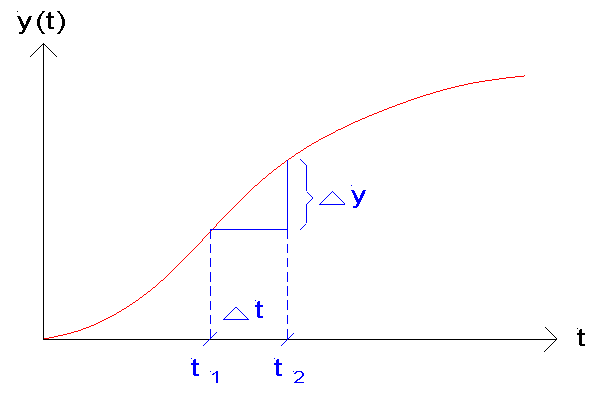
What a difference a 'differential' makes!
Differential calculus plays an important role in the mathematical foundations of science. The notion of ‘change’ as ‘difference’ not only shapes our scientific models and solutions, but seems to ‘bleed through’ and shape our social behaviours. (more…)
My Letter on ‘Climate’ to the ‘Islands Independent’
0June 3, 2010
by ted lumley
in APN

Canadian Youth Climate Coalition - G8/G20 Pledge
I will hold the Canadian Government responsible for their failure to take action to stop climate change. If the government continues to dismiss its residents, I will come to the G20 meeting in June or participate in demonstrations in my community. I will make it clear to the world that people in Canada care about climate change and won’t accept inaction any further.
Ok, I participated in ‘activism’ in my student days and I think there is a need for the upcoming generation to ‘stir it up’ and make people think. But, … a partnership with the Pembina Institute!?! Is youth the victim of the ‘politicizing of science’?
* * *
I believe that the motivation for the statements on ‘climate’ by Elizabeth May, Nadia Nowak and Peter Carter is ‘the health and harmony of the community/habitat’, and this is true also for myself. This common motivation makes of us a kind of ‘virtual team’. But as in many teams, there is not always a common understanding of ‘the issues’.
My virtual ‘team-mates’ and I currently differ in our understanding of ‘climate’, me being the ‘odd man out’, and I wrote a letter (click here) to the ‘Islands Independent’ (which may be published in the June 11th issue) thanking the paper (Laurie Kay) for providing fair and open access for comments on such issues. (more…)
Most Recent Comments