An inclusional worldview
APN
Author’s Subtext: Darwin’s Troubling Choice
1March 13, 2010
by ted lumley
in APN
One can understand very well Emerson’s view of ‘evolution’ and how it is more truthful to life and experience than Darwin’s, if and only if one trains one’s ‘mind’ to suspend acculturated ‘perception framing habits’.
Without suspending these habits, it is pointless to ‘debate’ an Emersonian ‘worldview’ with others. Emerson realized this and would not accept invitations to debate his views with those who were clearly coming from a different set of basic ‘framing’ assumptions than he. There would be no point since, by coming from different foundations, the two would be talking at crossed purposes, unless they preceded their debate with a debate on those different foundations.
Emerson declared what his were, but many people didn’t listen, so in spite of Emerson’s readings and writings being extraordinarily inspirational, the logicians working them over concluded that they boiled down to nothing tangible and usable, that they were all ‘smoke and mirrors’ e.g;
“Dr. Burnap of Baltimore described Transcendentalism as “a new philosophy which has risen, maintaining that nothing is everything in general, and everything is nothing in particular.”” (more…)
Darwin’s Troubling Choice
0March 11, 2010
by ted lumley
in APN

darwin................................... emerson....................................newton
Darwin, pausing briefly on the wave-washed decks of the Beagle, contemplated how close to the edge of an early ‘recycling’ in nature that the ship, its crew and passengers were now hanging. The thought of the ship being broken open by the sea and its plummeting descent to a peaceful resting place in the briny depths was not entirely unpleasant, in view of how it would bring an end to his frightful mal-de-mer. On the sea bottom, his body would be food for algae and the algae would be food for plankton and the plankton food for fish. Some other human mariner would eat that fish that ate the plankton that ate the algae that ate Charles Darwin and the circle of life would go on. In his log he wrote;
“In the Bay of Biscay there was a long and continued swell, and the misery I endured from seasickness is far far beyond what I ever guessed … Nobody who has only been to sea for 24 hours has a right to say that sea-sickness is even uncomfortable. The real misery only begins when you are so exhausted that a little exertion makes a feeling of faintness come on.” — ‘Charles Darwin and the voyage of the Beagle’. (more…)
What’s (the) Matter?
2March 6, 2010
by ted lumley
in APN

Chief Dan George, ........................... Erwin Schroedinger, ........................ Albert Einstein
Erwin Schroedinger, Albert Einstein and Chief Dan George get together in a longhouse on the Northwest Pacific coast to compare notes on science and reality and ‘what’s the matter’. The following is a transcript of their dialogue; .
Chief Dan George: Welcome, Erwin, Albert, let us start by paying tribute to the rocks which make Turtle Island possible for us to sit together here, patient bearers of moss and bird droppings (… mind yourself there, Erwin), we salute you, and we salute as well all of the four-leggeds, two-leggeds, rooted and winged ones, the running waters that transport us, the fresh winds that breathe life into us, and the sun now shining brightly above us which warms our brows and brings flowers from the earth to brighten our spirits. We are but strands in this web-of-life though our proud words often take us captive and have us strut about as if we were its owners. (more…)
God Is Under Review
0February 10, 2010
by ted lumley
in APN
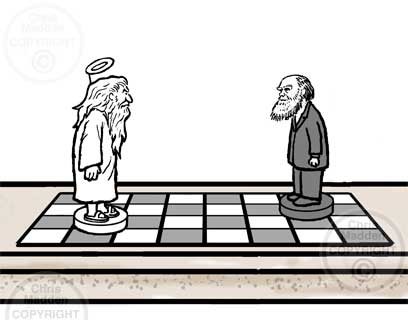
did Darwin UNNECESSARILY throw the Baby out with the bathwater?
There is always controversy in talking about God, starting from the basic issue of whether or not ‘God Exists’. But there is general agreement that different people have different views on the topic.
Thus, there is an opportunity to review the different ‘ways of seeing things’ that influence one’s views on this matter which in turn have a major influence on the global social dynamic.
I will ‘jump in’ upfront with a simplifying hypothesis to avoid getting bogged down in a conventional review of this huge subject.
Science typically models the world in terms of LOCAL objects/organisms/systems and the actions/interactions of this diverse plurality, imputing them to have ‘their own LOCAL AGENCY’ and imputing to ‘living systems’, their own LOCALLY ORIGINATING (internal process/purpose-driven) BEHAVIOUR, … however, … scientists are more often and more seriously challenging this (their own) ‘LOCAL-FORCING’ view of dynamics with the alternative ‘SPATIAL-FORCING’ (aka ‘CELESTIAL-SOURCING‘) view of dynamics. This issue is cross-coupled with theology since ‘GOD’ has always been associated with the ‘basic sourcing power of creation (i.e. ‘GOD’ has been the answer for many as to why we and other creatures are here and why the world dynamic unfolds the way it does. So, there is a question as to whether the fundamental (first-cause) creative sourcing power is ‘LOCAL’ and lies within local objects/organisms/systems (e.g. the ‘gene’, the ‘human’, the ‘earth’) or whether it permeates the energy-charged medium we call ‘SPACE’ that science now sees as the mothering medium of all precipitate material objects, organisms and systems. While this may seem to be an ‘intra-science issue’, it is tightly coupled to ‘THE GOD ISSUE’.
One of these seemingly ‘intra-science’ issues is ‘climate change’. Scientists are split as to whether this behaviour-of-the-total-earth is ‘celestially-forced’ or ‘locally (internal-process) forced’. (more…)
Are Russian Scientists More ‘Realistic’ Than ‘Western Scientists’?
0February 1, 2010
by ted lumley
in APN
Continuing inquiry into the ‘demographics’ of how people split into polarized opposition of views, is leading me to the notion (not yet a conclusion) that Russian scientists and perhaps the Russian people in general have a different ‘polarization of views’ profile than in ‘the West’.
What has led me to further explore this possibility is the remarkable difference in the proportion of scientists favouring ‘local forcing of climate change’ (CO2-forcing) versus those who favour ‘celestial forcing of climate change’, in ‘the West’ and in ‘Russia’ respectively. A rough estimate based on what is reported in the media and also through email exchanges with scientists is that, in the West, there is perhaps an 80% – 20% split in favour of ‘local [CO2} forcing of climate change’ while in Russia, the proportion seems to be inverted, with an 80% – 20% split in favour of ‘celestial [solar cycles, orbital deviation cycles] forcing of climate change’.
It seems fair to say that such differences in scientific views between Russia and the West haven’t been seen since the days of the cold war where, for example, many Americans believed that the 1959 Russian (Luna 3) pictures of the ‘dark side’ of the moon were faked.
So, what is the origin of this dramatic difference in scientific view? (more…)
Author’s Subtext: Invisible Spatial Origins of Material Dynamics
0January 9, 2010
by ted lumley
in APN
What was I thinking when I wrote ‘The Invisible Spatial Origins of Material Dynamics’?.
The assimilation of ideas of others is an everyday activity, and, most often, the ‘cognitive engine’ we employ in this activity is ‘untouched’ by the ideas we are ‘processing’, but in philosophical discourse, it often happens that there are ideas that concern the ‘cognitive engine’ itself, that require ‘real-time’ modifications to the cognitive engine in order to be ‘properly processed’ so that the ideas can be shared and discussed.
If, bundled in with the ideas, are some ‘instructions’ for modifications to the cognitive engine necessary for the proper processing of the ideas, and if the engine modifications are not made but the ideas are processed with the pre-existing cognitive engine, the ideas that ‘come through’ may be severely ‘bastardized’and confuse the dialogue.
[It may also be the case that our acculturation has been putting ‘governors’ on us that restrain the natural scope of our cognitive powers.]
That presents a problem to the writer (‘moi’, in this case) because it asks quite a bit of the reader. That is, if he tinkers around and tunes his cognitive engine for this reading, will he be able, at the same time, to get everything back together the old way? (more…)
The Invisible Spatial Origins of Material Dynamics
0January 8, 2010
by ted lumley
in APN
Consider the parallelism between Gabor’s Theory of Communication and human understanding of, for example, sediment deposition and/or climate change..
Gabor’s theory of communications augments a purely tangible (‘real’) time sequence of information elements into a ‘complex’ (‘real’ + ‘imaginary’) information signal. Gabor developed this ‘quantum physics compliant’ communications theory based on Pauli’s formulation of the ‘uncertainty principle’; i.e. wherein ‘time’ and ‘frequency’ are understood to be interrelated.
Gabor compares this to augmenting a ‘rotating vector’ with a ‘rotating field’ (which is 90 degrees phase shifted from the rotation of the vector). Tied up in this arguably more comprehensive ‘communications theory’ are the modes of understanding associated with ‘observation’, ‘experiencing’, ‘perception’ and a quality of observation that is termed in German ‘anschaulichkeit’§ (‘intuitively real’ or true to nature).
Imagine the rotating pinwheel appearance of a ‘hurricane’. (more…)
Author’s Subtext:-The Political Hijacking of Scientific Inquiry
0January 3, 2010
by ted lumley
in APN
The paper by Forbes and Stammler, ‘Arctic climate change discourse: the contrasting politics of research agendas in the West and Russia’, … brings home to me just deeply mired we are in ways of understanding that are the source of chronic social dysfunction.
The Nenets of Siberia and Northern Europe may be one of the last ‘communities’ on earth that have avoided co-optation by forms of social organisation that put anthropocentric self-interest first, as is bundled into ‘sovereignty’ and ‘democratic nation states’ (democracy is clearly anthropocentric in that it fails to respect and protect the rights of ‘wildlife’).
Where we are working together for the furtherance of man’s interests, we are letting the quality of the overall ecosystem space that we are included in ‘flap in the breeze’. However, if we are working together for the sustaining of the quality of the overall ecological space that we are included in, we will benefit in a sustainable sense (without the obscene exploitation of the natural space we are included in, as is occurring when we put the fulfilment of our species or race’s or sovereign nation-state’s self-interests first). (more…)
The Political Hijacking of Scientific Inquiry
0January 2, 2010
by ted lumley
in APN
Around the globe there is a rising awareness that ‘politics’ is in the process of hijacking scientific inquiry. While the ‘global warming obsession’ may be bringing this situation into the central foreground of our attention, it is by no means a recent or a single-issue based development, but an endemic socio-political process with deep psychological roots.
There is a dysfunction here wherein ‘man’ as the ‘child-of-nature’ sees himself as the ‘parent-of-nature’. The inverting of the true relationship parallels our popular error in treating storm-cells in the flow of the atmosphere (children-of-the-flow) as the source of the turbulent flow (as a disturbance with its own local agency) or as ‘parents-of-the-flow’.
The storm-cell is the ‘result’ of the flow and so too is ‘man’ the result of the dynamic space of nature. The intended use of ‘result’ here is ‘spatial’ rather than before-and-after ‘time-of-existence’ oriented; i.e. the flow continues on while the storm-cells gather and re-gather within it.
Western man, however, has promoted the notion of ‘progress’ wherein ‘modern man’ is ‘superior’ to ancient man and/or to ‘aboriginal cultures’ that retain an ancient world view.
This notional ‘superiority’ of modern man has been based on ‘what modern man can do’; i.e. on his ability to predict and control what unfolds. However, since the days of Galileo, where Galileo found that it was easier to describe the motion of material objects as if they were moving in a vacuum (generalizing the laws and principles of motion so as to remove the spatial-relational particulars), our scientific habit has been to model dynamics in these general ‘situation-free’ or ‘spatial-medium-free’ terms. Thus, as McLuhan observed in ‘Understanding Media’, we are very skilled at specifying how we are going to construct machinery and at predicting its operations and output, but in terms of what really transpires, it matters little if the machinery is producing Cadillacs or cornflakes, what ‘really’ matters is how our relationships with one another and the environment are transformed by such operations. (more…)
The Source of ‘Hollowness’ in Rational Thought
0December 28, 2009
by ted lumley
in APN
The global warming debate is opening up a portal for us to examine the source of the seeming ‘hollowness’ of rational thought, and it is a ‘crack’ in the rational defence system that we cannot afford to allow to re-seal before we get our investigative crowbars in there.
It is not that difficult to explain what is happening. The difficulty is in believing the explanation, because what we have come to accept as our ‘standard reality’ (a somehow stark and cold ‘rational’ reality) is over-simplified in a manner similar to the way in which Ptolemy’s geo-centric reality was over-simplified relative to Copernicus’ helio-centric reality; i.e. both views give answers that are consistent within their respective frameworks, but which differ in the comprehensiveness in which they ‘model’ our observations and experiences.
We all know that something is wrong with our rational world view; i.e. it always ‘hangs together’ but it ‘feels’ ‘incomplete’. As researchers such as Joseph Chilton Pearce have observed, the heart plays a role that is absent/denied in our rational world view. Our real-world observations/experiencing of human, animal and natural behaviour in general suggests that there is a ‘compassionate mind’ at work at the same time as the rational mind, but science (rational model based science) is not willing to concede this point. (more…)
Most Recent Comments